Treatment Timeline Dashboard China: Real-Time Procedure Progress Tracking
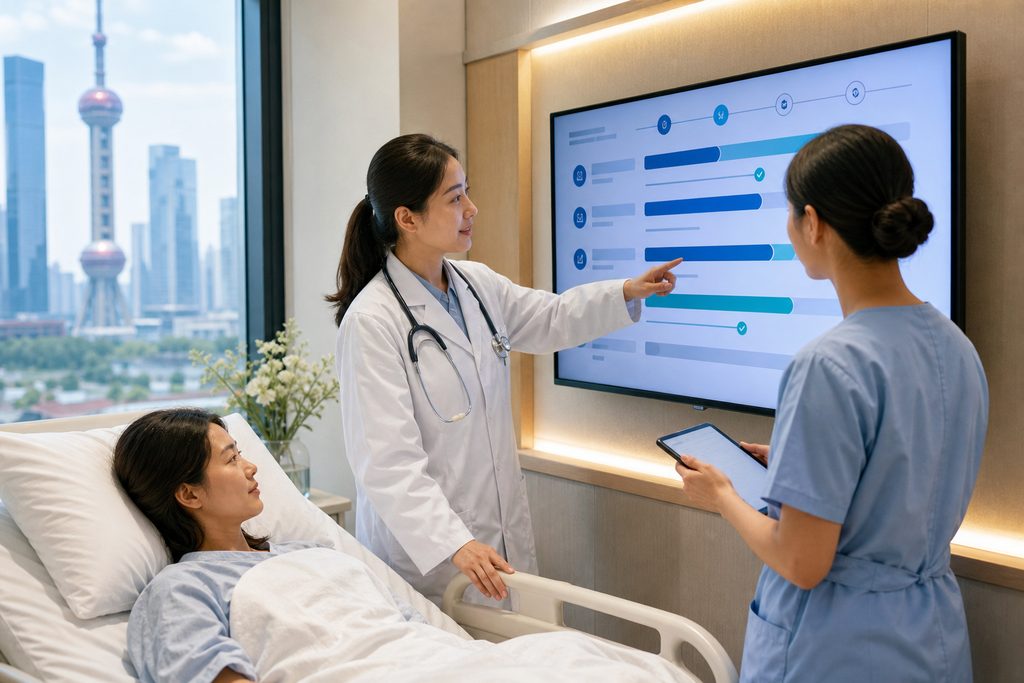
Have you ever handed a family member over to a surgical team, watched the operating room doors close, and then sat for hours with absolutely no information? That silence is brutal. It is also, for many international patients, completely unnecessary now.
Key Takeaways
- Real-time treatment timeline dashboards are now integrated into the international patient pathways at several of China’s 340+ top-ranked hospitals, giving you milestone updates from pre-op through discharge.
- The China medical procedure tracking app cost typically falls between $300 and $800 when bundled with a full coordination service, covering translation, dashboard access, and a bilingual liaison who interprets every update for you.
- Public hospital systems in China do not offer standalone tracking apps to overseas patients — this service exists exclusively through hospital international departments and third-party coordination teams who bridge the data gap.
- You should expect tracking granularity to vary by hospital and procedure type. A cardiac bypass at Fuwai Hospital will generate different data points than a spinal fusion at Peking Union Medical College Hospital. Always confirm the specific milestones you will see before booking.
The Problem: Flying Blind Through a Major Medical Event
Medical travel is already stressful. You are in an unfamiliar city. The language on every sign is opaque. And then you hand your spouse, parent, or child over to a surgical team you met only days ago. What follows is often a six-to-eight-hour information blackout. A 2023 survey by the Medical Tourism Association found that 64% of international patients cited “uncertainty about procedure status during treatment” as their top anxiety driver — ranking higher than cost or travel logistics. That uncertainty is not just emotional. It has practical consequences. Family members cannot coordinate recovery plans, arrange post-discharge transport, or communicate accurately with employers back home when they do not know whether a procedure is running on schedule, delayed, or finished.
This is the gap that a treatment timeline dashboard China hospital service is designed to close. Not with vague promises. With specific, timestamped milestones delivered to your phone.
Who We Are
We are China Medical Services. We are not a hospital. We do not provide medical treatment, clinical diagnoses, or any form of healthcare delivery. Our team functions as your logistical architects and on-the-ground coordinators. We connect you with the right specialists from our network of 340+ top-ranked hospitals across 37 cities, then we build the operational bridge — visa guidance, appointment scheduling, bilingual medical companion support, and yes, real-time procedure tracking so you know exactly what is happening while it happens. Think of us as the people who make sure the machine runs smoothly around you, so you can focus entirely on the medical outcome.
How a Treatment Timeline Dashboard China Hospital Service Actually Works
Let us be concrete. You are not getting a login to the hospital’s internal electronic health record system. That is not how Chinese public hospitals operate. What you receive is a structured, human-verified update stream that pulls from the hospital’s actual scheduling and clinical data, translated and contextualized for you in real time. Here is what that looks like in practice.
The Pre-Procedure Phase: Locking in Every Milestone Before Day Zero
Before you ever board a flight, our coordination team works with the hospital’s international department to map out a granular timeline. This is not a generic itinerary. It specifies the date and time window for each pre-operative test — blood panels, ECG, imaging — and flags which results must clear before the procedure can proceed. A patient coming to Shanghai for a minimally invasive mitral valve repair, for instance, would see a timeline that includes a transesophageal echocardiogram slot, a cardiologist clearance window, and an anesthesiology consult, each with a hard deadline. The dashboard reflects all of this. If a lab result is delayed, you see that. If everything clears ahead of schedule, you see that too. No phone tag. No guessing.
The Day of the Procedure: From “Wheeled In” to “Closed and Stable”
This is where the service transforms the experience. On procedure day, your assigned bilingual medical companion is physically present at the hospital. They receive updates directly from the nursing station and operating theater liaison. Those updates hit your dashboard as timestamped milestones: “Patient checked in to pre-op holding at 7:42 AM.” “Anesthesia induction started at 8:15 AM.” “First incision at 8:31 AM.” “Surgeon reports primary repair complete, closing at 11:20 AM.” “Patient transferred to PACU, vitals stable, at 11:55 AM.”
Each milestone arrives in English. Each one is verified by a human being standing inside the hospital. This is not automated data scraping. It is a person with clinical vocabulary skills, standing at a nurse’s station, getting the facts and transmitting them to you. That distinction matters enormously when the information is this critical.
Recovery Tracking: The Days That Actually Determine Outcomes
Surgery is an event. Recovery is a process. Our dashboard extends through the inpatient recovery phase, tracking drain removals, first ambulation, pain score trends, and discharge clearance milestones. For international patients, this phase often determines whether you can fly home on schedule or need to extend your stay. Getting a daily update that says “chest drain output below threshold, removal scheduled for tomorrow AM” lets you rebook flights with confidence — or hold off. This is what a recovery tracking system for international patients China looks like when it is built around real clinical milestones, not generic checklists.
What Determines the China Medical Procedure Tracking App Cost
Let us address the question directly. The cost of this tracking capability is almost never a standalone line item. It is embedded within a broader coordination package. When you see a price range of $300 to $800 for the tracking and dashboard component, that typically includes the pre-procedure timeline mapping, the day-of live milestone updates via a dedicated liaison, and the post-procedure recovery tracking through discharge. Factors that push the cost toward the higher end include procedure complexity — a multi-stage oncology surgery with a 10-day inpatient recovery requires far more touchpoints than a single-day orthopedic procedure — and the hospital’s own data accessibility. Some international departments provide structured status updates on a fixed schedule. Others require our companion to proactively gather information at specific intervals. More labor means a higher coordination fee.
For patients booking surgery with progress tracking China, the dashboard access is usually part of the Hospital Appointment Coordination service, which starts from $300, or the VIP End-to-End Coordination package, which ranges from $5,000 to $8,000 and covers everything from airport pickup to discharge. The tracking component itself is not where the cost lies. The cost lies in having a competent bilingual professional physically present, interpreting clinical data in real time, and ensuring nothing gets lost between a Chinese hospital system and an English-speaking family.
Why This Approach Delivers Results Where Standalone Apps Fall Short
Clinical Volume Creates Structural Efficiency
Chinese top-tier hospitals operate at a scale that is difficult to comprehend until you see it. Fuwai Hospital in Beijing performs over 14,000 cardiac surgeries annually — the highest volume of any cardiac center globally. Zhongshan Hospital at Fudan University handles an enormous oncology and cardiology caseload daily. This volume means that surgical teams, recovery wards, and discharge planning units run on tightly choreographed protocols. Milestones are predictable. A surgeon who performs 400 valve repairs per year knows with high precision when a patient will be ready for extubation, when chest tubes come out, and when discharge criteria will be met. That predictability is what makes a real-time tracking dashboard actually useful. The data is not guesswork. It is pattern recognition at scale.
Technology Infrastructure in International Departments
Most public Chinese hospitals still run internal systems that are not designed for patient-facing access, let alone English-language access. But the international departments at hospitals like Peking Union Medical College Hospital and Huashan Hospital have invested in parallel systems specifically for overseas patients. These departments maintain separate scheduling databases, English-capable nursing documentation, and dedicated liaison staff. Our dashboard service plugs into that infrastructure. We are not hacking into a Chinese EMR. We are working through the official international patient channel that the hospital itself has built for exactly this purpose. That is why the service works reliably, and why it cannot be replicated by downloading an app and showing up alone.
Cost Advantage Without Quality Compromise
A cardiac bypass that costs $120,000 or more in the United States runs between $12,000 and $20,000 at a top Chinese public hospital through the international department. The tracking and coordination service adds perhaps $500 to $1,000 to that total. You are still at roughly one-sixth to one-tenth of the US price. And the clinical outcomes? Fuwai Hospital reports a risk-adjusted mortality rate for isolated coronary artery bypass grafting that is comparable to the best STS-reported centers in North America. Lower cost does not mean lower quality here. It means a different economic structure — lower labor costs, higher patient throughput, and a hospital system designed for volume rather than margin maximization. The tracking dashboard is simply a layer of transparency laid on top of an already high-performing clinical machine.
What You Need to Know Before Trying to Track Everything Yourself
Some patients assume they can replicate this with a translation app and a friendly nurse. They cannot. Here is why.
- Public Hospital Access Rules: Ordinary outpatient departments at Chinese public hospitals do not allow overseas patients to pre-book surgeries remotely. You must appear in person for a consultation first. The surgical schedule is then built around the surgeon’s availability, which is often booked weeks out. Without an international department coordinator, you have no visibility into that schedule until you are physically in China. A treatment timeline dashboard China hospital service works because the international department has already reserved your slot and built your timeline before you arrive.
- Language Barriers in Clinical Contexts: The vocabulary of a surgical timeline is not the vocabulary of a Mandarin 101 class. Terms like “extubation,” “chest tube output,” “INR level,” and “ambulation clearance” require precise translation. A general translation app will fail you at the moment you need accuracy most. Our bilingual companions have clinical vocabulary training specifically for these scenarios.
- Data Silos Between Departments: In a large Chinese hospital, the operating theater, the ICU, and the general ward may run on different information systems. A nurse on the floor may not have real-time visibility into what is happening in the OR. The international department liaison consolidates data from multiple sources. That consolidation is the core value of the dashboard — and it cannot be done by a patient family member wandering the hallways with a phrasebook.
How We Help You Navigate This
Our process starts with a free consultation. You tell us what procedure you need, your preferred timeframe, and any hospital preferences you have — perhaps you have read about Fuwai for cardiac care or Peking Union Medical College Hospital for complex endocrinology. We match you with the appropriate hospital from our network and obtain a preliminary treatment plan and cost estimate. At that stage, we also map out what the tracking dashboard will show you for your specific procedure. You will know, before you commit to anything, exactly which milestones will appear on your phone and at what frequency.
Once you decide to proceed, we handle the S2 visa guidance — the correct visa category for medical treatment in China, with your hospital invitation letter as supporting documentation. We book your initial consultation, coordinate your pre-operative testing schedule, and assign your bilingual medical companion. On procedure day, that companion is your eyes and ears inside the hospital. You receive dashboard updates. You can ask questions through the companion. You are never in the dark.
After discharge, we continue tracking your recovery milestones through the follow-up period, coordinating any necessary outpatient visits before you fly home. If you need a written second opinion or a post-recovery video consultation with your surgeon, we arrange that too. And if your treatment requires a return visit — say, a staged oncology protocol — your entire timeline history is preserved for continuity.
Frequently Asked Questions
Generally, no. The dashboard is not a standalone software product you can subscribe to. It is a service delivered by a human being who is physically present at the hospital, accessing information through official international department channels. That labor cost is unavoidable. Some hospitals may offer basic SMS updates through their international department directly, but these are typically in Chinese and lack the granularity of a dedicated tracking service. If real-time English-language tracking matters to you, it will come as part of a coordination package.
Yes. This is one of the most important functions of the dashboard. If a surgery runs long — which happens for clinically valid reasons, not because of disorganization — your companion receives that information from the OR liaison and updates your dashboard immediately. You will see a notification like “Procedure extended, surgeon reports no complications, revised completion estimate 1:30 PM.” Silence on the dashboard means nothing has changed. An update means something has changed. That distinction alone reduces enormous anxiety.
The dashboard is a read-only view of milestone events, not a repository of your full medical record. It contains procedure status updates, not diagnostic images or lab values. The underlying data is transmitted through hospital international department systems that comply with China’s Personal Information Protection Law. Our coordination team accesses only the information necessary to provide you with status updates. We do not store or share your clinical data beyond what is required for the service.
Shanghai, Beijing, and Guangzhou all host multiple top-tier hospitals with international departments, and the coordination costs are broadly similar across these three cities. Shanghai tends to have slightly higher baseline costs for accommodation and transport, which can affect the overall package price but not the tracking component specifically. The tracking service cost is driven more by procedure complexity and hospital data accessibility than by geography. A straightforward orthopedic procedure tracked in Guangzhou will cost less than a complex neurosurgical case tracked in Shanghai, regardless of city.
Your Next Step
Real-time procedure tracking is not a luxury add-on. For international patients traveling to China for major surgery, it is the difference between sitting in a waiting room with no information and watching a structured timeline unfold on your phone, milestone by milestone, in a language you understand. The technology exists. The infrastructure exists. What makes it work is having someone on the ground who knows how to access it.
If you are considering a procedure in China and want to understand exactly what tracking visibility you would have — for your specific procedure, at your specific hospital — we can walk you through it. No commitment. Just clarity. Visit our patient coordination page to start a conversation, or explore our database of top-ranked hospitals to see which institutions match your medical needs.
For more medical information and treatment options in China, visit chinamedservices.com (China Medical Services).
