Medical Repatriation From China: What Families Need to Know
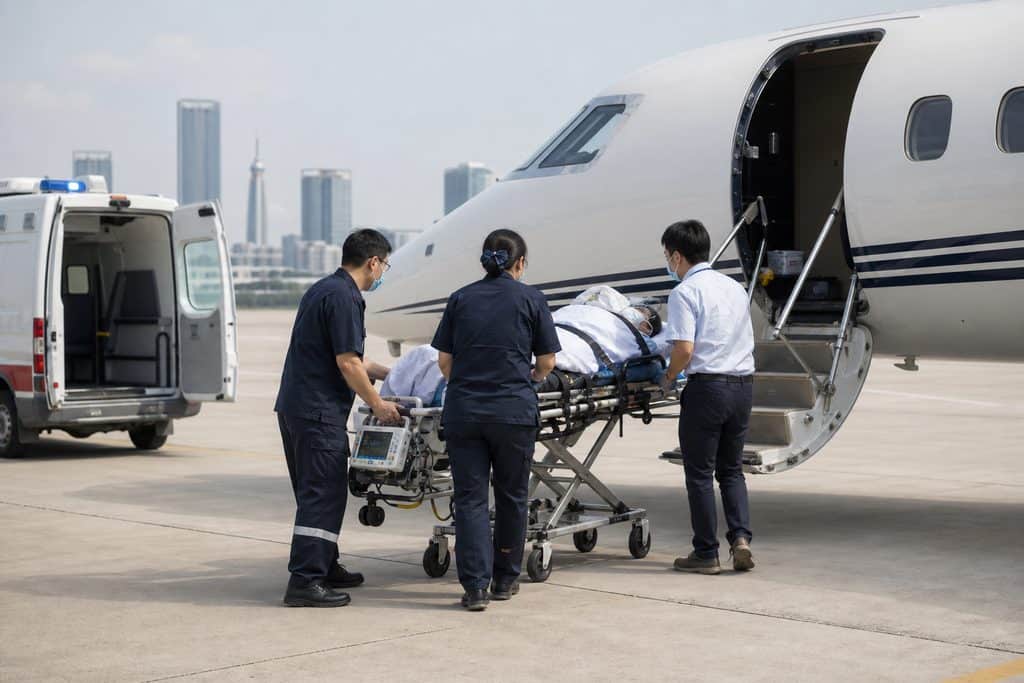
The core message: Most families searching for medical repatriation from China cost figures are actually looking for one of two very different things — a stabilized patient who can fly commercially with a medical escort, or a critical-care patient who needs an air ambulance. The price gap between those two scenarios is enormous, and knowing which one applies to you changes everything.
How This Actually Works, Step by Step
You’ve probably heard that once a patient is hospitalized in China, getting them home is a bureaucratic nightmare. The reality is more structured than that — but it does require sequence discipline. Here is the actual path.
Step one is a fitness-to-fly assessment. No reputable transfer company will move a patient without a written clearance from the treating hospital in China. That document states the diagnosis, current stability, oxygen requirements, whether the patient can sit upright for the flight duration, and any equipment that must travel with them. Without it, nothing else can be booked.
Step two is choosing the transfer mode. A patient who is stable, conscious, and not on a ventilator can usually fly on a commercial airline with a medical escort — a nurse or physician who travels in the cabin and monitors vitals. A patient on a ventilator, with an intra-aortic balloon pump, or with unstable cardiac rhythms needs a dedicated air ambulance with a stretcher, a portable ICU setup, and a flight crew trained in critical care transport.
Step three is documentation. You will need the patient’s passport, the Chinese hospital discharge summary, imaging and lab results, the fitness-to-fly letter, and — for air ambulance — overflight and landing permits for every country the aircraft crosses. Permit processing alone can take two to five business days.
Step four is the receiving end. The destination hospital must agree in advance to accept the patient. A US hospital will not simply take a transfer without an accepting physician and a confirmed bed. This is often the slowest link in the chain.
Step five is execution. Ground ambulance in China to the airport, tarmac transfer, in-flight care, ground ambulance at the destination, admission. Each handoff is a documented event.
Why the Medical Repatriation From China Cost Varies So Dramatically
The single biggest driver of medical repatriation from China cost is not distance. It is the level of clinical care required in the air.
A commercial flight with a medical escort typically runs in the range of $8,000 to $25,000 depending on the escort’s qualifications, the number of seats required, and whether the airline charges for a stretcher installation. A dedicated air ambulance from Beijing or Shanghai to the US West Coast generally starts around $80,000 and can exceed $180,000 for a full ICU configuration with a physician-led team. These are ranges, not quotes — every case is priced individually based on the patient’s condition, the aircraft available, and the routing.
| Transfer Mode | Typical Cost Range (USD) | Best For | Lead Time |
|---|---|---|---|
| Commercial flight, medical escort | $8,000 – $25,000 | Stable, ambulatory or wheelchair patients | 3 – 7 days |
| Commercial stretcher, medical escort | $25,000 – $60,000 | Non-ambulatory but clinically stable | 5 – 10 days |
| Air ambulance, single patient | $80,000 – $180,000+ | Ventilated or critical-care patients | 2 – 5 days |
Geography matters less than most people assume. A Beijing-to-Los Angeles air ambulance and a Shanghai-to-New York air ambulance land in a similar bracket because the aircraft, crew, and fuel costs are comparable. What shifts the number is the medical configuration — a ventilator, a defibrillator, and a critical care nurse add tens of thousands of dollars.
One more factor: timing. A non-urgent transfer booked two weeks out is cheaper than an emergency lift arranged in 24 hours. If the patient is stable enough to wait, waiting saves money.
A Realistic Timeline
Families consistently underestimate how long this takes. Here is a realistic sequence, assuming no complications.
- Day 1 – 2: Contact a repatriation coordinator. Gather the Chinese hospital’s records and confirm the patient’s current stability. Request the fitness-to-fly letter.
- Day 2 – 4: Records translated into English if needed. Destination hospital identified and contacted for acceptance.
- Day 3 – 6: Transfer mode confirmed. Air ambulance operator begins permit applications, or commercial airline medical clearance is filed.
- Day 5 – 10: Permits approved. Receiving hospital bed confirmed. Flight crew assigned. Ground ambulance arranged at both ends.
- Day 7 – 14: Transfer executed. Patient admitted at destination facility.
For a commercial flight with a simple escort, the whole process can compress to four or five days if the patient is truly stable and the receiving hospital moves quickly. For a critical-care air ambulance, plan on seven to fourteen days from first call to wheels-up. Emergency lifts happen faster, but they cost more and carry more clinical risk.
Practical tip: Start the receiving-hospital conversation on day one, in parallel with everything else. A confirmed bed is usually the longest pole in the tent, and no flight can be booked until it exists.
What Can Go Wrong — and What Happens Then
The most common failure is a patient who deteriorates between the fitness-to-fly assessment and the flight date. When that happens, the transfer is paused, the patient is re-stabilized in China, and a new assessment is issued. The cost of the delay falls on the family. This is why air ambulance operators build in a clinical re-check within 24 hours of departure.
The second failure is a receiving hospital that withdraws acceptance. US hospitals can decline a transfer if the bed is needed for a local patient or if the accepting physician is unavailable. The recourse is to have a backup facility identified before the flight is booked. Never rely on a single receiving hospital.
Permit delays are the third. A country can take longer than expected to approve an overflight, particularly for aircraft carrying medical equipment that requires customs clearance. The mitigation is straightforward: apply early, and build two to three buffer days into the schedule.
Weather and mechanical issues are the fourth. Aircraft go technical. Storms close airports. A good operator has a contingency aircraft on standby or a clear rebooking policy. Ask about this before you pay a deposit.
Caution: Be wary of any provider that quotes a fixed price before reviewing the patient’s clinical records. Reputable repatriation is priced per case, and a fixed quote without a medical review is a red flag.
How to Evaluate International Medical Repatriation Services in China
Not every provider is equipped for every case. The organizations that handle critical-care air ambulance transfers are not the same ones that arrange commercial escorts, and a company that specializes in one may subcontract the other. Ask directly who operates the aircraft and who employs the medical crew.
Look for accreditation. In the US, CAMTS (Commission on Accreditation of Medical Transport Systems) accreditation is the benchmark for air medical services. In Europe, EURAMI serves a similar function. A provider that holds one of these has been audited on clinical protocols, equipment, and crew training.
Ask about physician involvement. For a ventilated patient, a flight crew led by a critical care physician or a specially trained flight nurse is standard. For a stable patient on a commercial flight, a registered nurse with transport experience is usually sufficient. The level of escort should match the acuity — not more, not less.
And ask what happens if the patient’s condition changes mid-flight. Every air ambulance should carry a contingency plan and enough supplies to manage a deterioration for the duration of the flight. If the answer is vague, keep looking.
For families who are still weighing whether to continue treatment in China or return home, a written second opinion from a Chinese specialist can clarify whether the patient is stable enough to travel — and whether further treatment in China would change the outcome. That kind of remote review, arranged through a platform like China Medical Services, often costs a fraction of a repatriation quote and can prevent an unnecessary transfer.
Practical Considerations: Insurance, Visa, and Records
Is medical repatriation from China covered by insurance? Sometimes. Travel insurance policies vary widely. Some cover emergency medical evacuation up to a stated limit — often $50,000 to $250,000 — but many exclude pre-existing conditions, and a planned transfer after elective treatment in China is frequently classified as non-emergency. Read the policy language carefully, and call the insurer before assuming coverage. If the patient is a US citizen with Medicare, note that Medicare does not cover medical care outside the US, and it does not cover repatriation.
On the visa side, a patient who entered China on an S2 visa for medical treatment and now needs to leave has no special exit requirement beyond a valid passport and, if applicable, a discharge summary. Family members who traveled on S2 visas can depart on the same documents. There is no separate “repatriation visa.”
Records matter more than most families expect. The Chinese hospital’s discharge summary, operative notes, imaging on disc, and medication list should travel with the patient — physically and digitally. The receiving hospital will need them on arrival, and reconstructing them later from overseas is slow and expensive.
Payment is usually required before the flight departs. Most repatriation providers do not bill insurers directly; the family pays and seeks reimbursement. Budget for that cash-flow reality.
If the patient’s condition is stable enough that transfer is not urgent, it is worth exploring whether a short course of treatment in China — particularly rehabilitation or traditional Chinese medicine — could improve the patient’s fitness to fly and reduce the complexity of the transfer. Our team can outline those options through a free consultation before any commitment is made.
Frequently Asked Questions
Yes, but only by air ambulance with a critical-care crew and a portable ventilator. Commercial airlines will not accept a ventilated patient. Expect the highest cost tier and a lead time of at least several days for permits and aircraft positioning.
For a stable patient on a commercial flight with an escort, roughly four to seven days. For an air ambulance, plan on seven to fourteen days from first contact to departure. Emergency lifts can move faster, but at higher cost and with less clinical buffer.
It depends entirely on your policy. Some travel and expatriate plans include emergency evacuation benefits; most standard health plans do not cover transport originating outside the country. Call your insurer, ask specifically about “repatriation” and “medical evacuation,” and get the answer in writing.
The passport, the Chinese hospital discharge summary, operative and imaging records, a medication list, and a fitness-to-fly letter signed by the treating physician. For air ambulance, the operator handles permits, but you should confirm they have everything they need at least 48 hours before departure.
For a stable patient on a commercial flight, some families manage it directly with the airline’s medical desk. For anything involving a stretcher, oxygen, or critical care, a specialized provider is effectively mandatory — airlines and airports will not coordinate the clinical logistics on their own.
Your Next Step
Medical repatriation is not a single product with a single price. It is a clinical logistics problem, and the right solution depends entirely on how sick the patient is and how quickly they need to move. Get the fitness-to-fly assessment first. Everything else follows from it.
We are China Medical Services — a bilingual coordination team that helps international patients and their families navigate Chinese hospitals, from second opinions and appointment coordination to discharge planning and transfer logistics. We do not provide medical care, and we do not promise outcomes. We connect you with the right people and handle the parts that are hardest to do from abroad.
If you are trying to bring a family member home, or weighing whether to continue treatment in China, start with a conversation. No pressure, no obligation — just a clear picture of what is possible.
For more medical information and treatment options in China, visit chinamedservices.com (China Medical Services).
