China Hospital for Children: Costs, Safety, and How to Choose
Key Takeaways
- Complex pediatric cardiac surgery at a top Chinese hospital typically runs $8,000–$25,000, against $75,000–$150,000 or more in the United States.
- China’s leading children’s hospitals concentrate enormous case volume — thousands of pediatric cardiac operations per year at single institutions — which is why outcomes at the top tier are internationally credible.
- The hard part is not the surgery. It is the language barrier, the fact that public hospital outpatient slots cannot be pre-booked from abroad, and the paperwork.
- Nothing should be decided before a remote review of your child’s actual records. No surgeon anywhere can give you a real plan without them.
What if the surgery your child needs is available, excellent, and priced at one-fifth of what you were quoted at home — but you have no idea how to reach it, or whether it is even safe to try?
That question is exactly why families contact us. Our team at China Medical Services works with international patients navigating the Chinese system every week, and pediatric cases are the ones that require the most care. So let’s walk through it properly: what a China hospital for children actually offers, what pediatric heart surgery cost China really looks like, and where the genuine risks sit.
The Problem: A Quote That Stops You Cold
In the United States, a single congenital heart defect repair can generate hospital charges north of $100,000. Families with high-deductible plans frequently face $20,000–$40,000 out of pocket even when insured. And that is before the weeks of lost income that follow.
Public systems in Canada and the UK remove the bill but not the clock. A child awaiting non-urgent cardiac surgery in parts of Canada has faced waits measured in months, sometimes stretching past a year depending on the procedure and the province. Cardiologists will tell you that for certain defects, that timeline matters.
So parents start searching. They find that China performs an extraordinary volume of pediatric cardiac surgery — Fuwai Hospital in Beijing alone reports more than 14,000 cardiac operations annually across its programs — and that the price tags are a fraction of Western ones. Then they hit a wall. Which hospital? How do you even get an appointment? Is it safe to take my child to China for treatment?
Those are the right questions. Let’s take them one at a time.
Why China’s Top Pediatric Hospitals Deliver Results
There is a well-documented relationship in surgery between how many times a team performs a procedure and how well patients do. Pediatric cardiac surgery is one of the clearest examples. A surgeon who repairs 150 tetralogy of Fallot cases a year is not the same surgeon as one who does 15.
China’s flagship children’s hospitals sit at the extreme end of that curve. Beijing Children’s Hospital, Shanghai Children’s Medical Center, and the pediatric cardiac programs attached to Fuwai and Zhongshan Hospital Fudan University handle case volumes that most European centers would take a decade to accumulate. That volume is concentrated in a handful of cities, which is precisely why choosing the right hospital matters more than choosing the right country.
Technology and Efficiency at Scale
Walk into a major Chinese children’s hospital at 7 a.m. and you will see something that surprises Western visitors: thousands of families moving through a system designed for throughput. Registration, bloodwork, imaging, and pharmacy are often on the same campus, sometimes on the same floor. A cardiac MRI that takes three weeks to schedule in some systems can happen in days.
That efficiency is not comfort. It is speed. And for a child with a correctable defect, speed has clinical value.
Cost Advantage Without a Quality Trade-Off
Lower prices in China come from labor economics, hospital scale, and domestic manufacturing of devices and consumables — not from cutting corners on the operation itself. The surgeon is the same surgeon. The bypass circuit is the same class of equipment. What differs is the cost structure around them.
| Procedure | Typical Cost in China (Top-Tier Hospital) | Typical Cost in the U.S. |
|---|---|---|
| Ventricular septal defect (VSD) repair | $8,000–$15,000 | $60,000–$120,000 |
| Tetralogy of Fallot repair | $12,000–$22,000 | $80,000–$150,000 |
| ASD closure (surgical) | $8,000–$14,000 | $50,000–$100,000 |
| Complex single-ventricle staging | $15,000–$25,000 | $100,000–$200,000+ |
| Pediatric oncology (per treatment cycle) | $2,000–$8,000 | $15,000–$50,000 |
These are ranges. They vary by hospital and case complexity, and no responsible party will quote you a firm number before seeing your child’s echocardiogram, catheterization data, and prior records. Anyone who does quote a firm number upfront is guessing.
What the Journey Actually Looks Like, Step by Step
Here is the part most articles skip. The clinical sequence for a foreign child coming to China for surgery follows a predictable path, and knowing it in advance removes most of the anxiety.
Step 1 — Records review (days 1–7). You send existing reports: echocardiograms, CT or MRI images, catheterization results, prior operative notes, current medications. A Chinese pediatric specialty team reviews them and returns a written assessment with treatment direction. This is where you learn whether surgery in China is even the right conversation.
Step 2 — Video consultation (week 1–2). You speak directly with the specialty team, explain your child’s history and your goals, and hear their recommendations. Cost estimates usually firm up here, because the team now knows what it is dealing with.
Step 3 — Visa and logistics (week 2–6). Foreign patients coming to China for medical treatment apply under the S2 visa category, with supporting documentation from the receiving hospital. Accompanying family members apply under the same category. This is subject to the latest embassy or consulate requirements, and no one can guarantee approval — plan for the timeline, not around it.
Step 4 — Arrival and in-person consultation. Here is a fact that surprises most families: at Chinese public hospitals, outpatient appointments generally cannot be pre-booked from overseas. You register on the day, in person. Surgery is scheduled only after an in-person consultation. The exception is the hospital’s international or VIP department, which can pre-arrange consultations and offers English-speaking staff — at roughly 1.5 to 2 times the standard channel price.
Step 5 — Admission and surgery. Public hospitals require prepayment; insurance reimbursement happens afterward, on your own. Private international hospitals often bill insurers directly.
How to Judge Whether a Chinese Children’s Hospital Is Right for Your Case
Not every child should travel. That sentence is not a sales tactic — it is the single most useful filter we can offer.
Travel makes sense when the procedure is well-defined, the child is stable enough to fly, and the cost gap is large enough to justify the disruption. It makes much less sense when the diagnosis is still evolving, when the child is critically unstable, or when the required follow-up spans years and you cannot return.
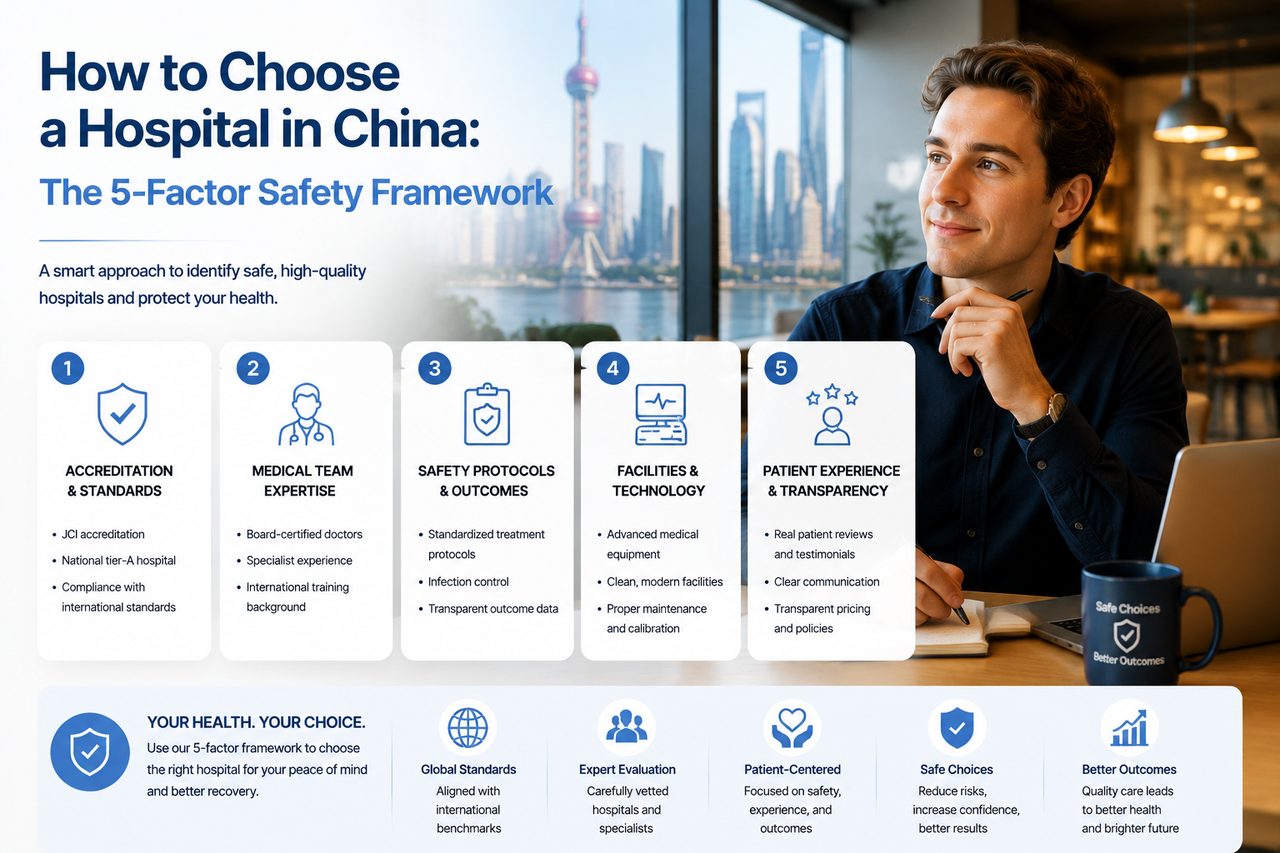
When evaluating a specific hospital, ask about four things. First, the annual volume for your child’s exact condition — not the hospital’s total surgical count. Second, whether the international department will assign a named treating team before you commit. Third, what the follow-up protocol looks like after you fly home, and whether your local cardiologist can execute it. Fourth, what happens if a complication extends the stay — who bears that cost, and how it is estimated.
Families searching for the best children’s hospital in Shanghai for international patients usually land on Shanghai Children’s Medical Center, which has a dedicated international wing. In Beijing, Beijing Children’s Hospital holds comparable standing. Both appear in the Fudan specialty rankings, which list the top 10 hospitals per specialty rather than a single national order — a distinction worth understanding before you compare claims. You can browse the specialty rankings on our departments page, including pediatric and cardiac surgery listings.
Families looking to book pediatric cancer treatment China should expect a longer and more complex process than cardiac surgery. Oncology protocols run in cycles over months, require repeat imaging, and often cannot be compressed into a single trip. Plan for multiple stays or an extended one.
Practical Considerations for Families
Documents. Bring certified translations of all medical records, your child’s passport and birth certificate, vaccination records, and a signed consent document if only one parent travels. Chinese hospitals will not accept a parent’s verbal consent for a minor’s surgery.
Visa timing. S2 applications typically require the hospital’s invitation or confirmation letter. Build in at least four to six weeks. Rules change, so verify current requirements with the Chinese embassy or consulate in your country before booking flights.
Payment. Public hospitals want prepayment, usually by bank transfer or international card, and daily card transaction limits can complicate large payments — arrange the transfer before you fly. Private international hospitals frequently bill insurers directly, which is a real advantage if you carry international coverage.
Language. This is the barrier families underestimate most. Top Chinese hospitals see tens of thousands of outpatients daily. Signage, registration systems, and staff interactions are overwhelmingly in Chinese. A bilingual medical companion — someone who handles registration, queuing, payment, wayfinding, and interpretation alongside you — is not a luxury for a family navigating a pediatric admission. It is the difference between a manageable week and a chaotic one.
Follow-up. Before surgery, confirm in writing what imaging and reports you will receive at discharge, and whether your home cardiologist can work from them. Ask for operative notes and imaging in a format your local team can open.
Frequently Asked Questions
Is it safe to take my child to China for treatment?
At the top-tier hospitals, pediatric cardiac and surgical outcomes are internationally credible, and the volume data supports that. Safety depends heavily on which hospital you choose, how stable your child is before travel, and whether the case is well-defined. A remote records review before any commitment is the single best risk-reduction step available to you.
How much does pediatric heart surgery cost in China, and what is not included?
Most corrective procedures fall between $8,000 and $25,000 at top public hospitals, varying by hospital and case complexity. That figure typically covers surgery, ICU, and the inpatient stay. It usually does not cover flights, accommodation for the family, visa costs, translation, or any extended stay if recovery takes longer than expected. Budget a meaningful buffer.
How long do children recover after surgery in China?
For a straightforward defect repair, many children are discharged within five to ten days and cleared for normal activity within four to six weeks. Complex repairs take longer. Your surgeon’s discharge plan is the only reliable timeline — general figures should never override it.
What if something goes wrong after we return home?
This is the question that deserves the most preparation. Before you leave China, obtain complete operative notes, discharge summaries, and imaging. Confirm that your home cardiologist has agreed to take over follow-up. If a complication emerges later, your local team manages it — which is exactly why the handover documentation matters so much.
Do we need a medical tourism package for children in China?
Packages exist, but the term covers everything from genuine coordination to inflated markups. What actually helps is straightforward: a written second opinion, a video consultation with the treating specialty, appointment coordination through the hospital’s official international channel, and a bilingual companion on the ground. Anything promising guaranteed admission or a specific surgeon’s calendar deserves scrutiny.
Your Next Step
The decision in front of you is not “China or nothing.” It is whether a top-tier Chinese children’s hospital is a better fit for your child’s specific case than what you can access at home — and that question can only be answered with your child’s records in hand. We are a coordination service, not a hospital. We do not diagnose, we do not treat, and we do not promise outcomes. What we do is connect families with the right specialty team, arrange written second opinions and video consultations, and handle the logistics that make a trip to China workable. If you would like a straight assessment of whether your child’s case fits this path, start with a free consultation at our patient services page.
This article is for general information only and does not constitute medical advice. Treatment decisions for a child should always be made with a qualified pediatric specialist who has reviewed the full medical record.
For more medical information and treatment options in China, visit chinamedservices.com (China Medical Services).
