Peking Union Medical College Hospital: A Complete Guide for Foreign Patients
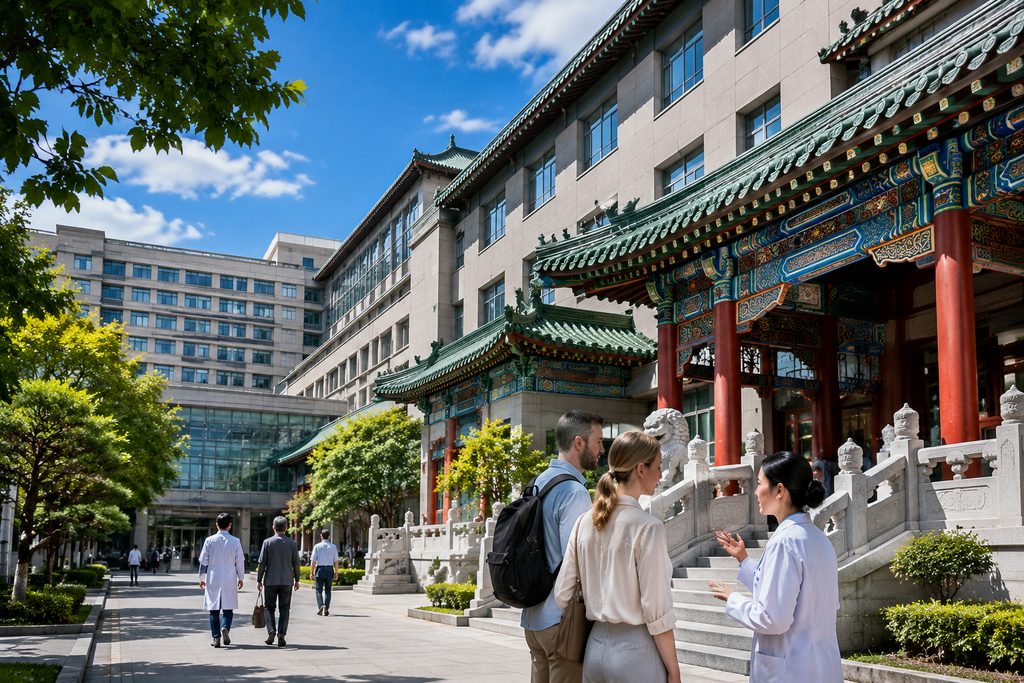
Peking Union Medical College Hospital: A Complete Guide for Foreign Patients
You have probably heard that getting treated at China’s most famous hospital is either impossible for foreigners or shockingly cheap. Both stories are half true. Peking Union Medical College Hospital cost figures do sit far below Western benchmarks, and the hospital does accept international patients — but almost never through the same door local residents use.
Peking Union Medical College Hospital (PUMCH) sits in the Dongcheng district of Beijing. It has been the country’s reference hospital since 1921, and in the Fudan Hospital Rankings it holds the highest tier, A++++, in the general category. That tier is not a rank number. The Fudan general list groups the top 100 hospitals into five grades, and PUMCH sits in the top grade. In the specialty reputation lists, where individual departments are ranked, PUMCH appears among China’s top ten in more than twenty specialties.
What follows is what our team has learned helping international patients navigate this specific institution.
Peking Union Medical College Hospital: The Short Answer
Yes, you can be treated there as a foreigner. No, you cannot simply book an appointment online and show up. PUMCH runs a separate International Medical Services department, and that is the only realistic route for a patient arriving from abroad. Everything else — the standard outpatient system — operates on same-day queueing that assumes you read Chinese, hold a Chinese ID or residence permit, and can navigate a campus that handles tens of thousands of outpatient visits daily.
The caveat that complicates every simple answer: PUMCH is a referral hospital. Its specialists expect to see complex, already-investigated cases. If you arrive with an unremarkable problem that any good hospital could handle, you may wait a long time for a slot that a more appropriate facility could have given you next week.
Who This Is Right For — and Who It Isn’t
PUMCH rewards a specific kind of patient.
- You have a diagnosis that is unclear, contested, or rare, and you want an expert second read.
- You have a complex surgical problem — endocrine, cardiac, neurological, rheumatological — where case volume matters.
- You can send complete records in advance: imaging on disc or DICOM files, pathology slides or reports, lab trends, operative notes.
- You are willing to fund the international channel, which costs roughly 1.5 to 2 times the standard rate.
And who should look elsewhere?
- Patients seeking routine screening, a simple hernia repair, or a first opinion on a common condition. A mid-tier tertiary hospital or a private international facility in Beijing will serve you faster and cheaper.
- Anyone needing emergency stabilization. Go to the nearest hospital first. PUMCH is not a place to arrive unstable and unannounced.
- Patients who cannot travel to Beijing at all, or who need a guaranteed appointment date within days. No one can promise that at a hospital of this size.
The Options, Compared
Foreign patients in Beijing realistically choose between three channels. The table below reflects typical patterns, not quoted prices — every figure varies by hospital and case complexity.
| Channel | Who it suits | Booking method | Language support | Typical cost vs. standard | Payment |
|---|---|---|---|---|---|
| PUMCH International Medical Services | Complex or unclear diagnoses; second opinions | Advance booking via the international office; records required | English-speaking staff, limited availability | 1.5–2x standard rate | Prepayment; insurance reimbursed afterward |
| PUMCH standard outpatient | Local residents, Chinese speakers | Same-day queue or app, Chinese ID required | None in practice | Baseline | Prepaid at each step |
| Private international hospital (Beijing) | Straightforward procedures, executive checkups | Online booking, often within days | Full English service | Higher than PUMCH international | Direct insurance billing common |
If your problem is genuinely complex, the first column is worth the premium. If it is not, the third column will save you weeks. The second column is not a real option for most readers of this page.
Is Peking Union Medical College Hospital Good for International Patients?
Clinically, yes — this is the strongest concentration of specialist expertise in the country. Logistically, “good for international patients” depends entirely on which door you enter. The international department exists precisely because the standard pathway does not work for non-Chinese speakers.
Two structural facts shape the experience. First, PUMCH is enormous. Daily outpatient volume runs into the tens of thousands across the campus. Wayfinding alone is a genuine obstacle, and appointment slots for popular specialists release on tight schedules. Second, the hospital operates on prepayment. You pay at each stage — registration, examination, pharmacy, bed — and your insurer reimburses you later. Patients used to direct billing at home find this jarring.
For context on where PUMCH sits in the wider landscape, Beijing holds 21 of the Fudan top-100 hospitals, more than any other Chinese city. Our ranked list of China’s top hospitals by city shows how the capital compares with Shanghai and Guangzhou. If your condition points to a specific specialty rather than a specific hospital, the department-level rankings are the faster starting point.
How to Book an Appointment at Peking Union Medical College Hospital
The sequence matters, and getting it wrong costs weeks.
Step one: assemble records. Imaging files, pathology reports, lab results, medication list, a short summary in English of your history. Incomplete records are the single most common reason a request stalls.
Step two: route the request through the international channel. The hospital reviews whether your case fits the department you have asked for. A cardiology request with no cardiac imaging will be sent back.
Step three: confirm the consultation. If the case is accepted, you receive a date. You travel to Beijing. You see the specialist in person.
Step four: only then does surgery become discussable. The surgeon assesses you, orders any additional tests, and decides whether to schedule. Nothing is guaranteed at this stage.
This staged approach is exactly what our patient consultation service is built around. It is also the honest answer to the question of how to book an appointment at Peking Union Medical College Hospital: you do not book it yourself from abroad. You route it.
What It Costs
Peking Union Medical College Hospital cost figures vary enormously by department and complexity. What we can give you are the coordination costs, which are predictable, and the hospital costs, which are not.
On the coordination side, a written second opinion from a top-tier specialist runs $300–500. A video consultation with a standard tertiary international department is $100–300; with a top specialist, $500–800. A multidisciplinary team review, where several departments weigh in together, is $1,500–2,000. In-person top-specialist consultation coordination is $800–1,200. Hospital appointment coordination starts from $300. Bilingual medical companion support is from $300 per day, covering registration, queueing, payment, wayfinding, and interpretation.
Any consultation fee is credited in full toward on-the-ground coordination if you proceed to treatment within 90 days. That credit applies to the coordination fee only, never to hospital charges.
Hospital charges themselves — consultation fees, imaging, labs, bed fees, surgeon fees — depend on the department and the procedure. As a general marker, major surgery at a top Chinese public hospital commonly lands at one-fifth to one-tenth of the equivalent US figure. A cardiac bypass that bills above $120,000 in the United States is typically quoted between $12,000 and $20,000 at a leading Chinese public hospital. Treat those as directional, not as quotes.
Practical Considerations
Visa. Medical travel to China uses the S2 visa, annotated for medical treatment. Stays beyond 180 days require S1. Accompanying family members apply for S2 as well. The M visa is for commercial and trade activity and has nothing to do with medical treatment — if a service tells you otherwise, walk away. Requirements shift, so confirm current rules with your nearest Chinese embassy or consulate and bring the hospital’s supporting documents.
Payment. Public hospitals, PUMCH included, expect prepayment. Bring a card that works internationally plus a backup. Private international hospitals in Beijing often bill insurers directly; PUMCH generally does not.
Language. Outside the international department, English is scarce. Do not assume you can manage alone.
Follow-up. Plan how you will continue care at home before you leave. Request copies of imaging, operative notes, and discharge summaries in English while you are still on site. Getting them later is slow.
Frequently Asked Questions
Technically you can enter the campus, but you will not get a meaningful specialist appointment that way. Standard outpatient registration runs on same-day queueing with Chinese-language systems and local identification. International patients need to route through the international department in advance.
Usually yes, even at international-channel rates. Private international hospitals charge more but offer faster scheduling, full English service, and direct insurance billing. If speed and comfort matter more than cost, the private route is often the better trade.
It happens, and it is useful information. You will have a written assessment and a clearer picture of what you actually need. In some cases a different Chinese hospital — or a different specialty within PUMCH — is the right answer, and the assessment tells you which.
No. There is no official package product. What exists is coordination: records preparation, appointment routing through the international office, interpretation, and logistics. Be skeptical of anyone selling a bundled “Peking Union Medical College Hospital medical tourism package” with guaranteed surgical dates.
For a second opinion, two to three weeks is often enough. For an in-person consultation plus possible surgery, allow six to twelve weeks from first contact, and understand that surgical dates are set only after the face-to-face visit.
Your Next Step
PUMCH is a genuinely world-class institution, and the international channel makes it accessible — but only if your records are complete, your expectations are calibrated, and your route in is correct. The patients who struggle are almost always the ones who tried to book it like a hotel.
We are not a hospital and we do not diagnose or treat anyone. We are a coordination team: we help international patients assemble records, route requests to the right Chinese department, arrange interpretation, and manage the logistics around a trip. If you want to know whether PUMCH is the right fit for your case, start with a free consultation at our patient services page and we will tell you honestly — including when the answer is no.
This article is for general information only and does not constitute medical advice. Treatment decisions should always be made with a qualified physician who has reviewed your individual case.
For more medical information and treatment options in China, visit chinamedservices.com (China Medical Services).
