Disc Replacement Cost in China: Real Prices, Top Hospitals, and How to Plan
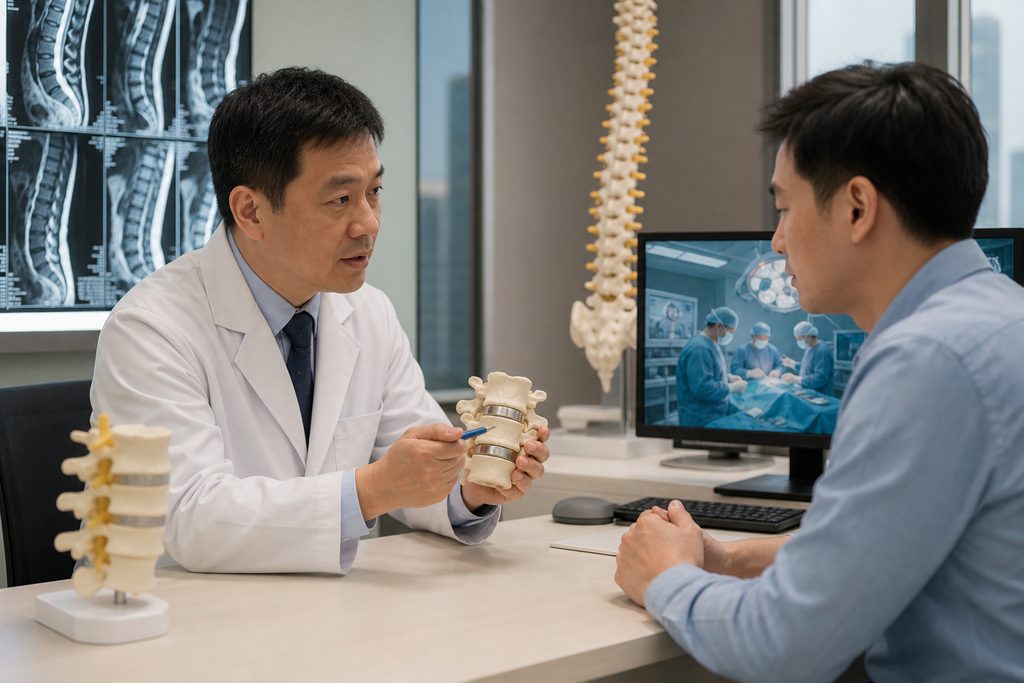
A cervical disc replacement in the United States frequently runs $30,000 to $60,000 before insurance, and patients in single-payer systems can wait a year or more for a surgical slot. At the same time, a growing number of international patients are paying a fraction of those figures at Chinese hospitals that perform spine procedures by the thousand each year. The gap is real, but the number you see online is rarely the number you pay. Here is what disc replacement cost in China actually looks like in 2026, and how the process works for someone flying in from abroad.
How This Actually Works, Step by Step
Nobody lands in Beijing or Shanghai and gets operated on the next morning. Public hospitals in China do not sell surgery slots to overseas patients the way a booking site sells hotel rooms. So the honest sequence looks like this.
Step one — you send records. You gather your MRI report, X-rays, CT scans, EMG results if you have them, and any prior surgical notes. These go to a coordinator who arranges translation into Chinese. Radiologists and spine specialists read images, not English summaries, so the original DICOM files matter more than a typed report.
Step two — a Chinese spine team reviews the file. Within roughly three to seven working days, you receive either a written second opinion or, if you prefer, a video consultation where you speak directly with the specialty team. They tell you whether you are a candidate for artificial disc replacement at all. Not everyone is. Significant facet joint arthritis, osteoporosis, or multi-level degeneration can rule it out, and a good team will say so plainly.
Step three — you get a cost estimate tied to a specific hospital. This is where the real number appears. It reflects the implant brand the hospital stocks, the number of levels being treated, the ward class you choose, and how many nights you stay.
Step four — visa and logistics. Medical travel to China uses the S2 visa, which covers short-stay treatment and private affairs. Accompanying family members apply under the same category. Processing typically takes one to two weeks depending on your consulate, and you will need an invitation or supporting document from the treating hospital.
Step five — arrival, in-person consultation, then surgery. Even with a confirmed plan, the surgeon examines you in person before scheduling the procedure. That final step is not negotiable at any Chinese public hospital.
What Disc Replacement Cost in China Really Includes
The headline price people quote usually covers the artificial disc device, surgeon and anesthesia fees, the operating room, standard hospitalization, and basic post-operative imaging. What it often leaves out: the cervical disc itself can vary enormously in price depending on whether the hospital uses an imported brand or a domestically manufactured one.
| Cost Component | Typical Range (USD) |
|---|---|
| Artificial disc device (single level) | $3,000 – $9,000 |
| Surgeon and anesthesia fees | $2,500 – $6,000 |
| Hospital stay (3–5 nights, standard ward) | $1,200 – $3,500 |
| Pre-op imaging and lab work | $400 – $1,200 |
| Post-op rehabilitation (initial phase) | $500 – $2,000 |
| Total, single-level cervical | $8,000 – $20,000 |
Two-level procedures push the upper end toward $25,000. Lumbar disc replacement sits higher still, often $15,000 to $28,000, because the implants are larger and the surgery is more invasive. These figures vary by hospital and case complexity, and any clinic quoting you a single flat number before seeing your MRI is guessing.
For comparison, the same single-level cervical procedure in the United States commonly lands between $30,000 and $60,000, and in the UK private sector between £18,000 and £30,000. That is the arithmetic behind the “one-fifth to one-tenth” figure you read about, though the honest multiplier for disc replacement tends to be closer to one-third to one-half of US pricing, not one-tenth. Spine implants are expensive everywhere.
Which Hospitals Foreigners Actually Use
China has more than 35,000 hospitals. Our database covers 340+ top-ranked institutions across 37 cities, selected by Fudan University rankings and JCI accreditation — roughly the top 5% nationally. For spine work, the names that come up most often include Peking Union Medical College Hospital, West China Hospital in Chengdu, and the major orthopedic centers in Beijing and Shanghai.
You have two very different routes, and the price gap between them is significant.
- Public hospital international or VIP department. Senior specialists, English-speaking staff, faster scheduling. Expect roughly 1.5 to 2 times the standard-channel price. Prepayment is required and insurance is reimbursed afterward.
- Private international hospital. JCI-accredited facilities such as United Family, Jiahui, or Parkway. Western-style care, direct insurance billing with many carriers, but the highest prices on the board — sometimes approaching European private rates.
If your priority is the artificial disc replacement price in Shanghai specifically, the city concentrates several of the country’s strongest spine programs, and competition between public international departments and private hospitals keeps quotes relatively transparent. You can browse options by city on our ranked hospital directory or filter by specialty through the department rankings.
A Realistic Timeline
| Stage | Realistic Duration |
|---|---|
| Collecting and sending records | 3 – 10 days |
| Translation and specialist review | 3 – 7 working days |
| Video consultation (if requested) | Within 1 week of review |
| Written cost estimate from hospital | 2 – 5 working days |
| S2 visa application and processing | 1 – 3 weeks |
| Flight and accommodation booking | 3 – 7 days |
| Arrival, in-person consult, pre-op tests | 2 – 4 days |
| Surgery and hospital stay | 4 – 7 days |
| Local recovery before flying home | 10 – 21 days |
Total from first email to surgery: typically six to ten weeks. The steps people forget are document translation, which adds days, and the fact that some surgeons are booked four to six weeks out. Rushing the visa stage is the most common cause of delay.
What Can Go Wrong — and What Happens Then
You may not be a candidate. Roughly a meaningful share of people who inquire about disc replacement are told they need a fusion instead, or nothing at all. That is a good outcome, not a wasted trip — but it means you should never book flights before a specialist confirms candidacy.
The implant you were quoted may not be in stock. Hospitals order devices per case, and supply gaps happen. The recourse is straightforward: the hospital substitutes an approved equivalent and adjusts the price, or you wait for the specific brand.
Complications occur everywhere. Infection, nerve irritation, and implant migration are rare but documented risks of this surgery globally, not just in China. What matters is whether the hospital has a clear revision pathway and whether you have someone who can communicate with the medical team on your behalf at 2 a.m. That last point is where language barriers become a genuine safety issue, not an inconvenience.
And the appointment you want may not materialize. No coordinator, ours included, can guarantee a specific surgeon or a specific date at a Chinese public hospital. What can be guaranteed is a refund if a booked appointment does not happen.
Is Disc Replacement Surgery Safe in China?
This is the question that decides most people’s trip, and it deserves a direct answer. Chinese high-volume spine centers perform these procedures with outcomes broadly comparable to Western benchmarks — the surgical technique is standardized, the implants are the same international brands used in Europe and North America, and many senior surgeons trained or published internationally.
Safety, though, is not only about the operating room. Three factors determine your real risk profile:
- Hospital volume. A center doing hundreds of disc replacements annually has seen more complications than one doing twenty.
- Your candidacy. The right patient for this surgery does well almost anywhere. The wrong patient does poorly almost anywhere.
- Communication. If you cannot describe new numbness or a fever to a nurse, small problems become large ones.
China’s top hospitals are enormous — some see over 10,000 outpatient visits a day. Navigation is genuinely difficult without Chinese. That is a logistical fact, not a criticism of the care.
Practical Considerations: Records, Visa, Payment, Follow-Up
Records. Bring original imaging on a USB drive, not just printed reports. Chinese radiologists will re-read your images regardless of what your home doctor wrote.
Visa. The S2 category is the standard route for short-stay medical treatment, with S1 for stays beyond 180 days. Family members accompanying you apply under S2 as well. Requirements shift, so confirm current rules with your nearest Chinese embassy or consulate before applying. The M visa is for commercial and trade activity and has nothing to do with medical treatment.
Payment. Public hospitals require prepayment; international insurance is usually reimbursed after the fact. Private international hospitals often bill insurers directly. Budget a buffer of 10 to 15 percent above the quoted figure for the unexpected.
Follow-up at home. Arrange a local surgeon or physiotherapist before you leave China. You will need post-operative imaging reviewed somewhere, and having that contact ready prevents a gap in care.
Language and companionship. This is the part most people underestimate. Bilingual medical companions handle registration, queueing, payment windows, pharmacy runs, and translation during rounds. Rates start from $300 per day for a full eight-hour shift. It is labor and coordination, not a shortcut to a specific doctor.
Frequently Asked Questions
A single-level cervical disc replacement in China generally runs $8,000 to $20,000 all-in, versus $30,000 to $60,000 in the United States and £18,000 to £30,000 privately in the UK. The exact figure depends on the implant brand, the hospital tier, and how many levels are treated.
You can begin the process remotely by sending your imaging for review, and you can secure a written estimate and a surgery window. But the surgeon still examines you in person before confirming the operation. No legitimate provider can skip that step, and any that claims otherwise should concern you.
At high-volume spine centers, outcomes are broadly comparable to Western standards, using the same implant brands. The variables that matter most are your candidacy, the hospital’s case volume, and whether you have reliable communication support throughout your stay.
Rarely everything. Typical packages cover the implant, surgical fees, and the hospital stay, but exclude flights, accommodation, visa costs, and extended rehabilitation. Always ask for a written itemized quote and check what happens if the procedure changes mid-surgery.
That is a clinical judgment, and a second opinion from another center is reasonable and often free of charge when you already have imaging. Fusion is the appropriate operation for many patients, and pushing for disc replacement against medical advice is not in your interest.
Your Next Step
The core message is simple: disc replacement in China can cost a third to half of Western pricing, but the number only becomes real after a specialist reads your MRI. Everything before that is an estimate.
Our team at China Medical Services connects international patients with 340+ top-ranked hospitals across 37 cities. We coordinate records, appointments, and bilingual accompaniment. We are not doctors, and we do not promise outcomes or priority access — we handle the logistics so your surgeon can focus on your spine. If you would like a written second opinion or a cost estimate tied to a specific hospital, you can start with a free consultation and decide from there.
This article is for general information only and is not medical advice. Treatment decisions should always be made with a qualified physician who has reviewed your individual case.
For more medical information and treatment options in China, visit chinamedservices.com (China Medical Services).
