Uveal Melanoma in China: Eye and ENT Team Care Explained
Uveal Melanoma in China: Eye and ENT Team Care Explained
Uveal melanoma is a cancer that starts inside the eye — in the uvea, the pigmented layer that includes the iris, ciliary body and choroid. It is rare, it is serious, and it behaves differently from skin melanoma. For international patients weighing uveal melanoma treatment cost in China, the practical numbers look like this: plaque brachytherapy at a top-tier public hospital typically runs $18,000–$35,000, proton or heavy-ion therapy $30,000–$60,000, and enucleation (eye removal) $8,000–$15,000. Those are ranges, not quotes — final pricing depends on the hospital, the isotope used, imaging requirements and how complex your case turns out to be.
Here is the part that surprises most patients. In China, your eye cancer care is rarely handled by one department alone. It is handled by a team — and that team usually spans ophthalmology and an ENT or head-and-neck oncology group working the same case from different angles.
Uveal Melanoma Treatment in China: The Short Answer
China can treat uveal melanoma at a high standard, and at a fraction of US cost. A US plaque brachytherapy episode frequently lands between $60,000 and $150,000 before insurance. Proton therapy in the United States often exceeds $100,000. The same categories of treatment in China’s top-ranked hospitals generally fall into the ranges above — roughly one-fifth to one-third of American pricing.
What China does not offer is speed of access for a walk-in foreigner. Public hospital outpatient slots cannot be reserved from overseas in the ordinary channel. You arrive, you queue, you are seen. Surgery follows a face-to-face consultation, not a phone call. That single rule shapes the entire timeline, and it is the reason most international patients route through a hospital’s international or VIP department instead.
Bottom line: the clinical capability exists at a handful of Chinese centers. The bottleneck is logistics — getting records reviewed, getting an appointment, and getting a surgical date. Plan for the process, not just the procedure.
Who This Is Right For — and Who It Isn’t
Not every uveal melanoma patient is a sensible candidate for traveling to China. Being honest about that up front saves everyone time and money.
Typically a reasonable fit:
- You have a confirmed or strongly suspected diagnosis with imaging and pathology already in hand.
- You are weighing eye-preserving options (plaque brachytherapy, proton/heavy-ion, or in selected cases laser or observation protocols) against enucleation.
- You are uninsured, underinsured, or facing a deductible that makes US treatment financially impossible.
- Your case is stable enough to allow weeks of coordination rather than days.
- You can travel, and you have a companion or are willing to pay for a bilingual escort.
Probably not the right path:
- You have an acute emergency — sudden severe pain, rapidly worsening vision, or suspected extraocular extension needing immediate surgery. Treat locally, now.
- You have metastatic disease requiring urgent systemic therapy. That is an oncology problem first, not a travel problem.
- You are seeking a guarantee of a specific surgeon on a specific date. No hospital in any country promises that, and we do not either.
- Your tumor is small and your home country offers a clear, affordable, timely plan. Staying home is often genuinely better.
The Options, Compared
Four realistic paths exist for a uveal melanoma patient. The table below compares them on the variables that actually drive decisions: cost, eye preservation, and how long you are likely to be in-country.
| Path | Typical China Cost (USD) | Eye Preserved? | Approx. In-Country Time | Best Suited To |
|---|---|---|---|---|
| Plaque brachytherapy (iodine-125 or ruthenium-106) | $18,000–$35,000 | Usually yes | 2–4 weeks | Medium tumors, single-eye preservation priority |
| Proton / heavy-ion therapy | $30,000–$60,000 | Usually yes | 4–8 weeks | Larger or awkwardly placed tumors; limited Chinese availability |
| Enucleation with orbital implant | $8,000–$15,000 | No | 1–2 weeks | Large tumors, poor vision, or patient preference |
| Transscleral resection / local resection | $20,000–$40,000 | Sometimes | 2–4 weeks | Selected peripheral tumors at experienced centers |
Which column matters most depends on you. A 45-year-old with a 9 mm tumor and good vision will usually prioritize preservation and accept a longer stay. A 70-year-old with a large tumor and no useful vision in that eye may reasonably choose enucleation, finish faster, and spend less. Neither choice is wrong. Both require an ophthalmologist’s assessment of your specific tumor dimensions.
Why the Eye and ENT Oncology Team Matters in China
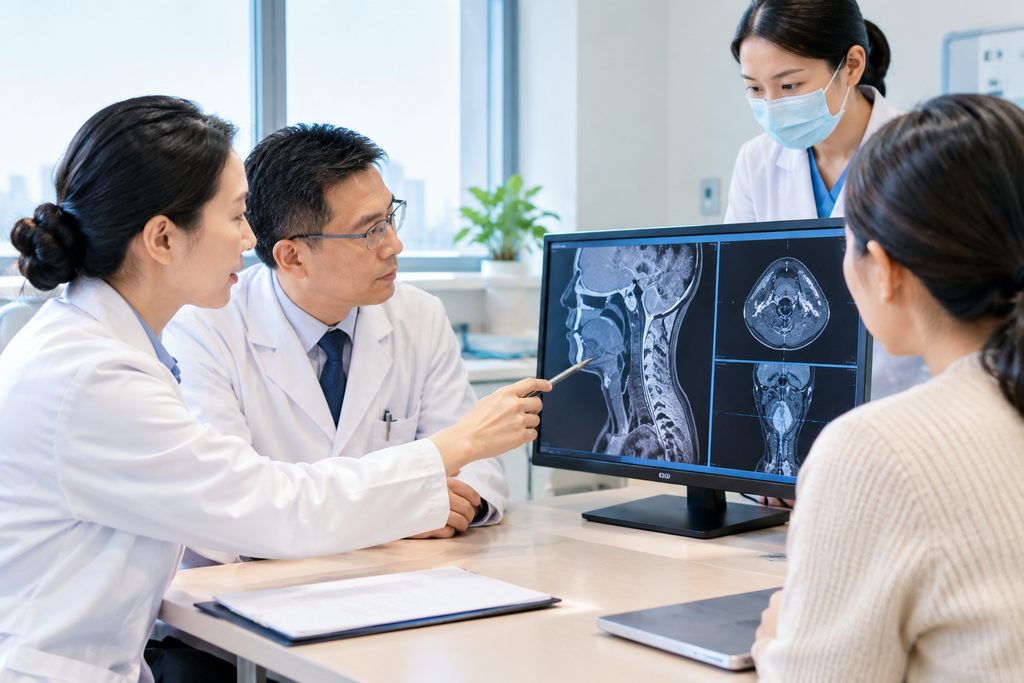
This is the piece Western patients rarely anticipate. Uveal melanoma is an eye disease, but it is also an oncology disease. Chinese academic hospitals frequently structure the work as a joint effort — the ophthalmology department handles intraocular imaging, tumor measurement and the local procedure, while a head-and-neck or ENT oncology group contributes to staging, systemic workup, liver surveillance and multidisciplinary review.
That combination is not cosmetic. The liver is the most common site of metastasis in uveal melanoma, and surveillance imaging is part of standard follow-up. Having medical oncology, radiology and ophthalmology in one review meeting shortens the gap between diagnosis and a coherent plan.
Shanghai and Beijing both host academic centers where this team structure exists. When patients ask us about the eye and ENT oncology team Shanghai model, we explain it as a coordinated review rather than a single superstar doctor. You can browse the relevant specialty rankings on our department-by-department top 10 hospital lists to see which institutions carry recognized strength in ophthalmology and oncology.
For patients searching for the best eye cancer center Beijing, the honest answer is that “best” depends on your tumor. A center with deep brachytherapy volume may not be the same center with the most proton experience. Matching tumor characteristics to institutional strength is the work.
How Long Does Uveal Melanoma Treatment Take?
Patients often ask how long does uveal melanoma treatment take, expecting a single number. There isn’t one — but the sequence is predictable.
- Weeks 1–3 (remote): Records collection, translation, written second opinion or video consultation. This happens before you fly.
- Days 1–5 after arrival: In-person examination, imaging, confirmatory diagnostics, surgical planning. Plaque cases require a customized plaque, which adds days.
- Procedure day: Plaque insertion is typically a same-day or short-stay operation. Proton therapy runs as daily fractions over several weeks.
- Days 3–14 post-op: Follow-up examination, pressure checks, wound review, and clearance to fly.
- Months 3, 6, 12: Surveillance imaging — often done at home, with results shared back to China for review.
Total in-country time for plaque brachytherapy usually lands between two and four weeks. Proton therapy stretches to six or eight. Enucleation is the shortest at roughly one to two weeks.
Practical Considerations for International Patients
Records first. Send your fundus photographs, OCT, B-scan ultrasound with tumor dimensions, MRI if performed, and any biopsy report. Without tumor measurements, no Chinese specialist can tell you whether you are a brachytherapy candidate or an enucleation candidate. Vague inquiries get vague answers.
Visa category matters and is frequently gotten wrong. Medical travel to China uses the S2 visa, which covers short-stay private affairs including medical treatment, and requires supporting documentation from the receiving hospital. Stays beyond 180 days fall under S1. Accompanying family members apply under S2 as well. The M visa is a commercial and trade category and has nothing to do with medical treatment — if anyone tells you otherwise, they are mistaken. Always confirm current requirements with the nearest Chinese embassy or consulate, since documentation standards change.
Payment is another reality check. Public hospitals generally require prepayment, with insurance reimbursement handled afterward in your home country. Private international hospitals more often bill insurers directly. Bring more than you think you need, and confirm the payment method in writing before arrival.
Language is the third hurdle. A top Chinese hospital may see ten thousand or more outpatients in a single day. Signage, registration systems and queue management are built for Chinese speakers. A bilingual medical companion handles registration, queuing, payment, wayfinding and interpretation — practical support, not medical decision-making. Details are on our patient consultation and companion service page.
Finally, plan your follow-up before you leave. Ask explicitly which imaging you need at three months, who reads it, and how results reach your Chinese team. Continuity is where international care most often breaks down.
Frequently Asked Questions
China’s top-ranked public hospitals perform these procedures at established volume, and plaque brachytherapy is a mature technique there. Safety depends heavily on tumor size, location and your overall health — not on the country alone. Any center that promises a specific outcome before examining you should be treated with caution.
You can book a written second opinion or a video consultation remotely, and that is the sensible first step. What you cannot do is reserve an ordinary public outpatient slot or a surgical date from overseas. Surgery is scheduled only after an in-person examination. The workaround is the hospital’s international or VIP department, which is priced higher but far more navigable.
Rarely. Quoted figures typically cover the procedure and standard hospital stay. They may exclude customized plaque fabrication, proton fraction packages, imaging, medication, accommodation and companion services. Ask for an itemized estimate and confirm what happens financially if the plan changes mid-treatment.
Then the priority shifts. Metastatic uveal melanoma requires systemic oncology care, and travel becomes secondary to getting treatment started quickly. Discuss this with your local oncologist before considering any international option.
Your Next Step
Uveal melanoma is rare enough that most patients never meet another person with it, which makes every decision feel improvised. It doesn’t have to be. China offers genuine clinical depth in eye oncology at a fraction of Western pricing — the difficulty is navigation, not capability.
We are China Medical Services, a coordination service, not a hospital. We do not diagnose, we do not treat, and we do not promise outcomes. What we do is review your records with the right specialty, arrange written second opinions or video consultations, coordinate appointments through official international departments, and provide bilingual support on the ground. A sensible first move is a written second opinion — it costs far less than a flight and tells you whether traveling is even worth considering. You can start that conversation through our free consultation page, or explore hospital options across 37 Chinese cities on our main hospital directory.
This article is for general information only and is not medical advice. Uveal melanoma treatment decisions must be made with a qualified ophthalmologist or oncologist who has examined you. Costs cited are approximate ranges and vary by hospital and case complexity.
For more medical information and treatment options in China, visit chinamedservices.com (China Medical Services).
