Peripheral Nerve Surgery Cost in China: 2026 Price Guide & Top Hospitals
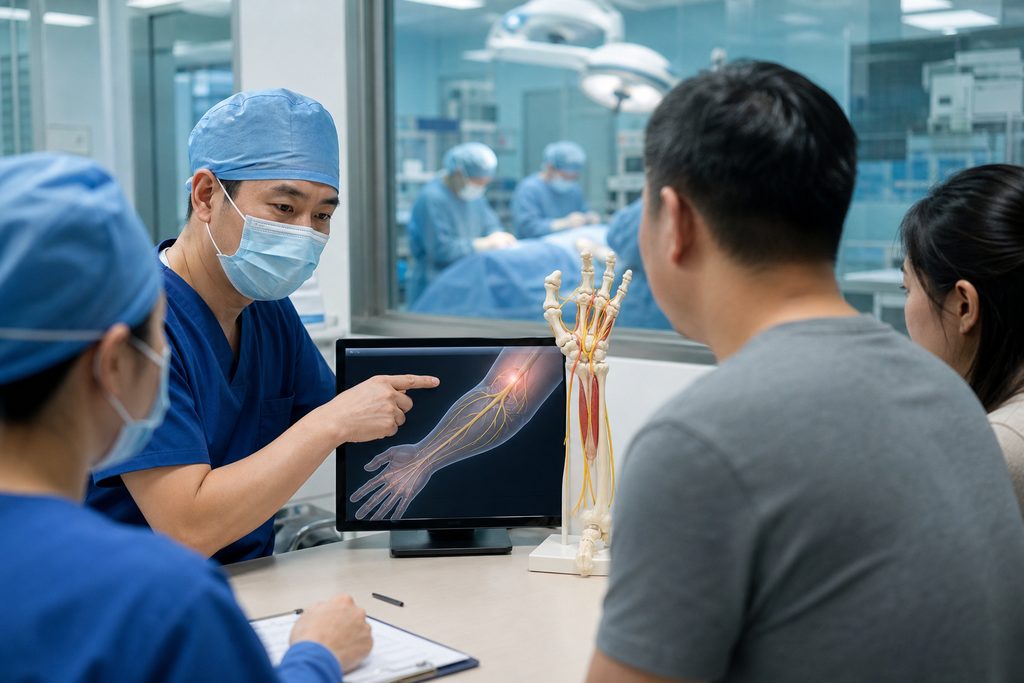
While patients in Canada wait a median 28.6 weeks for orthopedic procedures, surgeons at Beijing Jishuitan Hospital routinely perform over 300 joint replacements per month. That contrast — months of waiting versus industrial-scale surgical volume — is exactly why international patients start searching for peripheral nerve surgery cost China figures before they ever book a flight. The numbers are striking. So is the gap between what people assume and what actually happens on the ground.
Key Takeaways
- Peripheral nerve surgery in China’s top public hospitals typically runs $4,500–$18,000, compared with $30,000–$75,000 in the United States for comparable procedures.
- China’s largest centers perform nerve decompression and repair at volumes Western hospitals rarely match — and high volume correlates with surgical proficiency.
- The hard part is not the surgery. It is the logistics: public hospital outpatient slots cannot be reserved from overseas, and no one speaks English in the queue.
- Anyone considering this should understand the difference between a general public channel and an international department before comparing quotes.
The Problem: Western Nerve Surgery Prices Are Out of Reach
Carpal tunnel release in the United States averages around $6,000 when billed through insurance — and patients without coverage often see charges of $10,000 or more once facility fees, anesthesia, and follow-up visits are added. For something more complex, like brachial plexus reconstruction or a nerve graft after traumatic injury, US hospital charges regularly land between $40,000 and $80,000. A 2023 analysis published in the Journal of Hand Surgery found that even minor nerve procedures carry list prices that have grown faster than general inflation for a decade.
Europe is cheaper, but not by enough. Private clinics in Germany quote €8,000–€25,000 for nerve repair. In the UK, NHS waiting lists for peripheral nerve surgery stretch past 30 weeks in several trusts, and going private means paying out of pocket. Meanwhile, patients in the Middle East, Southeast Asia, and Russia often face a third problem: no local surgeon with sufficient subspecialty experience.
So people look elsewhere. And increasingly, they look at China — not because it is cheap in a bargain-bin sense, but because the price-to-volume ratio is genuinely different.
Why China Delivers Results in Peripheral Nerve Surgery
China’s top hospitals are not smaller versions of Western hospitals. They are larger, faster, and structured differently. That structure has real consequences for nerve surgery outcomes and cost.
Clinical Volume That Western Surgeons Rarely See
A senior hand and peripheral nerve surgeon at a top Chinese hospital may perform 300–500 nerve-related procedures annually. The average US hand surgeon does closer to 100–150. Volume matters because peripheral nerve surgery is technically demanding — identifying a damaged fascicle, deciding between neurolysis and grafting, and handling scar tissue all require pattern recognition that only comes from repetition.
Hospitals like Huashan Hospital in Shanghai and Jishuitan in Beijing are referral centers for the entire country. Complex brachial plexus injuries from motorcycle accidents in provinces without specialist care end up there. That referral pattern creates a case mix that is unusually deep.
Microsurgical Infrastructure at Scale
Nerve repair depends on equipment and team coordination as much as surgeon skill. Operating microscopes, intraoperative nerve monitoring, and microsurgical instrumentation are standard in Chinese tertiary hospitals. So is the supporting cast: dedicated hand therapy units, electrophysiology labs for pre-operative EMG/NCS testing, and rehabilitation departments that start patients on protected mobilization within days of surgery.
That last point is often overlooked. Nerve recovery takes months. A hospital with an integrated rehab pathway produces better functional results than one where the patient is discharged with a pamphlet and told to find a physiotherapist.
Why the Cost Is Lower Without Cutting Corners
The cost advantage is structural, not a quality compromise. Chinese surgeon salaries are a fraction of US levels. Hospital overhead is lower. Implants and suture materials are often domestically manufactured at 30–50% below imported equivalents. And the sheer throughput of these hospitals spreads fixed costs across thousands of cases per year.
None of that changes the surgical technique. The microscope is the same. The suture is the same. The difference is who pays for the building.
What Peripheral Nerve Surgery Actually Costs in China: Real Numbers
Prices vary by hospital tier, city, and case complexity. The figures below reflect ranges reported by international departments at tertiary hospitals and should be treated as planning estimates, not quotes.
| Procedure | China (Top Public Hospital) | China (Private International) | United States |
|---|---|---|---|
| Carpal tunnel release | $2,000–$4,500 | $5,000–$9,000 | $6,000–$12,000 |
| Ulnar nerve transposition | $4,000–$8,000 | $9,000–$15,000 | $15,000–$35,000 |
| Nerve graft / repair | $6,000–$14,000 | $14,000–$25,000 | $30,000–$60,000 |
| Brachial plexus reconstruction | $10,000–$18,000 | $20,000–$35,000 | $50,000–$80,000+ |
| Nerve decompression (lower limb) | $3,500–$7,000 | $8,000–$14,000 | $12,000–$28,000 |
These ranges include surgeon fees, anesthesia, hospital stay, and standard implants. They do not include flights, accommodation, or the cost of a companion. A realistic all-in budget for a patient traveling from the US for nerve graft surgery — including two weeks in China, a companion, and follow-up imaging — lands between $12,000 and $22,000. That is still less than the US facility fee alone.
How to Choose a Hospital: Public International Department vs. Private
This is the decision that trips up most international patients. There are two distinct pathways, and they are not interchangeable.
Public hospital international department (VIP/特需): You see a senior specialist, often a department head, with English-speaking support staff. Prices run roughly 1.5–2x the standard public channel. Appointments can sometimes be arranged in advance through the international office. This is where most complex nerve cases end up.
Private international hospital: United Family, Jiahui, Parkway, and similar facilities offer Western-style service, direct insurance billing, and shorter waits. But for highly specialized nerve reconstruction, the deepest surgical expertise usually sits in public tertiary hospitals, not private ones. A private hospital may refer you out for the actual surgery.
For straightforward carpal tunnel release, either works. For brachial plexus work, the public international department is almost always the right call.
If you are searching for the best nerve surgery hospital Shanghai price comparisons, start with the specialty rankings by department rather than generic hospital lists. Shanghai’s Huashan Hospital and Ruijin Hospital both appear in the top tier for hand surgery and microsurgery.
Is Peripheral Nerve Surgery Safe in China? What the Data Says
Safety questions deserve direct answers, not reassurance. Here is what is actually true.
China’s top tertiary hospitals are accredited by the same bodies that evaluate Western institutions. Many hold JCI accreditation. Surgical site infection rates at these centers are published in peer-reviewed literature and fall within international norms. The hospitals themselves are enormous — daily outpatient volumes at a single top-tier hospital can exceed 10,000 patients — which means infection control and perioperative protocols are built for scale.
The real safety variable is not the country. It is the specific hospital and surgeon. A nerve repair performed by a subspecialist at a high-volume center carries a very different risk profile than the same procedure done at a small regional facility.
Two practical safeguards matter. First, request the surgeon’s case volume for your specific procedure. Second, ensure pre-operative EMG/NCS testing is done and reviewed before any surgical decision. If a hospital skips electrophysiology and jumps straight to surgery, that is a red flag anywhere in the world.
Practical Considerations: Visa, Payment, and Follow-Up
Not through the standard public channel. Public hospital outpatient appointments generally cannot be reserved from abroad — you register in person on the day. Surgery follows an in-person consultation, so a first visit is required before any operation is scheduled. The international department pathway allows some advance coordination, and that is the route most foreign patients use.
Complications happen in every healthcare system. Top Chinese hospitals have established protocols for revision surgery, infection management, and second opinions. What they cannot do is guarantee outcomes, and neither can any hospital anywhere. Before committing, confirm what your travel insurance covers, whether your policy excludes pre-existing conditions, and how you would handle a prolonged stay if recovery takes longer than expected.
At international departments, English-speaking coordinators are available. Outside those departments — in imaging centers, pharmacies, billing windows, and the general wards — English is rare. A bilingual medical companion who handles registration, queuing, payment, and translation is not a luxury in a hospital that sees 10,000 outpatients a day. It is the difference between a manageable trip and a chaotic one.
Your Next Step
Peripheral nerve surgery in China costs a fraction of Western prices, and the surgical expertise at top-tier hospitals is genuinely world-class. The barrier is not quality — it is navigation. Public hospital systems are built for Chinese-speaking patients, and the gap between a good outcome and a frustrating one often comes down to logistics.
We are China Medical Services, a coordination platform connecting international patients with 340+ top-ranked hospitals across 37 cities. We are not a hospital and we do not provide diagnoses or treatment. What we do is help you understand your options, arrange written second opinions or video consultations with the right specialty, and support you on the ground if you decide to travel.
If you want to know whether your case is a fit for treatment in China, start with a free consultation. No pressure, no obligation — just a clear picture of what is possible.
This article is for informational purposes only and does not constitute medical advice. All treatment decisions should be made in consultation with a qualified physician. Prices are estimates and vary by hospital and case complexity.
Frequently Asked Questions
Yes. The hospitals used for international patients are JCI-accredited and follow the same international safety standards as top hospitals in the US and Europe. Surgical teams perform high volumes of procedures — often more than their Western counterparts — which studies show leads to better outcomes.
Costs vary by procedure and hospital, but international patients typically save 40-80% compared to US prices — even when factoring in travel and accommodation. A consultation with our team will give you an exact, all-inclusive quote with no hidden fees.
Send us your existing medical reports to get started. We handle everything from hospital selection and appointment scheduling to visa assistance and post-operative recovery planning. Your medical records are reviewed by the specialist before you even book a flight.
For more medical information and treatment options in China, visit chinamedservices.com (China Medical Services).
