Pediatric-Friendly Hospital Ward Coordination China: Toys, Activities, and Child-Safe Environments
Key Takeaways
- China’s top-tier children’s hospitals perform clinical volumes that are staggering by Western standards — Beijing Children’s Hospital alone handles over 3 million outpatient visits annually, which drives deep subspecialty expertise.
- A genuinely child-safe ward in China is not a marketing slogan; it requires on-the-ground verification of window locks, rounded furniture corners, non-toxic play surfaces, and 24/7 family chaperone policies — details that can’t be assessed from a website.
- The primary barrier for international families is not clinical quality. It is the operational chaos of a massive public system where pediatric playrooms may exist but sit locked, and where activity coordination depends entirely on a Mandarin-speaking advocate physically present on the ward.
- Before you commit to any pediatric medical travel plan, understand that “child-friendly” in China’s public hospitals often means the international/VIP wing only. The standard public wards are safe but stark. Your expectations must match the specific hospital tier you are entering.
The Problem: A Hospital Stay That Traumatizes Instead of Heals
A 2023 systematic review in the Journal of Pediatric Nursing found that hospitalized children exposed to unstructured, non-play environments showed measurably elevated cortisol levels and required 27% more sedative interventions during routine procedures compared to peers in wards with dedicated child-life support. Nobody plans a medical trip hoping their child will remember it as a frightening blur of white walls and strangers in masks. Yet for families traveling to unfamiliar healthcare systems, that is precisely the risk.
China has some of the highest-volume pediatric centers in the world. The clinical outcomes in cardiac surgery, oncology, and orthopedics often match or exceed Western benchmarks. But the soft infrastructure — the playrooms, the activity coordinators, the environmental safety modifications — varies enormously between hospitals. A facility that ranks among the best pediatric hospital in China for international patients on clinical metrics may still fall short on the lived experience of a frightened five-year-old. And that matters. A child who feels safe complies with treatment. A child who plays recovers faster. The research backs this up, and so does every parent who has sat through a long postoperative night in a foreign ward.
Who We Are
We are not a hospital. We do not provide medical treatment, clinical diagnoses, or pediatric therapeutic services. Our team functions as logistical architects for families navigating China’s healthcare landscape. We verify ward environments in person, coordinate bilingual child-life support, and ensure that the hospital you choose actually delivers the child-safe environment it promises on its international patient brochure. We bridge the gap between a family’s legitimate anxiety and the genuine clinical excellence available in China’s top-tier pediatric centers.
Why China’s Pediatric Ecosystem Delivers When Properly Navigated
Clinical Volume Creates Subspecialty Depth You Cannot Find Elsewhere
Beijing Children’s Hospital, affiliated with Capital Medical University, records over 3 million outpatient visits and 70,000 inpatient admissions each year. Shanghai Children’s Medical Center performs more than 4,000 pediatric cardiac surgeries annually — a caseload that dwarfs most major European centers. This is not abstract scale. It means the surgeon assigned to your child’s congenital heart defect has likely repaired that exact anomaly dozens of times in the past month alone. The best pediatric hospital in China for international patients earns that designation through sheer repetition, which the data consistently links to lower complication rates.
But volume alone does not make a ward child-friendly. It can actually work against it. A hospital processing 10,000 outpatients daily operates with assembly-line efficiency. The public corridors are loud, crowded, and not designed with a child’s sensory needs in mind. This is where the distinction between a standard public ward and an international/VIP wing becomes non-negotiable for foreign families.
The Real Definition of a Child-Safe Hospital Ward in China
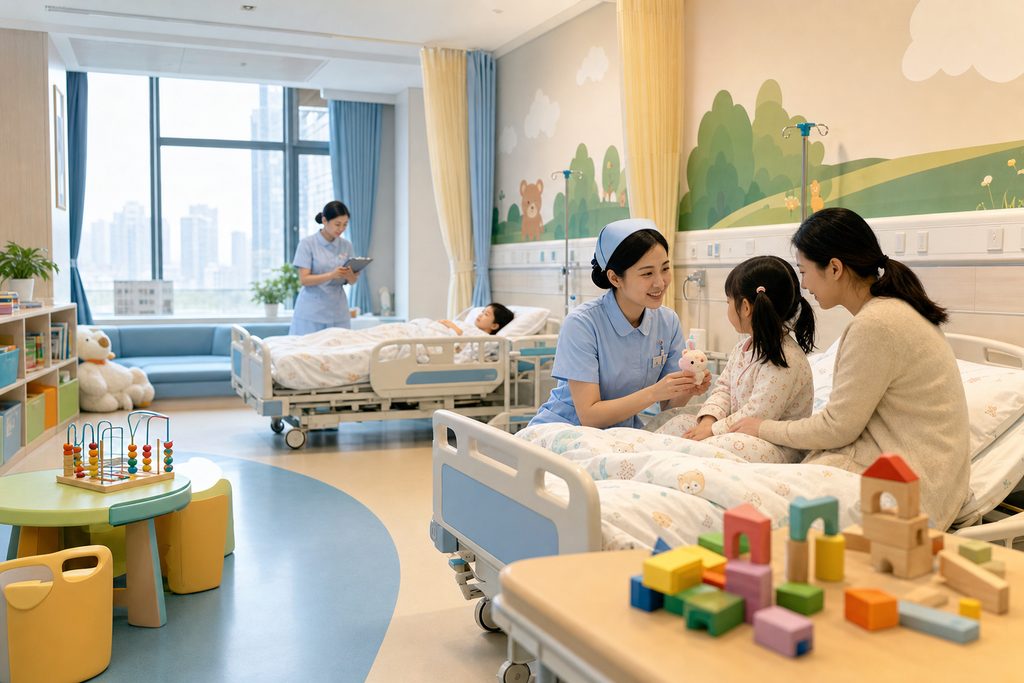
When we assess a children’s hospital with playroom and toys China for our clients, we look past the photos. A playroom that exists on the hospital map but remains locked from 5 PM to 8 AM is useless to a jet-lagged child who wakes up scared at midnight. A toy corner stocked with plush animals that are never sanitized between patients poses an infection risk for an immunocompromised oncology patient. Child-safe means window restrictors that prevent falls, furniture anchored to walls, electrical outlets covered, and hard corners padded — standards that are inconsistently applied across Chinese public hospitals but rigorously maintained in accredited international wings.
We also verify activity coordination. Some hospitals employ designated child-life specialists who bring crafts, music, and therapeutic play to the bedside. Others expect parents to fill that role entirely. Knowing which is which before you board a flight changes everything.
Cost Advantage Without Cutting Corners on Safety
A comprehensive pediatric surgical package at a top-tier Chinese hospital’s international wing typically ranges from 20% to 35% of the equivalent US cost. A complex orthopedic procedure that bills at $80,000 in the United States may run $15,000 to $25,000 in Shanghai or Beijing, inclusive of the private room, nursing care, and postoperative rehabilitation coordination. The cost of pediatric care in China with child-friendly services added — meaning a dedicated bilingual companion, verified playroom access, and activity supplies — adds a modest daily coordination fee rather than a multiplier on the clinical bill. The structural economics are straightforward: lower labor costs, higher patient throughput, and a hospital system that does not carry the administrative overhead of US insurance billing.
Lower cost does not signal lower safety. It signals a different economic model. The hospitals we work with maintain JCI accreditation or China’s equivalent national evaluation standards. Their infection control protocols, surgical checklists, and adverse event reporting systems are audited. What they lack is the layer of patient-experience staff that Western families take for granted. That gap is fillable. It just requires someone on the ground who speaks both languages and understands both cultures.
What You Need to Know Before Going Alone
Families who attempt to arrange pediatric ward coordination independently encounter structural obstacles that no amount of pre-trip research can resolve. These are not failures of the Chinese system. They are features of how it operates for domestic patients, and they become barriers only when international expectations collide with local realities.
- Visa Documentation Requires a Hospital-Issued Invitation Letter: Medical travel to China operates on an S2 visa with a treatment-purpose annotation. The hospital must issue a formal invitation letter confirming your child’s admission. Public hospital administrative offices rarely process these quickly without an in-person advocate. Delays of two to three weeks are common. A missing or incorrectly formatted letter means a visa rejection, and a rejected visa means a postponed surgery.
- Playroom Access Is Often Gated by Ward Tier: The brightly colored playroom featured on the hospital’s English-language website may be located in the international wing, accessible only to patients paying the higher private-room rate. Standard ward patients — even those admitted for the same procedure by the same surgeon — may have no access. Nobody tells you this during the initial inquiry call because the international patient office assumes you already understand the tier structure.
- Activity Coordination Depends Entirely on a Mandarin-Speaking Advocate: Even in hospitals that employ child-life staff, those staff members overwhelmingly speak Mandarin. A child who cannot communicate their fear, boredom, or pain to the person offering comfort is a child who remains isolated. Bilingual activity coordination — someone who can explain a craft project in English while simultaneously updating the nursing station in Mandarin — is not a luxury. It is the mechanism that makes the entire child-friendly promise actually function.
How We Help You Navigate This
Our team visits the ward before your child arrives. We walk the corridors of the international wing. We check whether the playroom door is actually unlocked at 7 PM on a Tuesday. We photograph the window locks, the bathroom setup, the distance from the nurse station to the patient room. We ask the hard questions: How often are toys sanitized? Is there a designated family sleeping area? Can a parent stay overnight without additional fees? The answers shape our recommendation, and sometimes that recommendation is to choose a different hospital entirely.
Once your child is admitted, a bilingual medical companion remains on-site. This person handles the practical flow — translating doctor rounds, coordinating meal preferences, ensuring the activity supplies we pre-positioned are actually brought to the bedside. They do not provide medical care. They provide presence. They make sure the child-safe environment that was promised during the planning phase is the environment your child actually experiences. If something falls short, they fix it in real time, in Mandarin, with the ward head nurse. That is the coordination layer that no amount of pre-trip emailing can replicate.
Are Chinese Children’s Hospitals Safe for Foreigners? Answering the Core Concern
We pre-position age-appropriate activity kits before admission. These are not generic toy bags. They are curated based on your child’s age, mobility restrictions, and infection control requirements. A post-cardiac-surgery toddler needs different stimulation than a school-age orthopedic patient. We also coordinate with the ward nursing team to ensure the supplies are compatible with clinical protocols.
In international wing private rooms, yes — typically one parent can sleep on a provided cot or sofa bed, and the second parent can remain in the room during waking hours. Standard public wards often restrict overnight stays to one caregiver and may not provide sleeping arrangements. This is a critical detail to confirm before booking, especially for longer postoperative stays where parent fatigue becomes a real factor.
Our companion remains on-site and escalates immediately. If a promised private room is unavailable on admission day, we work with the international patient office to resolve it before your child is settled. If the playroom is unexpectedly closed, we arrange alternative activity support at the bedside. The value of having a Mandarin-speaking advocate physically present is that problems get solved in hours, not days.
Rarely. A small number of private international hospitals in Shanghai and Beijing employ English-speaking child-life specialists, but they are the exception. In most top-tier public hospital international wings, the playroom exists, the toys are present, but the staff speak Mandarin. Our bilingual companion fills that communication gap, translating between your child and the activity staff, and often directly facilitating play when no English-speaking staff member is available.
Your Next Step
Choosing a pediatric hospital abroad is not a transaction. It is a sequence of verifications that must happen before, during, and after the clinical event. The surgery matters. So does the window lock, the unlocked playroom door, and the person sitting with your child while you finally get a meal. If you are considering pediatric care in China, start with a clear-eyed assessment of what each hospital actually provides — not what its brochure describes. Our team handles that assessment so you can focus on your child.
Frequently Asked Questions
Yes. The hospitals used for international patients are JCI-accredited or major Grade 3A tertiary centres and follow the same international safety standards as top hospitals in the US and Europe. Surgical teams perform high volumes of procedures — often more than their Western counterparts — which studies show leads to better outcomes.
Costs vary by procedure and hospital, but international patients typically save 40-80% compared to US prices — even when factoring in travel and accommodation. A consultation with our team will give you an exact, all-inclusive quote with no hidden fees.
Send us your existing medical reports. The relevant specialty reviews them and gives you a written opinion, including treatment direction and options, before you commit to any travel. From there you can add a video consultation with the doctor, or have us attend an appointment on your behalf.
For more medical information and treatment options in China, visit chinamedservices.com (China Medical Services).
