Eye Health Screening in China: A Guide for Foreign Patients
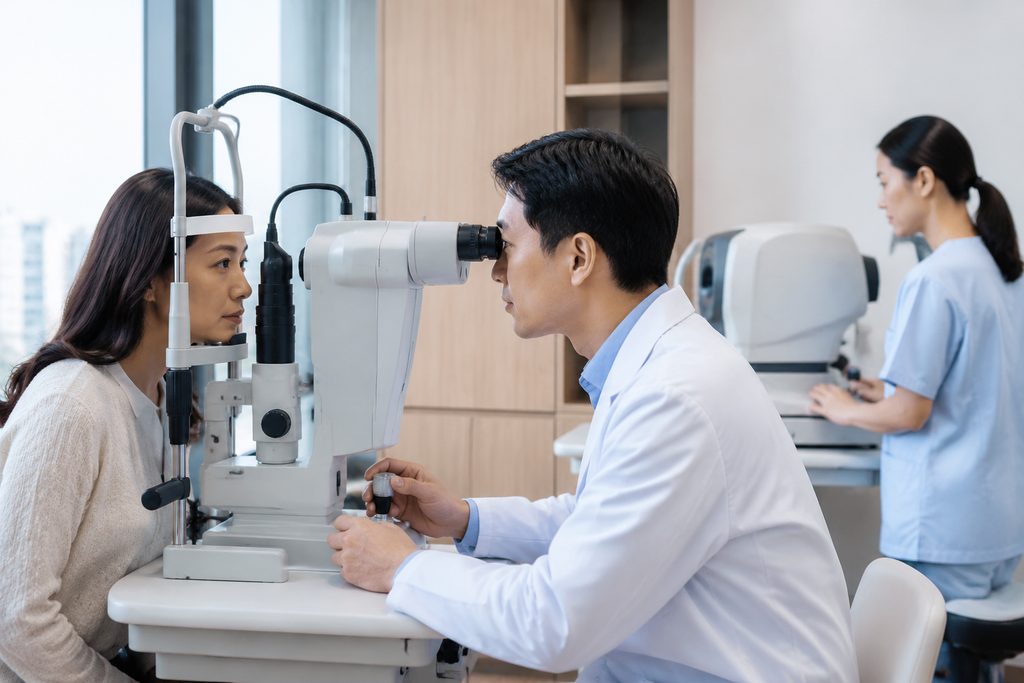
What if a routine eye exam could catch a problem months before you’d notice it yourself — at a fraction of what you’d pay at home?
That question sits behind almost every inquiry we receive about eye health screening in China. Some people are chasing a lower eye screening cost China clinics can offer. Others simply can’t get an appointment at home before next spring. A few have a family history of glaucoma or macular degeneration and want a deeper look than a standard refraction test provides.
This guide walks through what screening in China actually involves, what it costs, which hospitals foreign patients use, and where the process gets bumpy.
How This Actually Works, Step by Step
Here’s the real sequence, from first email to final report. No idealized version.
Step one — you send what you already have. Recent prescriptions, prior OCT scans, visual field printouts, a doctor’s note if you have one. Anything in English or Chinese is fine. Other languages need translation, which typically takes two to four business days.
Step two — a specialty team reviews your file. For screening rather than treatment, this usually means an ophthalmology department at a public tertiary hospital or a private international clinic. They tell you which tests make sense for your age, symptoms, and history. A 34-year-old with no complaints needs a very different panel than a 61-year-old diabetic.
Step three — appointment coordination. This is where most foreign patients hit a wall. Public hospital ophthalmology clinics generally don’t accept overseas bookings in advance. You queue for a same-day number, and popular slots vanish by mid-morning. Private international hospitals do take advance bookings, at roughly 1.5 to 2 times the public-channel price.
Step four — the visit itself. A comprehensive exam at a major hospital runs 60 to 120 minutes and typically bundles several tests into one session. You’ll move between rooms, and the paperwork is in Chinese. This is the part where a bilingual companion earns their fee.
Step five — results and a written summary. Same-day for most screening panels. If something needs follow-up imaging or a specialist opinion, that gets scheduled separately.
What a Comprehensive Eye Exam in China Includes — and What It Costs
Screening is not one test. It’s a bundle, and the bundle determines the price. A basic vision and pressure check might cost $30 to $60 at a public hospital. A full panel with dilated fundus exam, OCT, and visual fields lands considerably higher.
For readers asking how much does comprehensive eye exam cost in Shanghai or Beijing, the honest answer is a range, because hospital tier and test count vary enormously.
| Screening Package | Typical Tests | Public Tertiary Hospital | Private International Clinic |
|---|---|---|---|
| Basic vision screening | Visual acuity, refraction, intraocular pressure | $30–$70 | $80–$150 |
| Standard comprehensive exam | Above plus slit-lamp, dilated fundus exam | $80–$180 | $200–$400 |
| Advanced retinal panel | Above plus OCT, fundus photography | $180–$350 | $400–$700 |
| Glaucoma workup | Visual fields, gonioscopy, pachymetry, OCT | $200–$400 | $450–$800 |
| Diabetic retinopathy screen | Dilated exam, fundus photos, OCT | $150–$300 | $350–$600 |
Prices vary by hospital and case complexity. The same OCT scan can cost three times more at a JCI-accredited private facility than at a public tertiary hospital — and the equipment is often identical. You’re paying for English-speaking staff, shorter waits, and direct insurance billing.
Compare that to the United States, where a comprehensive exam with retinal imaging routinely runs $250 to $500 before insurance, and an OCT add-on can push past $700. The gap is real. It’s also not the main reason people come.
A Realistic Timeline
Nobody plans a medical trip around a single eye exam. Screening is usually folded into a longer stay, or paired with a second opinion on an existing condition. Still, the logistics have a shape.
| Stage | What Happens | Realistic Duration |
|---|---|---|
| Records review | You send existing reports; specialty team assesses which tests apply | 2–5 business days |
| Document translation | Non-English, non-Chinese records translated for hospital review | 2–4 business days |
| Appointment coordination | Public hospital slot secured or private clinic booked | 3–10 business days |
| Visa (if traveling) | S2 short-stay visa for medical treatment, subject to consulate requirements | 1–3 weeks |
| The screening visit | On-site exam, usually same-day results | Half day |
| Follow-up or specialist review | Only if findings require it | 1–7 days |
Total from first contact to completed screening: roughly three to six weeks if a visa is involved, and about two weeks if you’re already in China. The waiting step people forget is appointment lead time at popular public hospitals, which can stretch during peak periods.
What Can Go Wrong — and What Happens Then
Screening is low-risk. The logistics are not.
You arrive and can’t get a same-day number. Public ophthalmology clinics fill fast. If you show up without coordination, you may wait hours and leave with nothing. The fix is booking through a hospital’s international department or a private clinic, which accepts advance reservations.
Dilation ruins your afternoon. Dilating drops blur your near vision for four to six hours and make bright light uncomfortable. Don’t schedule a screening the morning of a flight or a business meeting. This catches people constantly.
Language gaps cause miscommunication. A technician says “look left” and you look right. Instructions about when to blink, when to hold still, and which drops go in which eye all happen in Mandarin. Misread instructions can produce unusable images and a repeat visit.
Findings need follow-up you didn’t plan for. Roughly one in eight adults over 40 has some form of diabetic retinopathy or early glaucoma, and screening sometimes surfaces something that needs a specialist. That’s a good outcome — but it extends your stay or requires a second appointment.
Insurance doesn’t reimburse. Public hospitals require prepayment. International clinics often bill insurers directly, but not every policy covers elective screening abroad. Confirm before you book, not after.
Choosing a Hospital: What Actually Matters
For readers searching for the best eye hospital in Beijing or elsewhere, the ranking question is more nuanced than it looks. China’s Fudan rankings list the top 100 hospitals by tier rather than individual position, and ophthalmology has its own specialty reputation list. Several Beijing and Shanghai institutions rank among the country’s top ten for ophthalmology, which is a meaningful signal.
But ranking isn’t the whole decision. Three things matter more for screening specifically:
- Equipment vintage. An OCT scanner from 2015 and one from 2023 produce different image quality. Ask.
- Volume. A department performing hundreds of retinal scans weekly reads them faster and more consistently than one doing a handful.
- English capability. Not the doctor’s English — the intake process. Forms, instructions, and result explanations all need to be navigable.
Private international hospitals such as United Family, Jiahui, and Raffles solve the language problem cleanly and bill insurance directly. Public tertiary hospitals offer deeper subspecialty expertise at lower cost, but you’ll need support to navigate them. Our directory of top-ranked hospitals by city lists both categories with tier labels so you can compare before deciding.
One more consideration: if your screening is preventive rather than symptom-driven, a private clinic is often the better fit. If you have a known condition and want the deepest possible evaluation, a public tertiary ophthalmology department is usually worth the extra friction.
Is Eye Health Screening Safe in China?
Yes, with context. China’s major hospitals operate under the same diagnostic standards as their counterparts in Europe and North America, and top-tier facilities hold JCI accreditation. Equipment at leading hospitals is current-generation. The safety question isn’t about clinical quality — it’s about process.
The genuine risks are procedural: unclear communication, uncoordinated scheduling, and payment surprises. All three are manageable with preparation. None are clinical dangers.
What we won’t tell you is that screening replaces a full medical evaluation. It doesn’t. It’s one data point about one organ system, and it should be interpreted by a qualified ophthalmologist alongside your history.
For patients considering medical tourism eye checkup packages in China, the practical advice is this: skip the packaged “executive health” bundles that include eye tests as a checkbox item. A dedicated ophthalmology screening at a proper eye department gives you more usable information than a general physical with a vision chart bolted on.
Practical Considerations: Records, Visas, Payment, Follow-Up
Records. Bring everything. Prior scans are more valuable than any single new test, because comparison over time is what detects progression. Digital copies on a USB drive or in cloud storage work fine.
Visa. Foreign patients traveling to China for medical treatment typically use the S2 short-stay visa, which covers medical treatment and private affairs. Stays beyond 180 days fall under S1. Accompanying family members apply under the same category. Requirements change, so verify with the nearest Chinese embassy or consulate and confirm which supporting hospital documents they want. Don’t assume one visa category fits every case.
Payment. Public hospitals require prepayment, with insurance reimbursement handled afterward on your own. Private international hospitals frequently bill insurers directly. Bring a card that works internationally, and expect some public hospital payment terminals to be cash or domestic-app only.
Language. Assume nothing is in English outside international departments. A bilingual medical companion handles registration, queueing, payment, wayfinding, and translation throughout the visit — from $300 per day for a half or full day.
Follow-up at home. Request a written summary with images before you leave. Your own ophthalmologist will want the raw OCT files, not just a narrative. Ask for both.
If you want to understand how appointment coordination works before committing to travel, our consultation and coordination service page explains the staged options — written review first, video consultation if useful, in-person coordination only once a plan makes sense.
Frequently Asked Questions
Private international hospitals accept advance bookings directly, usually by email or online form. Public tertiary hospital ophthalmology departments generally don’t — you take a same-day number in person, or go through the hospital’s international department. A coordination service can handle registration and secure a slot on your behalf, with a full refund if the requested appointment can’t be arranged.
Clinically, yes. Top hospitals meet international diagnostic standards and several hold JCI accreditation. The realistic concerns are communication and scheduling rather than clinical risk. Dilation effects, language gaps, and uncoordinated queues are the things that actually trip people up.
A standard comprehensive exam at a Shanghai public tertiary hospital runs roughly $80 to $180; the same panel at a private international clinic runs $200 to $400. In the US, comparable exams with retinal imaging typically cost $250 to $500 or more. Prices vary by hospital and case complexity, and advanced panels with OCT cost more.
Possibly, but it’s a separate pathway. Screening is diagnostic. If a finding requires treatment, the hospital will conduct its own evaluation and consent process, and any admission or procedure remains subject to hospital rules. Nothing about a screening visit guarantees later treatment access.
The S2 short-stay visa is the applicable category for medical treatment and private affairs, subject to current embassy and consulate requirements and supporting hospital documents. The M visa is for commercial and trade activities and is not a medical visa. Approval is never guaranteed, and requirements vary by nationality.
Your Next Step
Screening in China is affordable, clinically solid, and logistically manageable — provided you plan the appointment and the language support before you book a flight. The savings are real, but they’re not the whole story. What most patients value is getting a clear answer without waiting six months.
We’re China Medical Services, a coordination team that connects international patients with hospitals across 37 cities. We don’t diagnose, and we don’t promise outcomes. We handle the parts that don’t translate: registration, scheduling, bilingual accompaniment, and the paperwork in between.
If you’d like to know which hospitals fit your situation and what a screening would realistically cost, start with a free consultation. No pressure, no obligation — just a clearer picture before you decide anything.
For more medical information and treatment options in China, visit chinamedservices.com (China Medical Services).
