Body Composition in Beijing: What to Expect From Testing
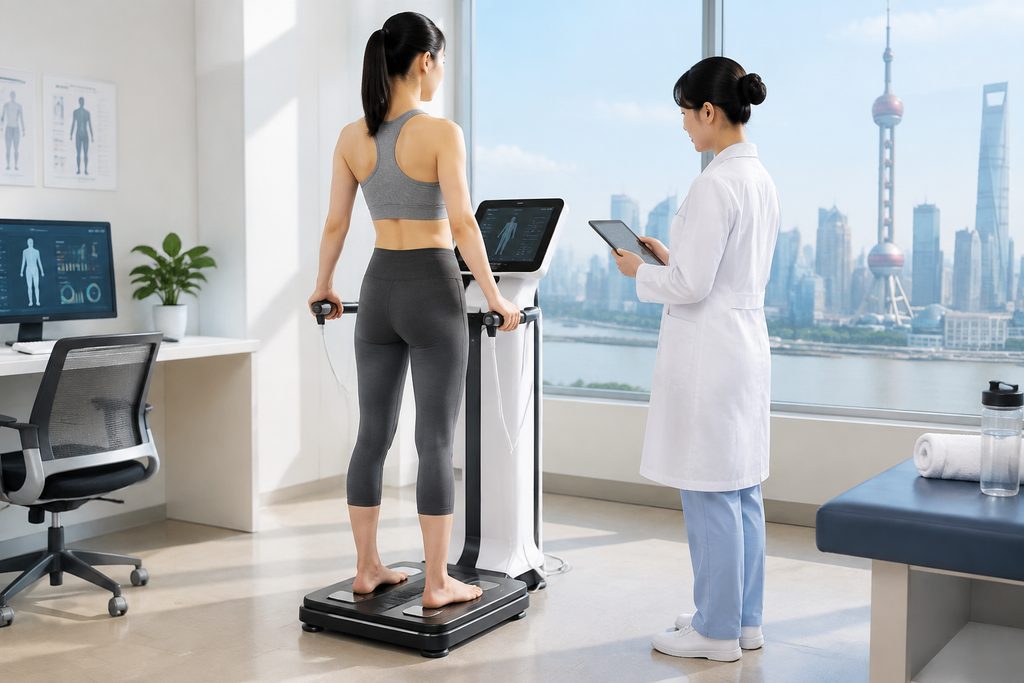
Roughly one in three adults worldwide now tracks some marker of metabolic health, and a growing share of them are willing to travel for a more precise number. Body composition analysis cost Beijing sits at the center of that trend: a DEXA scan that runs $150–$300 in the United States often costs a fraction of that at a top-ranked Chinese hospital, with equipment and reporting standards that meet international norms. For international patients weighing whether to fold a body composition scan into a broader medical trip, the practical questions are straightforward — what the test measures, what it costs, how accurate it is, and how to actually get it done without speaking Mandarin.
How This Actually Works, Step by Step
Here is the real sequence, from first inquiry to printed report. No abstractions.
You start by sending us your existing records — recent bloodwork, any prior DEXA or InBody results, medication list, and a short note on what you want measured and why. A physician or dietitian at the receiving hospital reviews those documents, usually within two to five business days.
What comes back is a written recommendation: which scan type fits your goal, which department handles it, and a cost range. From there, three paths open up.
- Written second opinion — the specialty team reviews your reports and returns written analysis and direction. Useful if you are still deciding whether to travel at all.
- Video consultation — you speak online with the Chinese clinical team, explain symptoms and goals, and hear their recommendations directly. Fees run $100–$300 for a standard international department, or $500–$800 for a top-specialist session.
- Proxy consultation — you designate a city, hospital, or department, and we handle registration, creation of the hospital medical card, and an in-person visit using your materials. Any later admission remains subject to hospital rules.
Once a plan is agreed, we coordinate arrival support, hospital communication, and available green-channel logistics. We never promise admission, a specific appointment slot, or a clinical outcome — only that we will work the process properly.
What a Body Composition Scan Actually Measures
Body composition testing is not a scale with extra steps. It separates your body into compartments — fat mass, lean mass, bone mineral density, and often visceral fat and regional distribution. A bathroom scale tells you a single number. A DEXA scan tells you whether that number is muscle, fat, or fluid.
Three technologies dominate in Beijing hospitals, and they are not interchangeable.
| Method | What It Measures | Typical Cost (USD) | Best For |
|---|---|---|---|
| DEXA (dual-energy X-ray) | Fat mass, lean mass, bone density, regional distribution | $60–$150 | Clinical accuracy, bone health, research-grade data |
| BIA / InBody | Estimated fat and lean mass via electrical impedance | $15–$40 | Routine tracking, gyms, quick follow-up |
| MRI-based analysis | Visceral fat, muscle volume, organ-level detail | $200–$500 | Metabolic research, complex cases |
DEXA remains the clinical reference standard, and it carries a very low radiation dose — roughly equivalent to a day of natural background exposure. That safety profile is why it is repeated in longitudinal studies without concern.
How Accurate Is Body Composition Testing in China
Accuracy depends far more on the machine, the calibration schedule, and the operator than on the country. A DEXA scanner at a major Beijing teaching hospital is the same GE or Hologic hardware you would find in a Western clinic, maintained under the same manufacturer protocols.
Where variance creeps in is the software version and the reference database. A scanner calibrated against a Chinese reference population may report slightly different body-fat percentages than one calibrated against a Caucasian cohort — typically a difference of one to three percentage points. For tracking your own trend over time, that matters less than consistency. Use the same machine and the same software version for every follow-up.
BIA devices are a different story. Hydration status, recent exercise, and even room temperature can shift readings by several percentage points. If your goal is clinical decision-making, DEXA is the honest choice.
Is Body Composition Analysis Safe in Beijing Hospitals
Yes, with normal precautions. DEXA uses a low-dose X-ray, so pregnancy is the main contraindication — always disclose it before scanning. MRI-based analysis carries no ionizing radiation but is unsuitable for patients with certain implanted devices.
Beijing’s top-tier hospitals operate under national radiation safety regulations that mirror international standards. Technicians are licensed, equipment is inspected, and dose records are kept. If you have had multiple CT scans in the past year, mention it — not because the DEXA is risky, but because cumulative exposure is worth tracking.
A Realistic Timeline
Most international patients underestimate the administrative lead time. Here is what a realistic schedule looks like.
| Stage | Timeframe | What Happens |
|---|---|---|
| Records submission and review | 2–5 business days | Specialty team reviews your documents and returns a written recommendation |
| Consultation (video or written) | 3–7 days after review | You discuss goals and receive a scan plan with cost range |
| Appointment coordination | 1–3 weeks | Registration, medical card creation, slot confirmation |
| Visa processing (S2) | 1–3 weeks | Short-stay visa for medical treatment and private affairs, subject to embassy requirements |
| Travel and scan | 1–2 days on site | Scan takes 10–20 minutes; report typically ready within 24–48 hours |
| Follow-up comparison | 3–6 months | Repeat scan on the same machine for trend data |
Total realistic window from first contact to scan in hand: three to eight weeks, depending on how fast documents move and how quickly a visa slot opens.
What Can Go Wrong — and What Happens Then
Honest failure modes, and the actual recourse for each.
The scan you wanted is not available at your chosen hospital. Not every facility runs DEXA; some offer only BIA. If the specific machine matters to you, confirm before booking. Our coordination fee is refunded in full if we cannot secure the appointment shown in your order.
Your report arrives in Chinese only. This is common at public hospitals. Translation is part of what we handle, but build in an extra day. Do not assume an English report is automatic.
You cannot get a same-day appointment. Public hospital outpatient registration generally works on a same-day queue basis, and imaging slots fill. This is exactly why international departments and VIP channels exist — they cost roughly 1.5 to 2 times the standard channel, and they are the realistic route for a scheduled scan.
The numbers do not match your home scan. Expected, for the reasons above. Bring both reports to a physician rather than trying to reconcile them yourself.
Payment complications. Public hospitals require prepayment; insurance reimbursement happens afterward. Private international hospitals often bill insurance directly. Know which model applies to you before you arrive.
Choosing a Clinic: What Actually Matters
For a routine body composition scan, you do not need a famous name. You need a calibrated DEXA machine, a licensed technician, and a report you can read. That said, several factors separate a smooth experience from a frustrating one.
Look for hospitals with an established international department. These are the facilities equipped for English-speaking patients, and they are the ones where appointment coordination actually functions. China’s top-ranked hospitals — the roughly 340 we work with across 37 cities, representing the top 5% of the country’s 35,000+ hospitals — include many with dedicated international wings.
Beijing alone hosts 21 hospitals on the Fudan ranking of China’s top 100, more than any other city. If you are combining a body composition scan with a broader health evaluation, that concentration is worth using. You can browse options by city on our Beijing hospital page, or filter by specialty through our department directory.
What should not drive your choice: a clinic’s marketing budget. A scan is a scan. The variable is the operator and the calibration log.
Practical Considerations: Records, Visa, Payment, Language
Records. Bring prior scans, bloodwork, and a medication list. If you have had a DEXA before, the comparison is the most valuable data point you own.
Visa. Medical travel to China uses the S2 visa for short stays, with S1 for stays exceeding 180 days. Accompanying family members apply for S2 as well. Requirements shift, so verify current rules with the nearest Chinese embassy or consulate. Note that the M visa is for commercial and trade activity and is not the medical category.
Payment. Public hospitals: prepay, then claim reimbursement. Private international hospitals: often direct billing with international insurers. Confirm before you book.
Language. China’s top hospitals handle enormous daily patient volumes, and English signage is limited outside international departments. A bilingual medical companion — from $300 per day — handles registration, queueing, payment, wayfinding, and interpretation. It is labor and coordination, not a purchased shortcut.
Follow-up at home. Ask for a digital copy of the raw data, not just the summary. Your home physician can then compare against future scans on any platform.
Frequently Asked Questions
A DEXA scan typically runs $60–$150 at a top public hospital, while BIA-based testing costs $15–$40. MRI-based visceral fat analysis runs higher, $200–$500. Final pricing varies by hospital and case complexity, and international departments charge more than standard channels.
You cannot reliably self-book through a standard public hospital queue from overseas. The practical route is a written second opinion or video consultation first, followed by appointment coordination through the hospital’s international department. That sequence confirms the right scan type before you commit to travel.
DEXA uses a very low radiation dose, comparable to natural background exposure over a day. The main contraindication is pregnancy. MRI-based analysis avoids ionizing radiation entirely but is unsuitable for some implanted devices. Disclose your full medical history before scanning.
Yes, and many patients do. A body composition scan pairs naturally with metabolic panels, cardiac screening, or a broader executive health assessment. Bundling reduces travel overhead, though each component is scheduled and priced separately by the hospital.
Rarely as a standalone preventive test, though coverage depends on your policy and whether the scan is medically indicated. Public hospitals require upfront payment with later reimbursement; some private international hospitals bill insurers directly. Check with your insurer before booking.
Your Next Step
Body composition analysis in Beijing is affordable, technically solid, and genuinely useful — provided you go in knowing the scan types, the realistic timeline, and where the friction lives. The data is only as good as the planning behind it.
China Medical Services connects international patients with top-ranked Chinese hospitals, handling records review, appointment coordination, bilingual accompaniment, and visa guidance. We are not a hospital and we do not provide medical care or guarantee clinical outcomes. If you want to understand your options before committing to anything, start with a free consultation through our patient support page — no pressure, just a clear picture of what is possible.
This article is for general information only and does not constitute medical advice. Always consult a qualified physician about your individual health situation before undergoing any test or treatment.
For more medical information and treatment options in China, visit chinamedservices.com (China Medical Services).
