Thyroid Checkup in China: A Booking Guide for International Patients
Thyroid Checkup in China: A Booking Guide for International Patients
What if a complete thyroid workup — ultrasound, blood panel, and a specialist’s read — could be arranged in a single morning, for a fraction of what you’d pay in the United States? That’s the reality for many international patients who travel to China for diagnostic care. The average thyroid checkup cost China patients pay at a top public hospital typically runs $150 to $450 all-in, compared with $800 to $2,500 in the U.S. for the same combination of tests.
But cost is only half the story. The other half is logistics: Chinese public hospitals generally don’t accept overseas appointment bookings for standard outpatient visits. You show up, you queue, you register on the day. Understanding that single rule changes how you plan everything else.
Thyroid Checkup Cost China: The Short Answer
A standard thyroid panel (TSH, Free T3, Free T4, plus thyroid antibodies) at a top-tier Chinese public hospital costs roughly $40 to $90. A thyroid ultrasound adds $50 to $120 depending on the hospital tier and whether a senior sonographer performs it. A consultation with an endocrinologist runs $15 to $60 at the public rate, or $150 to $400 through an international department.
Add it up and a thorough one-visit workup lands between $150 and $450 at public rates. Private international hospitals — United Family, Jiahui, Parkway — charge two to four times more, but they offer English-speaking staff, same-week scheduling, and direct insurance billing. That trade-off is the real decision you’re making.
Key takeaway: The best thyroid hospital in Shanghai price point for a full workup sits around $200–$500 at public tier-one facilities, and $600–$1,400 at private international hospitals. The clinical quality at the top public hospitals is world-class; the difference is service, language, and scheduling flexibility.
Who This Is Right For — and Who It Isn’t
Not everyone should book a flight for a thyroid scan. Here’s an honest split.
Typically a good fit:
- You have a nodule, goiter, or abnormal TSH flagged by your home doctor and face a 3–6 month specialist wait
- You need a high-resolution ultrasound with an experienced sonographer — China’s top hospitals perform tens of thousands of these annually
- You’re already traveling to China for work or family and want to combine the trip with diagnostics
- You’re weighing surgery for a nodule and want a second imaging opinion before committing
Probably not the right move:
- You have an urgent, symptomatic thyroid storm or suspected anaplastic cancer — get care locally, immediately
- You need ongoing medication management and monitoring; that belongs with a doctor who can see you every 6–8 weeks
- You expect a Western-style clinic experience without paying private-hospital rates
- Your insurance won’t reimburse overseas diagnostics and the out-of-pocket cost would create real financial strain
The Options, Compared
Three realistic paths exist for a thyroid workup in China. Here’s how they stack up on the numbers that matter.
| Option | Typical Cost (USD) | Scheduling | English Support | Insurance |
|---|---|---|---|---|
| Public tier-one hospital, standard channel | $150–$350 | Same-day registration, queue-based | Limited | Pay upfront, reimburse later |
| Public hospital international/VIP department | $400–$900 | Pre-bookable, 1–2 weeks out | Yes, dedicated staff | Pay upfront, reimburse later |
| Private international hospital | $600–$1,400 | Pre-bookable, often same week | Yes, fully English | Direct billing with many insurers |
Which column suits you? If budget drives everything and you can bring a translator, the public standard channel delivers identical clinical accuracy for a third of the price. If you’re flying in for two days and can’t afford a wasted morning, the international department is the pragmatic pick. And if your insurer has a direct-billing relationship with a private hospital, the private route may actually cost you less out of pocket than the public one.
How Long Does Thyroid Ultrasound Take — and What the Visit Actually Looks Like
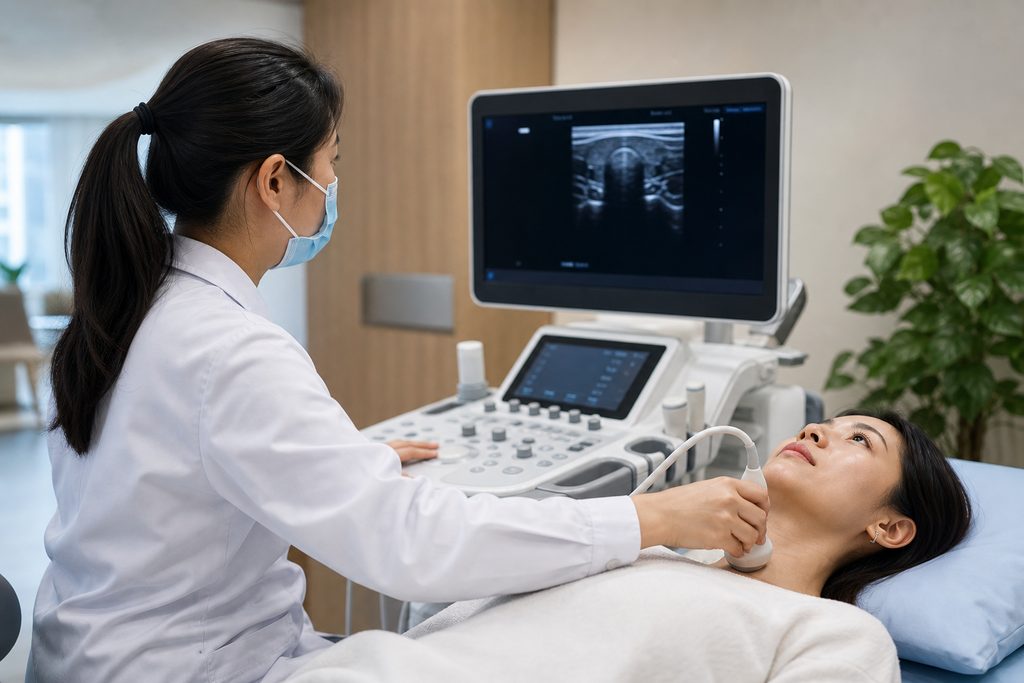
This is the question patients ask most, and the answer surprises people. The scan itself takes 15 to 25 minutes. A comprehensive exam with Doppler flow study might stretch to 30. What eats the day is everything around it: registration, payment windows, waiting areas, and the walk between buildings at hospitals that see 10,000+ outpatients daily.
Realistically, budget a half-day for the full visit. Blood draw in the morning (fasting is usually required for accurate TSH), ultrasound mid-morning, results collected in the afternoon, endocrinologist review before you leave. At a large facility like Ruijin Hospital or Zhongshan Hospital Fudan University, those steps happen in different buildings. This is exactly where a bilingual companion earns their fee — not for the medicine, but for the navigation.
Book your blood draw for the earliest slot available. Fasting thyroid panels are most accurate before 9 a.m., and the lab queue at major hospitals grows fast after 8:30.
Is Thyroid Checkup in China Safe? The Honest Answer
Yes — with the right expectations. China’s tier-one public hospitals operate some of the highest-volume endocrinology and imaging departments in the world. The equipment is current-generation. The sonographers at top facilities read thousands of thyroid scans a year, which builds real diagnostic pattern recognition.
What’s different is process, not medicine. Sterilization standards at public hospitals follow national protocols and are generally rigorous. Report formats may be in Chinese; you’ll need translation. And communication with the radiologist is not a given — you get the report, not a conversation.
Three practical safety notes. First, verify your chosen hospital is on the Fudan ranking or holds JCI accreditation — our directory of top-ranked Chinese hospitals by city groups these for you. Second, request your imaging on a USB or disc so your home doctor can review the actual images, not just the written summary. Third, if a nodule is found and surgery is proposed on the spot, slow down. Get a second read before consenting to anything.
Practical Considerations: Records, Visa, and Payment
Bring your existing records. Prior thyroid panels, any previous ultrasound images, medication lists, and a short summary from your home physician. Chinese specialists work efficiently from documents, and having them translated in advance saves a day.
On the visa question: medical travel to China uses the S2 visa, annotated for medical treatment purposes. Accompanying family members apply under the same category. The M visa is for commercial and trade activity and has nothing to do with medical care — don’t let anyone tell you otherwise. Processing times and document requirements shift, so confirm current rules with your nearest Chinese embassy or consulate before booking flights. Approval is never guaranteed, and the specific documents required depend on your case.
Payment at public hospitals is upfront — cash, Alipay, WeChat Pay, or international card at some counters. Reimbursement from your insurer happens afterward, and you’ll need itemized receipts in English, which the hospital international office can usually provide. Private international hospitals frequently bill your insurer directly, which removes that step entirely.
One more thing worth knowing: if you want to lock in a specific specialist or a guaranteed appointment window rather than queueing, that’s the international department channel, and it costs roughly 1.5 to 2 times the standard rate. It’s not queue-jumping — it’s a separate service tier that hospitals operate openly.
Frequently Asked Questions
At public hospitals, standard outpatient registration happens on the day — you cannot pre-book a routine thyroid visit from overseas. International and VIP departments do accept advance bookings, typically one to two weeks out. Private international hospitals are the most flexible, often confirming within days. If pre-booking matters to you, plan around the international channel.
You can absolutely arrange it yourself if you read Chinese or travel with someone who does. The obstacles are practical, not legal: registration forms, payment counters, department locations, and report collection are almost entirely in Chinese at public hospitals. A package or a companion service removes that friction. It doesn’t change the medicine or the price of the tests themselves.
Most thyroid nodules — over 90% in most series — are benign. If something suspicious appears, the hospital will recommend further steps, possibly fine-needle aspiration biopsy. You are never obligated to proceed with treatment in China. Take the images and report home, and let your own physician guide the next decision. Nothing about a diagnostic trip commits you to anything further.
Diagnostics alone: $150–$1,400 depending on hospital tier. Add flights, 2–3 nights of accommodation, and airport transfers. A bilingual medical companion runs from $300 per day if you want hands-on navigation. Total realistic budget for a 3-day diagnostic trip: $1,500–$3,500, excluding airfare from your home country.
Your Next Step
A thyroid workup in China is genuinely accessible, genuinely affordable, and clinically solid — provided you plan around how the system actually works rather than how you wish it worked. The single biggest variable isn’t the hospital you choose. It’s whether someone is standing next to you who speaks both languages and knows which building to walk into.
We are China Medical Services — a coordination service, not a hospital, and we don’t diagnose or treat. What we do is match you to the right facility from our database of 340+ top-ranked hospitals across 37 cities, handle appointment coordination, and provide bilingual companions who manage the logistics so you can focus on the results. If you’d like to talk through your situation before committing to anything, start with a free consultation — no pressure, no obligation.
This article is for general information only and does not constitute medical advice. Costs vary by hospital and case complexity. Always consult a qualified physician about your individual health.
For more medical information and treatment options in China, visit chinamedservices.com (China Medical Services).
