Cardiac Tests in Nanchang: Booking Guide for Foreign Patients
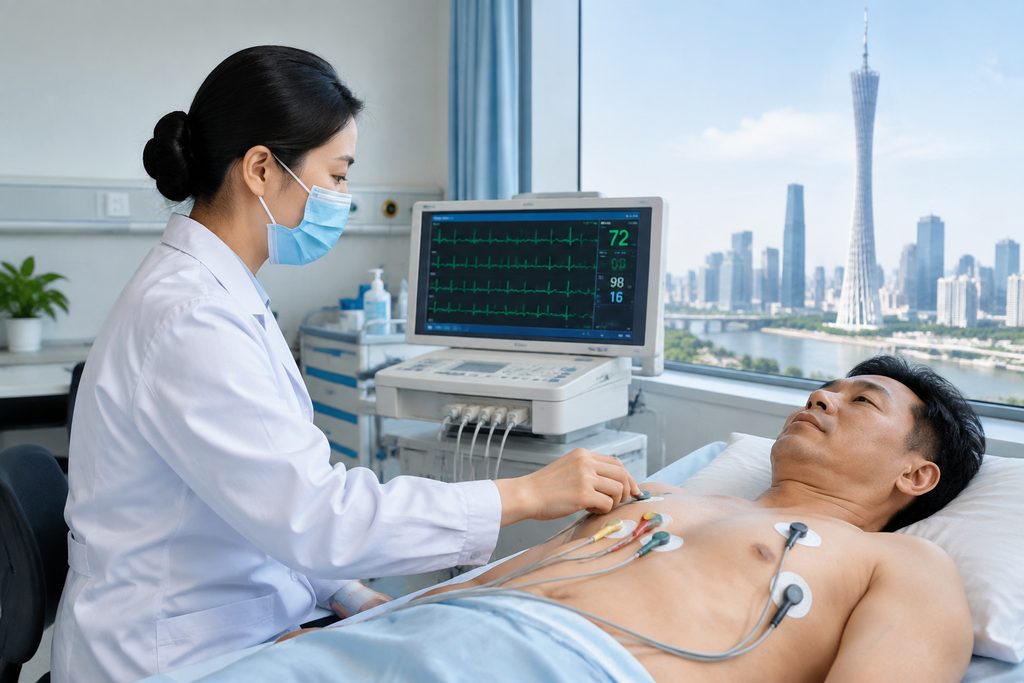
Cardiac Tests in Nanchang: Booking Guide for Foreign Patients
What does a cardiac stress test cost in Nanchang, and how does a foreigner actually book one? The honest answer is that the test itself is inexpensive by Western standards — often a fraction of U.S. pricing — but the booking process is where most international patients get stuck. This guide walks through the real numbers, the hospitals worth considering, and the sequence that turns a vague intention into a confirmed appointment.
Nanchang is the capital of Jiangxi province, a city of roughly 6 million people that most Western patients have never considered for medical care. That is changing. Jiangxi’s provincial flagship hospitals have invested heavily in cardiology over the past decade, and the cost gap versus the United States has drawn a small but growing number of international patients — particularly from Southeast Asia and the Chinese diaspora returning for care.
How This Actually Works, Step by Step
Here is the real sequence, without the marketing gloss.
Step one: you gather your existing records. Recent ECGs, echocardiogram reports, lipid panels, blood pressure logs, any prior stress test results, and a list of current medications. If your doctor at home has already flagged a concern — chest pain on exertion, an abnormal rhythm, a family history of early heart attack — say so explicitly in your inquiry. That single detail changes which department you are routed to.
Step two: those records get reviewed. A Chinese cardiology team reads them and tells you which tests are actually indicated. This matters more than people expect. Patients frequently arrive asking for a full battery of cardiac imaging when what they need is a treadmill test and a lipid panel. The reverse also happens.
Step three: you get a written plan and a cost estimate. Not a final bill — an estimate, with the caveat that final pricing depends on the hospital and what the tests reveal.
Step four: appointment coordination. This is the part that trips up independent travelers. At most Chinese public hospitals, standard outpatient registration happens on the day, in person, in a queue. You cannot simply reserve a cardiology slot from overseas the way you would with a U.S. clinic. International departments and VIP channels work differently — they can often pre-arrange appointments, but they cost more.
Step five: you arrive, register, and complete the tests. Most cardiac testing is outpatient and same-day. A stress test takes under an hour of actual testing time. An echocardiogram is 30 to 45 minutes.
Step six: results and interpretation. Chinese hospitals typically release results within 24 to 72 hours for standard cardiac tests. You will want a translated summary if you plan to show it to a cardiologist back home.
What Cardiac Tests Cost in Nanchang — and Why the Numbers Surprise People
Let’s put real figures on the table. A resting ECG in a Chinese public hospital commonly runs the equivalent of $15 to $40. A treadmill stress test sits somewhere between $80 and $250 depending on whether it includes imaging. A full cardiac checkup package — ECG, echocardiogram, bloodwork, chest X-ray, and a physician consult — is frequently quoted in the $300 to $800 range at provincial-level hospitals.
Compare that to the United States, where a single exercise stress test with imaging can bill at $1,000 to $3,000 before insurance adjustments, and a comprehensive cardiac workup easily exceeds $5,000.
| Test | Typical Nanchang Range (USD) | Typical U.S. Range (USD) |
|---|---|---|
| Resting ECG | $15–$40 | $50–$300 |
| Exercise stress test | $80–$250 | $500–$1,500 |
| Stress test with imaging | $150–$450 | $1,000–$3,000 |
| Echocardiogram | $60–$200 | $500–$2,500 |
| 24-hour Holter monitor | $80–$250 | $300–$1,200 |
| Cardiac checkup package | $300–$800 | $2,000–$6,000 |
These ranges vary by hospital and case complexity. A provincial flagship hospital with a dedicated international department will sit at the higher end. A standard outpatient cardiology clinic will sit near the bottom. The gap is real either way.
One thing worth flagging: the cardiac stress test cost Nanchang patients pay at a private international clinic can run two to three times the public hospital figure. You are paying for English-speaking staff, shorter waits, and direct insurance billing. Whether that is worth it depends entirely on your language comfort and your insurance setup.
A Realistic Timeline
Patients consistently underestimate how long the front end takes. Here is what a realistic schedule looks like.
| Stage | Typical Duration | Notes |
|---|---|---|
| Record collection and translation | 3–10 days | Longer if prior reports are in a non-English language |
| Remote review and written plan | 3–7 days | Depends on how quickly the specialty team responds |
| Appointment coordination | 1–3 weeks | International departments are faster than standard channels |
| Visa processing (S2) | 1–3 weeks | Varies by consulate; supporting hospital documents required |
| Travel and arrival | 1–2 days | Nanchang Changbei International Airport has direct domestic connections |
| Testing itself | 1–3 days | Most cardiac tests are outpatient and same-day |
| Results and interpretation | 24–72 hours | Complex imaging may take longer |
Add it up and you are looking at roughly four to eight weeks from first inquiry to completed testing. If you are trying to combine this with a broader trip, build in slack. Visa timelines in particular are not something anyone can compress on your behalf.
What Can Go Wrong — and What Happens Then
Being honest about failure modes is more useful than pretending they do not exist.
The appointment does not materialize. Public hospital cardiology slots are genuinely hard to pre-book from overseas. If a coordinator promises a specific specialist on a specific date and it falls through, the recourse is a refund of the coordination fee and a rebooking attempt. That is the standard we hold ourselves to, and any provider worth using should say the same.
The test reveals something serious. This is the scenario nobody plans for. If a stress test shows significant ischemia, you may be advised to stay for further evaluation — possibly a coronary angiogram, possibly intervention. That is a medical decision made by the treating team, not a logistical one. Having a contingency budget and flexible return travel is genuinely wise.
Language breakdown at the point of care. Nanchang’s public hospitals operate primarily in Chinese. Signs, registration forms, pharmacy instructions, and most physician communication happen in Mandarin. Without interpretation, even a simple ECG visit becomes stressful. This is the single most common complaint from independent medical travelers in second-tier Chinese cities.
Insurance does not reimburse. Chinese public hospitals generally require payment upfront. You file with your insurer afterward. Whether they pay depends entirely on your policy. Check before you book, not after.
Choosing a Hospital: What Actually Matters
Foreign patients searching for the best heart hospital in Nanchang for foreigners run into a structural problem. Nanchang’s strongest cardiac programs are inside large public teaching hospitals, and those hospitals are not designed around international patient service.
So the real question is not “which is best” but “which fits my situation.” Three criteria matter more than rankings.
Does the hospital have a functional international department? This determines whether you can pre-arrange an appointment, whether English-speaking staff will meet you, and whether the registration process will be navigable. Not every provincial hospital has one.
Does it have the specific subspecialty you need? General cardiology, interventional cardiology, electrophysiology, and cardiac surgery are different capabilities. A hospital excellent at hypertension management may not be the right place for complex arrhythmia work.
How does payment work? Private international hospitals in larger Chinese cities often bill insurance directly. Public hospitals in Nanchang typically do not.
For patients whose condition is complex, it is worth considering whether Nanchang is the right city at all. China’s highest-volume cardiac surgery programs are concentrated in Beijing and Shanghai — Fuwai Hospital in Beijing performs over 14,000 cardiac surgeries annually, the highest volume in the world. For straightforward diagnostic testing, Nanchang is perfectly adequate and considerably cheaper. For complex intervention, the calculus shifts.
Our specialty rankings by department list the top hospitals for cardiac surgery and cardiology across China, and the Fudan-ranked hospital directory organizes them by city.
Is Cardiac Testing Safe in China?
This question comes up constantly, and it deserves a direct answer.
Diagnostic cardiac testing — ECG, echocardiography, treadmill stress testing, Holter monitoring — uses standardized equipment and protocols that are internationally comparable. Major Chinese hospitals use the same device manufacturers as Western hospitals. The interpretation standards follow established guidelines.
The legitimate concerns are not about test quality. They are about communication, follow-up, and continuity of care. A stress test performed correctly but explained in a language you do not speak is a stress test you cannot act on.
Volume matters too. China’s top cardiac centers handle patient volumes that dwarf most Western hospitals, which translates into deep procedural experience. That advantage is more pronounced in surgical and interventional care than in routine diagnostics.
Practical Considerations: Records, Visas, Payment, and Language
Records. Bring everything. Original reports, translated if possible, plus a written medication list with generic drug names. Chinese physicians are thorough, but they work from what you provide.
Visa. Foreigners coming to China for medical treatment typically apply for an S2 visa with a notation for medical purposes. Stays exceeding 180 days generally fall under the S1 category. Accompanying family members apply under the same S2 category. Requirements change, so confirm current rules with the nearest Chinese embassy or consulate and secure supporting documentation from the hospital. Note that the M visa is for commercial and trade activity — it is not the correct category for medical travel.
Payment. Public hospitals require prepayment. Budget for the possibility that your insurer reimburses only part of the cost, or none.
Language. This is where a bilingual medical companion changes the experience entirely. Someone who handles registration, queueing, payment, wayfinding, and translation turns a confusing morning into a manageable one. Our patient consultation and coordination service exists precisely for this gap.
Follow-up at home. Ask for a translated summary report before you leave China. Your cardiologist at home will need it, and getting it later is far more difficult.
Frequently Asked Questions
A resting ECG at a Chinese public hospital typically costs the equivalent of $15 to $40. Private international clinics charge more, sometimes $80 to $150. The price varies by hospital tier and city, but even at the high end it is well below typical U.S. pricing.
Not through standard public hospital channels — those require in-person registration on the day. International departments and VIP channels can often pre-arrange appointments, usually at a higher price. A coordination service can help navigate which channel fits your case, though no one can guarantee a specific specialist on a specific date.
The testing itself uses internationally standard equipment and protocols, and major Chinese hospitals are well equipped. The real risks are communication gaps and follow-up continuity, not test quality. Bringing a bilingual companion or working with a coordination service addresses most of that risk.
Medical travel generally falls under the S2 visa category with medical-purpose notation, with S1 for stays over 180 days. Accompanying family members use the same S2 category. Confirm current requirements with your nearest Chinese embassy or consulate, since rules and documentation expectations can change.
Typical packages include a resting ECG, echocardiogram, blood panels (lipids, glucose, cardiac markers), blood pressure assessment, chest imaging, and a physician consultation. Packages generally run $300 to $800 at provincial-level public hospitals, with final pricing depending on the hospital and what the tests reveal.
Your Next Step
Cardiac testing in Nanchang is affordable, technically sound, and genuinely accessible — provided you understand that the hard part is logistics, not medicine. Get the records organized, confirm the visa category, and decide early whether you need language support.
We are China Medical Services, a coordination service that connects international patients with Chinese hospitals. We do not provide medical care and we do not diagnose. What we do is review your records with the relevant specialty, arrange appointments through official hospital channels, and provide bilingual support on the ground so nothing gets lost in translation.
If you are weighing whether to pursue testing in China, start with a conversation. No pressure, no obligation — just a clear picture of what is possible in your case.
This article is for general information only and is not medical advice. Cardiac symptoms require prompt evaluation by a qualified physician. Treatment decisions should always be made with a licensed clinician who has reviewed your individual case.
For more medical information and treatment options in China, visit chinamedservices.com (China Medical Services).
