Cardiac Imaging Review Service China: Expert Echo, CT Angio & MRI Reading
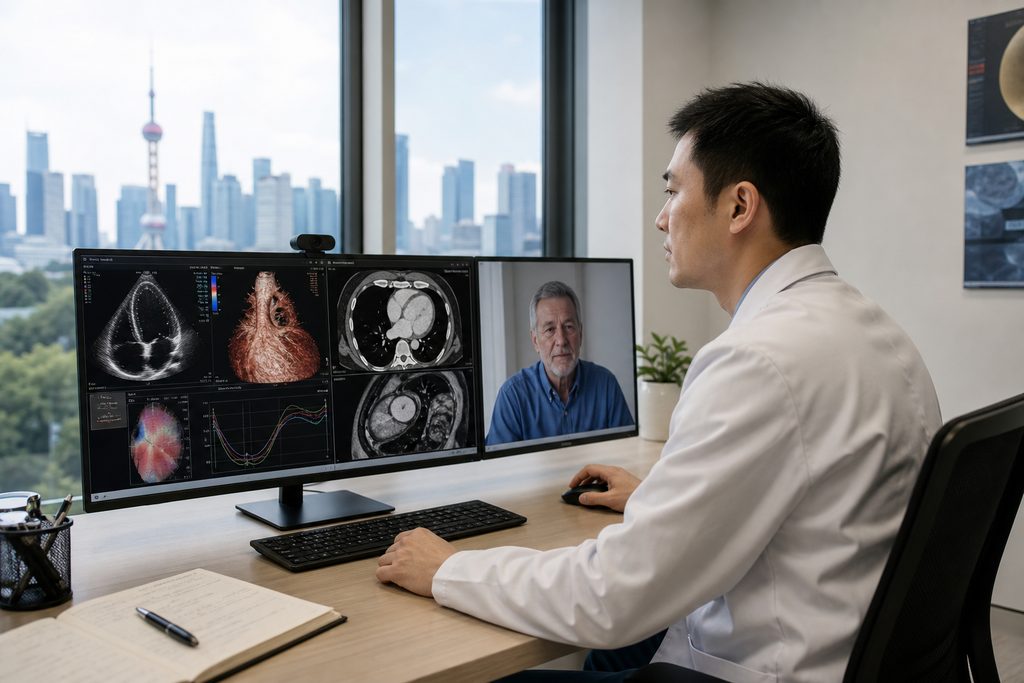
You have probably heard that getting a medical second opinion from abroad is complicated, slow, and reserved for only the most desperate cases. The opposite is true. A cardiac imaging second opinion China price starts at just a few hundred dollars, and the turnaround can be faster than waiting for a local appointment in London or Toronto. Yet most patients never explore this option — not because it is inaccessible, but because they simply do not know it exists.
We are not a hospital. We do not provide medical treatment or clinical diagnoses. Our team acts as your logistical architects — we bridge the gap between you and China’s top-tier cardiac imaging expertise. We handle the coordination, the language barrier, and the technical transfer of your DICOM files so that a senior radiologist at a high-volume Chinese heart center can review your scans. You get a detailed written report. Nothing more, nothing less.
Key Takeaways
- A written cardiac imaging second opinion from a top Chinese hospital costs between $300 and $500 — roughly one-tenth the price of a comparable US review.
- Chinese cardiac centers like Fuwai Hospital perform over 14,000 cardiac surgeries annually, giving their imaging specialists a diagnostic volume that is hard to match anywhere else.
- You cannot simply email a hospital and expect a response. DICOM file transfer, medical translation, and hospital coordination are real barriers — but they are solvable.
- Any second opinion is for reference only. It is not a prescription and does not replace an in-person consultation with your treating physician.
The Problem: When Your Heart Scan Leaves You With More Questions Than Answers
A patient sits in a cardiologist’s office in Manchester. The echo report mentions “mild to moderate regurgitation” but is vague about the valve morphology. The recommendation is to “monitor.” Six months later, nothing has changed on paper, but the patient feels worse. Another scan. Another ambiguous read. The wait for a specialist review stretches to 14 weeks on the NHS.
This is not an isolated story. Approximately 1 in 8 patients who undergo cardiac imaging receive reports with findings that fall into a gray zone — not clearly normal, not clearly surgical. And in many public health systems, the radiologist reading your cardiac CT angiography may not be a dedicated cardiac imager. They might be a general radiologist reading everything from knee MRIs to abdominal ultrasounds on the same shift.
That matters. A 2023 study published in the Journal of Cardiovascular Computed Tomography found that dedicated cardiac imagers detected 23% more non-calcified plaque features than general radiologists reviewing the same coronary CTA datasets. The difference is not in the technology. It is in the eyes looking at the screen.
So patients are left with a choice. Accept the first read and live with uncertainty. Or seek a second opinion — often at significant out-of-pocket cost and with long delays. A cardiac MRI second opinion at a major US academic center can run $1,500 to $3,000. And you might wait three to four weeks for the report.
There is another path. It involves sending your scans east, not west.
Who We Are
We are China Medical Services, a medical concierge organization that connects international patients with China’s 340+ top-ranked hospitals across 37 cities. We are not physicians. We are the operational layer — we translate your medical history, transfer your imaging files through hospital-compliant channels, coordinate with the hospital’s international department, and deliver the expert’s written report back to you in clear English. We exist because China’s best cardiac centers are world-class but not world-accessible without someone on the ground who speaks the language and understands the system.
Why a Cardiac Imaging Review Service in China Delivers Results
The value proposition is straightforward but worth examining in detail. Three structural advantages make Chinese cardiac imaging review uniquely compelling for international patients.
Clinical Volume That Reshapes Diagnostic Instinct
Fuwai Hospital in Beijing performs more than 14,000 cardiac surgeries each year. That is not a typo. The entire United Kingdom performs roughly 35,000 cardiac surgeries annually across all centers. One Chinese hospital handles 40% of a nation’s volume.
What does this mean for imaging review? A senior cardiac radiologist at Fuwai or Zhongshan Hospital in Shanghai reads more echocardiograms in a single month than many Western counterparts read in a year. They see rare presentations frequently. Anomalous coronary anatomy, infiltrative cardiomyopathies, subtle prosthetic valve dysfunction — these are not textbook curiosities. They are Tuesday morning.
Volume builds pattern recognition. Pattern recognition reduces diagnostic uncertainty. When you send your echo, CT angio, or cardiac MRI to a reviewer who has seen 50 cases of cardiac amyloidosis this year rather than five, the report you get back reflects that depth.
Technology Without the Wait
Chinese hospitals adopted digital imaging universally later than many Western institutions, which meant they leapfrogged directly to the latest PACS (Picture Archiving and Communication Systems). The post-processing capabilities for cardiac CT — fractional flow reserve CT (FFR-CT), plaque characterization, 3D volumetric reconstruction — are standard at top centers, not premium add-ons.
More importantly, the turnaround time is often faster. A written second opinion from a major Chinese cardiac center can be delivered within 5 to 7 business days once all materials are received and translated. Compare that to the 3-to-4-week wait at many North American academic hospitals. The bottleneck is not the reading. It is the scheduling queue. Chinese international departments operate with dedicated capacity for overseas patients, which keeps the pipeline moving.
The Cardiac Imaging Second Opinion China Price Advantage
Let us address the obvious question directly. Lower cost does not mean lower quality. The structural reasons for the price difference are mundane, not magical.
A written second opinion from a top-tier Chinese hospital costs between $300 and $500. A video consultation with a senior specialist runs $500 to $800. These prices reflect China’s lower physician labor costs and the efficiency of high-volume centers — not any compromise on expertise or technology.
The same review at a major US center: $1,500 to $3,000. At a leading private London hospital: £800 to £1,500. The diagnostic value is comparable. The price is not.
| Service | China (USD) | US (USD) | UK (GBP) |
|---|---|---|---|
| Written Cardiac Imaging Second Opinion | $300–500 | $1,500–3,000 | £800–1,500 |
| Video Consultation with Cardiac Specialist | $500–800 | $2,000–4,000 | £1,200–2,500 |
| Multidisciplinary Team (MDT) Review | $1,500–2,000 | $5,000–8,000 | £3,000–5,000 |
Prices vary by hospital and case complexity. All second opinions are for reference only and do not constitute a prescription or treatment recommendation.
How Reliable Is Cardiac Imaging Review Service in China?
This is the question that sits beneath every other concern. Can you trust a report from a hospital 6,000 miles away?
The answer depends on which hospital you are talking about. China has over 35,000 hospitals. The top 5% — roughly 1,700 institutions — are where quality concentrates. Our network includes only hospitals ranked by the Fudan University Hospital Ranking, China’s most authoritative hospital evaluation system, or those with Joint Commission International (JCI) accreditation.
Fuwai Hospital’s cardiac imaging department publishes in the same international journals as the Cleveland Clinic. Zhongshan Hospital’s echocardiography lab is a reference center for complex valve disease. These are not unknown entities operating in isolation. Their specialists present at ACC, ESC, and ASE conferences. Their diagnostic standards align with international guidelines.
Reliability is not a binary question. It is a function of the specific hospital, the specific reader, and the quality of the clinical information provided. A second opinion is only as good as the data it is based on. If you send incomplete imaging series or omit key clinical history, even the best reader cannot produce a meaningful report.
This is where our coordination role matters. We ensure the DICOM files are complete. We translate the clinical summary accurately. We route the case to a specialist whose subspecialty matches the clinical question — not just any available cardiologist.
Can I Send My Heart Scans to China for Expert Reading?
Yes. The process is more straightforward than most patients assume, though it requires attention to technical detail.
Modern cardiac imaging is digital. Your echo, CT angiography, and cardiac MRI studies exist as DICOM files — the universal standard for medical imaging. Hospitals in China use the same DICOM standard. The files are transferable.
The practical steps look like this. You request your imaging studies from the facility where they were performed. They will provide a CD or a secure download link containing the DICOM data. You also need the original written report and a summary of your clinical history — symptoms, relevant lab results, prior procedures, current medications.
We receive these materials, translate the clinical documents into Chinese, and submit the complete package to the hospital’s international department. The assigned specialist reviews the images and clinical context, then produces a written report. We translate that report back into English and deliver it to you.
The entire process, from receiving your materials to delivering the final report, typically takes 5 to 7 business days. A video consultation to discuss the findings adds a few more days for scheduling.
Book Cardiac MRI Second Opinion China Online: How the Process Works
You cannot simply go to a website, upload your scans, and receive a report 48 hours later. Chinese public hospitals do not operate as direct-to-consumer telehealth platforms. The process requires coordination through the hospital’s international department or VIP channel.
Our role is to be that coordination layer. Here is what happens step by step.
First, you contact us with a description of your case and the imaging studies you have. We help you identify which studies are relevant and what additional information the reviewing specialist will need.
Second, we match your case to an appropriate hospital and department. A complex congenital heart disease case goes to a different center than a straightforward coronary CTA. A question about infiltrative cardiomyopathy needs a center with dedicated cardiac MRI expertise.
Third, we handle the file transfer, translation, and submission. This is the operational heavy lifting — ensuring the DICOM files are complete and uncorrupted, the translation is medically precise, and the submission follows the hospital’s specific protocol.
Fourth, we receive the report, translate it, and deliver it to you. If you have follow-up questions, we can arrange a video consultation with the reviewing specialist.
Cardiac Imaging Review Package China International Patients: What Is Included
When international patients inquire about a cardiac imaging review package, they are usually asking what they actually receive for the fee. Here is the breakdown.
The core deliverable is a written report from a senior cardiac imaging specialist at a Fudan-ranked or JCI-accredited Chinese hospital. The report addresses the specific clinical question you have raised — valve morphology, coronary stenosis severity, myocardial tissue characterization, or whatever the diagnostic uncertainty may be.
The report is not a generic template. It is a detailed, case-specific analysis that references your imaging findings in the context of your clinical history. It will typically include measurements, observations, differential considerations, and recommendations for further evaluation if indicated.
What the package does not include is a prescription, a treatment plan, or a surgical recommendation. These can only be made after an in-person consultation and complete workup. The second opinion is a diagnostic input, not a treatment decision.
For patients who want more than a written report, we can arrange a video consultation with the reviewing specialist. This allows for a live discussion of the findings, with the opportunity to ask questions and clarify uncertainties. Video consultations range from $500 to $800 depending on the specialist’s seniority and the complexity of the case.
What You Need to Know Before Going Alone
The barriers to accessing Chinese cardiac imaging expertise independently are real. Being honest about them is more useful than pretending they do not exist.
- Language and Communication: Top Chinese cardiac radiologists read and publish in English-language journals. But their day-to-day clinical work is in Mandarin. The hospital’s administrative staff — the people who handle international inquiries — may have limited English proficiency. Sending an email in English to a general hospital inbox will almost certainly go unanswered. You need a Chinese-language clinical summary and a point of contact inside the international department.
- DICOM File Transfer Protocol: Chinese hospitals have strict data security policies. You cannot simply email a zip file of DICOM images or share a Dropbox link. Hospitals require transfer through approved channels — often a dedicated upload portal or physical media. File corruption during transfer is common, and incomplete series will result in the case being rejected. Someone needs to verify the data integrity before submission.
- Medical Record Formatting: The clinical summary submitted to a Chinese hospital must follow a specific format. It needs to include translated versions of key documents, a structured summary of the clinical question, and often specific lab values in standardized units. A pile of unorganized PDFs in English will not be accepted. The hospital’s international department expects a properly prepared case file.
These barriers are not insurmountable. They are structural features of a system designed for domestic patients and only recently adapted for international ones. Navigating them is what we do.
How We Help You Navigate This
The process we have built addresses each of these barriers directly.
Before anything else, we consult with you to understand your case. What imaging have you had? What is the clinical question? What have your doctors told you so far? This initial conversation is free and carries no obligation. It helps us determine whether a Chinese second opinion is actually appropriate for your situation — and sometimes it is not, which we will tell you honestly.
Once we confirm that your case is suitable, we guide you through obtaining your DICOM files and medical records. We provide specific instructions for requesting these from your imaging facility. When the files arrive, we verify them — checking that all series are present, that the images are not corrupted, and that the clinical documents are complete.
Our medical translators then prepare a Chinese-language clinical summary. This is not machine translation. It is done by bilingual medical professionals who understand cardiac terminology in both languages. A poorly translated clinical summary leads to a poorly informed second opinion. We do not cut corners here.
We submit the complete case file to the hospital’s international department and track its progress. If the reviewing specialist needs additional information — a specific lab value, a prior echo for comparison — we coordinate getting it. When the report is ready, we translate it back into English and deliver it to you, along with an explanation of any terminology or concepts that may be unfamiliar.
If you want to discuss the report with the specialist, we schedule and facilitate the video consultation. And if the second opinion leads you to consider traveling to China for treatment, the consultation fee is credited toward our coordination service.
Frequently Asked Questions
How do I know the Chinese specialist reviewing my scans is qualified?
The hospitals we work with are ranked among China’s top institutions by the Fudan University Hospital Ranking. Their cardiac imaging specialists are board-certified, publish in international peer-reviewed journals, and many have completed fellowships or observerships at major Western centers. We can provide the reviewing specialist’s credentials and publication record upon request. You are not getting a random radiologist — you are getting a senior specialist at a high-volume cardiac center.
What if the second opinion contradicts my local cardiologist’s reading?
This happens more often than you might expect, and it is precisely why second opinions exist. A discrepancy does not mean one reader is wrong and the other is right. Cardiac imaging interpretation involves judgment, and reasonable specialists can disagree — particularly on borderline findings. The value of the second opinion is that it gives you and your treating physician additional data to inform the clinical decision. We recommend sharing the report with your local cardiologist and discussing the findings together.
Is my medical data secure when sent to China?
Chinese hospital international departments handle patient data under protocols that meet international standards for medical information security. DICOM files are transferred through hospital-approved secure channels, not public file-sharing services. That said, data privacy regulations in China differ from HIPAA in the US or GDPR in Europe. We are transparent about this. If data sovereignty is an absolute requirement for you, a Chinese second opinion may not be the right choice. For most patients, the practical security measures in place are sufficient.
Can I use this second opinion to get treatment in my home country?
A written second opinion from a Chinese hospital is a medical document. You can share it with any physician you choose. Whether your local doctor or insurance company will act on it depends on their own policies and clinical judgment. The report carries the weight of the institution that produced it — a Fuwai Hospital or Zhongshan Hospital second opinion is generally taken seriously by cardiologists anywhere. But it is not a binding document. Your treating physician retains full clinical authority over your care.
What if I need treatment and want to come to China for it?
If the second opinion identifies a condition that requires intervention — valve surgery, bypass grafting, arrhythmia ablation — and you decide to pursue treatment in China, we can coordinate the entire process. This includes hospital selection, visa support, appointment scheduling, inpatient admission, and bilingual medical companionship throughout your stay. Any fees you paid for the remote second opinion consultation are credited in full toward our on-the-ground coordination service, provided you
For more medical information and treatment options in China, visit chinamedservices.com (China Medical Services).
