What a Gastroscopy Costs in China: 2026 Price Data and Hospital Guide
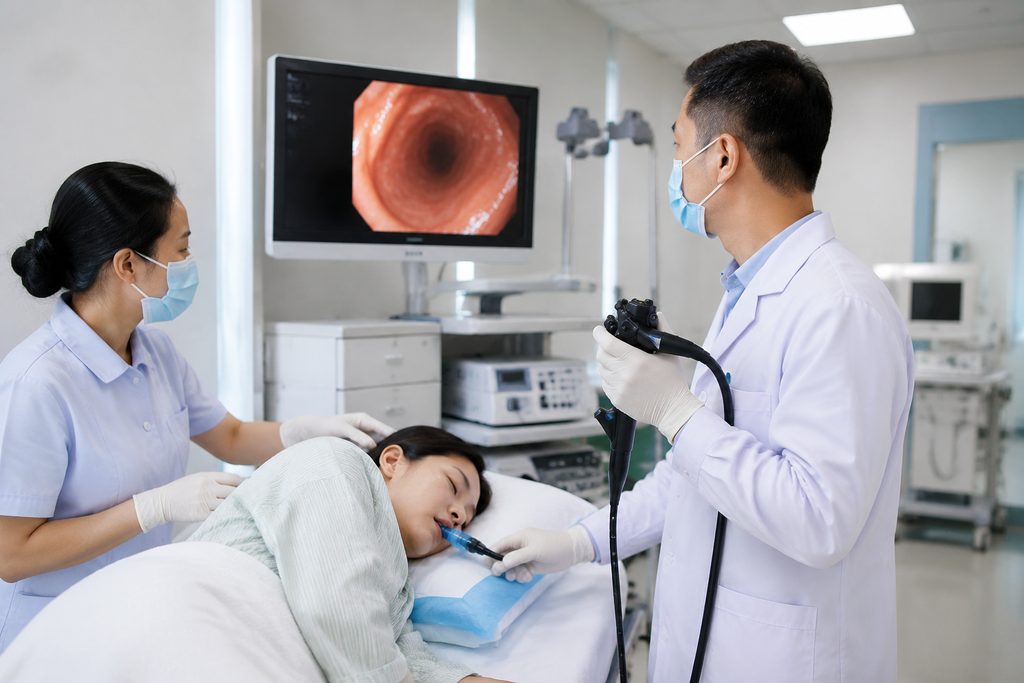
Roughly 1 in 3 international patients who contact us about digestive symptoms has already been quoted a price at home that made them pause — $2,500 to $4,500 for a diagnostic gastroscopy in the United States, often with a separate anesthesia bill and a facility fee attached. In China, the same procedure at a top-ranked public hospital typically runs $150 to $400. That gap is real, and it is the single biggest reason people start searching for the gastroscopy cost in China.
But price is only half the story. The other half is access: how a foreigner actually gets an appointment, who holds the endoscope, and what happens if the findings require treatment. This guide covers all of it.
How This Actually Works, Step by Step
Here is the real sequence, from the moment you decide to look into this to the moment you have a report in hand.
Step 1 — You send your existing records. That means any prior endoscopy reports, CT or ultrasound images, blood work, H. pylori test results, and a short written summary of your symptoms. If you have nothing yet, that is fine too; the specialist will work from your description.
Step 2 — A Chinese gastroenterology department reviews the file. Not a call center. The relevant specialty at a partner hospital reviews your materials and returns a written assessment: whether gastroscopy is appropriate, whether sedation is advisable, what additional tests they would want first, and a cost range for your specific case.
Step 3 — You decide the format. Some patients stop at the written opinion. Others move to a video consultation where they speak directly with the specialty team, ask questions, and hear recommendations. A third option is a proxy visit: you designate a hospital or specialist, and a coordinator registers you, creates the hospital medical card, and attends an in-person appointment on your behalf using your materials.
Step 4 — If you travel, the appointment is arranged through the hospital’s international office. This matters. Standard public outpatient registration in China generally cannot be pre-booked from overseas — you queue on the day. The international or VIP channel is the route that allows a scheduled slot, English-speaking staff, and a named specialist.
Step 5 — The procedure, then the report. A diagnostic gastroscopy itself takes 10 to 20 minutes. With sedation and recovery, plan on a half day at the hospital. Preliminary findings are usually discussed the same day; the written pathology report, if biopsies are taken, comes back in 3 to 7 working days.
What Drives the Gastroscopy Cost in China
Not through the standard public outpatient queue — that is walk-in registration on the day. The workable route is the hospital’s international or VIP department, which accepts advance scheduling with English service at roughly 1.5 to 2 times the standard fee. Coordination services can handle registration and the medical card on your behalf.
The S2 category covers short-stay medical treatment and private affairs, subject to current consulate requirements and supporting hospital documents. Accompanying family members apply the same way. Stays over 180 days use S1. The M visa is for business and trade only and is not a medical visa.
Packages vary widely, and the term is used loosely. A legitimate package typically bundles the consultation, pre-procedure tests, the endoscopy, sedation, and pathology. Be cautious with any package that quotes a single all-in figure without specifying whether biopsy, pathology, and anesthesia are included — those are the three line items that most often appear as extras.
For a straightforward diagnostic procedure, three to five days on the ground is realistic: one day for consultation and pre-procedure assessment, one day for the scope, and a buffer for the preliminary findings discussion. If biopsies are taken and you want to wait for the pathology report, add 3 to 7 working days.
Your Next Step
The core message is simple: a diagnostic gastroscopy in China costs a fraction of Western pricing, and the main obstacle is not money — it is navigation. Getting the right department, a scheduled appointment, and a report you can actually read at home takes local coordination.
We are China Medical Services. Our team connects international patients with 340+ top-ranked hospitals across 37 cities, and we handle hospital matching, appointment coordination, bilingual medical companionship, and visa guidance. We are not doctors and we do not provide medical advice, diagnose conditions, or guarantee any clinical outcome. What we do is make the logistics work.
If you would like a straight answer on cost and feasibility for your situation, send us your reports and a short description of your symptoms. You can start with a free consultation through our patient support page — no obligation, and no pressure to travel.
This article is for general information only and does not constitute medical advice. Gastroscopy carries risks and should be discussed with a qualified physician. Costs vary by hospital, city, and case complexity.
Frequently Asked Questions
Yes. The hospitals used for international patients are JCI-accredited and follow the same international safety standards as top hospitals in the US and Europe. Surgical teams perform high volumes of procedures — often more than their Western counterparts — which studies show leads to better outcomes.
Costs vary by procedure and hospital, but international patients typically save 40-80% compared to US prices — even when factoring in travel and accommodation. A consultation with our team will give you an exact, all-inclusive quote with no hidden fees.
Send us your existing medical reports to get started. We handle everything from hospital selection and appointment scheduling to visa assistance and post-operative recovery planning. Your medical records are reviewed by the specialist before you even book a flight.
For more medical information and treatment options in China, visit chinamedservices.com (China Medical Services).
