Bone Density in Shanghai: How to Book a DEXA Scan Fast
Key Takeaways
- A DEXA bone density scan in Shanghai typically costs far less than in the US or Europe — often a fraction of Western prices — and results are usually ready within 24 to 48 hours.
- Shanghai is home to 18 hospitals on the Fudan Top 100 list, giving international patients genuine choice in equipment, English support, and scheduling speed.
- Public hospital outpatient scans generally cannot be pre-booked from overseas; guaranteed appointments usually require the international or VIP department, which costs more.
- You need a passport, a referral or prior imaging where relevant, and realistic expectations about language barriers — most top public hospitals run on Chinese-language workflows.
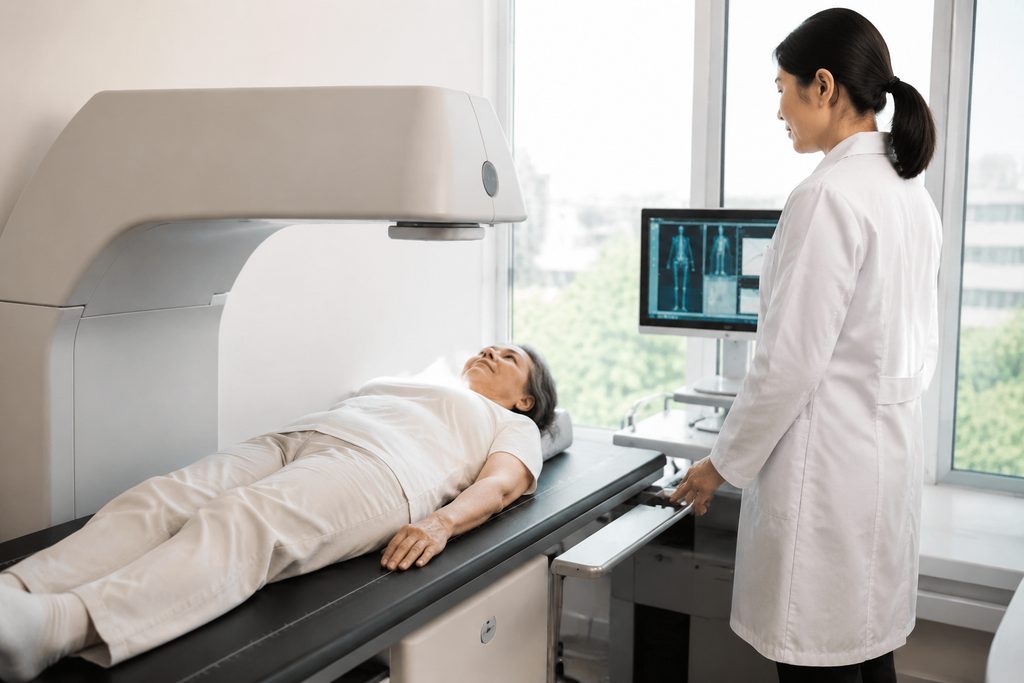
A bone density scan sounds technical, but the idea is simple. It measures how much mineral — mostly calcium — is packed into your bones. The most common method is DEXA (dual-energy X-ray absorptiometry), a low-dose X-ray that takes about 10 to 15 minutes and tells you whether you have normal bone mass, osteopenia, or osteoporosis. No needles. No dye. You lie still on a padded table while a scanner arm passes over your hip and spine.
People search for a bone density test cost Shanghai because they want a clear number before they commit. That is a reasonable instinct, and it is exactly what this guide delivers — real price ranges, hospital options, and the booking path that actually works for a foreign patient.
The Problem: Bone Loss Is Silent Until It Isn’t
The World Health Organization estimates that osteoporosis affects roughly 200 million people worldwide, and the International Osteoporosis Foundation reports that one in three women over 50 and one in five men over 50 will break a bone because of it. A hip fracture in an older adult carries a mortality risk comparable to some cancers in the first year after the break.
Here is the trap. Bone loss produces no symptoms. You feel nothing while your bone mineral density slides from normal into osteopenia, and then into osteoporosis. The first warning sign is often a fracture from a fall that should not have broken anything.
In the US, a DEXA scan without insurance can run $150 to $300 at a private imaging center, and considerably more at a hospital. In the UK, private DEXA scans commonly sit between £100 and £250. Wait times vary widely — some NHS trusts quote several weeks for a routine scan. If you are already in Shanghai for work, family, or a longer stay, waiting until you fly home is a poor use of your time. And if you are managing a condition like hyperparathyroidism, celiac disease, or long-term steroid use, you may not want to wait at all.
Why Shanghai Delivers Reliable Bone Density Results
Shanghai is not a compromise destination for imaging. It is one of the strongest diagnostic cities in Asia, and the reasons are structural.
Equipment and Volume at Scale
Shanghai’s major tertiary hospitals run high imaging volumes daily. A DEXA scanner at a large public hospital may process dozens of patients a day, which means technicians are highly practiced at positioning, and reporting radiologists see bone density studies constantly. Familiarity matters in diagnostic imaging. A radiologist who reads 40 bone density studies a week catches subtle changes that a generalist reading two a week might miss.
The city holds 18 hospitals on the Fudan Top 100 ranking, second only to Beijing. Those institutions — including Ruijin Hospital, Zhongshan Hospital, and Shanghai Sixth People’s Hospital, which is well known for orthopedics — operate modern DEXA equipment from major manufacturers like Hologic and GE Healthcare.
Speed From Scan to Answer
In many Western systems, you wait days or weeks for a scan appointment, then another week or more for the report to reach your physician. In Shanghai’s private international hospitals, you can often book within 48 hours, scan the same day as your consultation, and walk out with a printed report. Public hospitals are fast too, though the queueing process is less streamlined for non-Chinese speakers.
Cost Without Cutting Corners
Lower prices in China do not come from cheap equipment. They come from labor economics, high patient throughput that spreads equipment costs across more scans, and a healthcare system where imaging is priced as a routine diagnostic rather than a premium service. The clinical standard — the T-score and Z-score reporting format defined by the World Health Organization — is identical to what you would receive in Boston or Berlin.
Bone Density Test Cost Shanghai: What You Actually Pay
Prices depend on which type of facility you choose. Here is a realistic comparison.
| Facility Type | Typical DEXA Price (USD) | Wait Time | English Support |
|---|---|---|---|
| Public tertiary hospital (standard outpatient) | $30 – $80 | Same day to a few days | Limited |
| Public hospital international / VIP department | $100 – $250 | Often within 1–3 days | Yes |
| Private international hospital (e.g., United Family, Jiahui) | $150 – $400 | Usually within 48 hours | Full English service |
| US private imaging center (for comparison) | $150 – $300+ | Days to weeks | Yes |
Prices vary by hospital and case complexity, and a scan ordered as part of a broader bone health workup — including blood calcium, vitamin D, and PTH testing — will cost more overall. The scan itself is only one line item.
One important note: at public hospitals, you generally pay upfront and seek reimbursement from your insurer afterward. Private international hospitals often bill insurance directly if your plan has a China network. Check with your insurer before you book.
How to Book a Bone Density Scan in Shanghai: Step by Step
This is where most foreign patients get stuck. The booking logic in China is different from what you are used to.
Step 1 — Decide which channel fits you. If cost is the priority and you have some Mandarin support, a public hospital works. If you need English communication and predictable scheduling, the international or VIP department is the practical choice. Private international hospitals are the easiest entry point of all.
Step 2 — Get your documents ready. Bring your passport. Bring any prior DEXA reports, relevant blood work, and a referral letter from your home physician if you have one. A referral is not always mandatory, but it helps the Chinese physician understand why the scan is being ordered.
Step 3 — Understand the registration reality. At standard public hospital outpatient clinics, you generally cannot lock in an appointment from overseas. You register on the day, take a queue number, see the physician, get the scan order, pay, and then go to the imaging department. This is the standard workflow, and it is why many international patients choose the VIP or private route instead.
Step 4 — Book through the right channel. Private international hospitals accept online or phone booking directly. Public hospital international departments can often be reached by phone or email. For anything more complex, a coordination service can handle registration, medical card creation, and scheduling on your behalf.
Step 5 — Arrive early and bring a translator if needed. Even with an appointment, expect paperwork. Arrive 20 to 30 minutes ahead. If you do not speak Mandarin, having a bilingual companion removes almost all of the friction — from the registration window to the imaging room to the cashier.
Is Bone Density Testing in China Reliable?
This is the question every careful patient asks, and it deserves a direct answer.
The short version: yes, at the hospitals you would actually choose. China’s top tertiary hospitals use the same DEXA equipment manufacturers as Western centers, and their radiologists are trained to the same WHO diagnostic criteria. A T-score of -2.5 means osteoporosis in Shanghai exactly as it does in Chicago.
Where reliability can vary is at small, low-volume clinics that may use older equipment or single-site scanning. The fix is straightforward — stick to major tertiary hospitals or JCI-accredited international facilities. Shanghai’s leading institutions fall into both categories.
Two practical quality checks. First, ask whether the facility performs daily calibration on the scanner — good centers do. Second, if you will have follow-up scans in the future, try to use the same machine and facility each time, because comparing results across different scanners introduces variability that can look like bone loss when none has occurred.
Best Hospital in Shanghai for Bone Density Scan: How to Choose
There is no single “best” hospital for everyone. The right choice depends on your priorities:
- For orthopedic depth: Shanghai Sixth People’s Hospital has a strong reputation in orthopedics and musculoskeletal care.
- For comprehensive tertiary care: Ruijin Hospital and Zhongshan Hospital, both Fudan-ranked, offer full diagnostic capabilities if your bone density result needs further workup.
- For English service and convenience: United Family Healthcare, Jiahui Health, and similar JCI-accredited private hospitals provide a Western-style experience with direct insurance billing.
- For combining with Traditional Chinese Medicine: Some patients pair a DEXA scan with a TCM consultation for bone health and lifestyle guidance.
You can browse ranked institutions by specialty and city through our directory of Fudan-ranked hospitals, and see dedicated Shanghai options on the Shanghai city page.
Practical Considerations for International Patients
Visa. If you are traveling to China specifically for medical evaluation or treatment, the applicable short-stay visa category is S2, which covers medical treatment and private affairs and requires supporting documents from the hospital. Stays beyond 180 days fall under S1. Accompanying family members apply under the same S2 category. Always confirm current requirements with the nearest Chinese embassy or consulate, since rules and documentation expectations can change.
Payment. Public hospitals generally require upfront payment by cash, UnionPay, or major credit cards, with insurance reimbursement handled afterward in your home country. Private international hospitals frequently bill insurers directly. Confirm your plan’s China coverage before booking.
Language. This is the single biggest practical hurdle. Top public hospitals operate in Chinese. Signage, registration forms, and staff conversations are in Mandarin. A bilingual medical companion can handle registration, queueing, payment, wayfinding, and translation so you are not navigating a 10,000-patient-per-day hospital alone.
Records. Ask for your DEXA report and images on a USB drive or via the hospital’s app before you leave. You will want them for your physician at home.
Follow-up. Bone density changes slowly. Most guidelines recommend repeat scanning every two years for monitoring, though your physician may adjust that based on your treatment plan.
Frequently Asked Questions
A DEXA scan at a public tertiary hospital typically runs $30 to $80. International or VIP departments charge $100 to $250, and private international hospitals range from $150 to $400. Final pricing varies by hospital and case complexity, especially if additional blood work is included.
At private international hospitals, yes — online or phone booking is standard. At standard public hospital outpatient clinics, no; you register on the day. To lock in a scheduled appointment at a public hospital, you generally need the international or VIP department. Coordination services can assist with registration and scheduling where direct booking is not available.
At major tertiary and JCI-accredited hospitals, yes. They use the same DEXA equipment and apply the same WHO diagnostic criteria. For the most consistent tracking over time, use the same facility and machine for repeat scans.
Not always, but it helps. Many hospitals will accept a self-referred patient, though a referral letter from your home physician clarifies the medical reason and can speed up the process. Bring any prior imaging and relevant lab results.
Choose a private international hospital or a public hospital’s international department, both of which offer English-speaking staff. If you use a standard public hospital, arrange a bilingual companion in advance — it is the difference between a smooth 90-minute visit and a frustrating half-day.
Your Next Step
Getting a bone density scan in Shanghai is genuinely straightforward once you know which channel to use. The scan itself takes minutes, the results are reliable at reputable hospitals, and the cost is a fraction of Western pricing. The real variable is logistics — booking, language, and navigation.
China Medical Services helps international patients connect with 340+ top-ranked hospitals across 37 cities, and we handle appointment coordination, bilingual medical companions, and visa guidance. We are not a hospital and we do not provide diagnoses or treatment — we handle the path so your medical team can focus on your care. If you would like help finding the right Shanghai facility for your bone density scan, start with a free consultation through our patient support page, and we will walk you through your options.
This article is for general information only and is not medical advice. Always consult a qualified physician about your bone health, screening schedule, and any treatment decisions.
For more medical information and treatment options in China, visit chinamedservices.com (China Medical Services).
