Bone Density in Beijing: What to Expect, Cost, and Top Hospitals
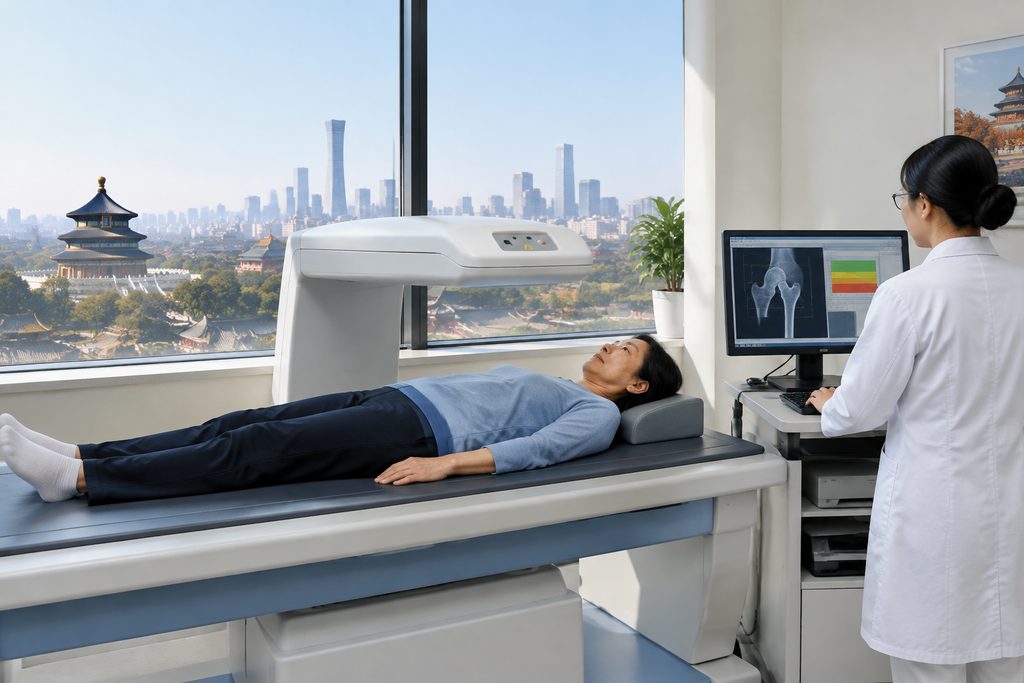
Bone Density in Beijing: What to Expect
Roughly one in three women over 50 and one in five men will break a bone because of osteoporosis, according to the International Osteoporosis Foundation. If you live in Beijing or plan to travel there for care, the practical question is simple: what does a bone density test cost in Beijing, and can you trust the result? The short answer is yes on both counts. A DEXA scan at a top-tier Chinese hospital typically runs $40–$120 out of pocket, a fraction of US pricing, and the equipment is the same Hologic and GE Lunar machines used in Western clinics.
What changes is everything around the scan. Registration, scheduling, language, and follow-up all work differently here. This guide walks you through the real sequence, the honest failure points, and how to plan your visit without wasting a trip.
How This Actually Works, Step by Step
Here is the actual path from “I think I need a scan” to “I have results in hand.”
You start by clarifying what you need. A screening DEXA for a healthy adult is different from a follow-up scan for someone on long-term steroids, or a workup after a fragility fracture. If you already have a diagnosis, gather your prior reports — older DEXA printouts, blood work, medication lists, imaging CDs. These matter more than most people expect, because Chinese endocrinologists and orthopedic specialists read trends, not single numbers.
Send those records to a coordinating service or directly to a hospital’s international department. A physician reviews them and confirms whether a DEXA is even the right test, or whether you also need vertebral fracture assessment, thyroid and parathyroid panels, vitamin D, or a bone turnover marker. This review step is where good planning saves you a second trip.
Then comes scheduling. At most public tertiary hospitals, you cannot book a routine outpatient slot from overseas in advance. You register on the day, queue, and see the doctor. For an international visitor, the workable route is the hospital’s international or VIP channel, which allows advance coordination, English-speaking staff, and a fixed appointment. Expect to pay roughly 1.5 to 2 times the standard fee for that convenience.
On scan day, you arrive, check in, and the DEXA itself takes 10 to 20 minutes on the table. You lie still, fully clothed in loose garments without metal zippers or buttons. No injection, no contrast, no fasting required. Results are usually ready the same day or within 24 hours, printed as a T-score and Z-score report with a bone mineral density value in g/cm².
Finally, a specialist interprets the numbers in context and recommends next steps — calcium and vitamin D, weight-bearing exercise, or pharmacological treatment if your T-score sits at or below -2.5.
What a Bone Density Test Costs in Beijing — and Why It Varies
The bone density test cost in Beijing depends on three things: which hospital you choose, whether you go through the standard or international channel, and whether the scan is bundled with a consultation.
| Setting | Typical DEXA cost (USD) | Consultation | Notes |
|---|---|---|---|
| Public tertiary hospital, standard channel | $40–$70 | $5–$15 | Queue-based, limited English |
| Public hospital international/VIP department | $70–$120 | $50–$150 | Advance booking, English support |
| Private international hospital | $150–$300 | $150–$400 | Direct insurance billing, Western-style service |
For comparison, a DEXA scan in the United States commonly bills $150–$300 before insurance, and in the UK private sector £100–£250. Prices in Beijing vary by hospital and case complexity, and a full bone health workup — DEXA plus labs plus specialist review — usually lands between $150 and $500 depending on the channel.
A Realistic Timeline
Here is what a well-planned bone health visit actually looks like, with realistic ranges rather than best-case numbers.
| Stage | Typical duration | What happens |
|---|---|---|
| Records collection and translation | 3–7 days | Gather prior scans, labs, medication list; translate if needed |
| Pre-visit review (written or video) | 2–5 business days | Specialist confirms test plan and any add-on labs |
| Appointment coordination | 3–10 days | International department books a fixed slot |
| Visa (S2, if traveling to China) | 1–3 weeks | Requires hospital invitation and supporting documents |
| Travel and arrival | 1–2 days | Flight, hotel, airport transfer |
| Scan day and consultation | Half day | DEXA, blood draw if needed, specialist review |
| Results and follow-up plan | Same day to 48 hours | Printed report, treatment recommendations |
Total elapsed time from first contact to results: roughly two to five weeks if you need a visa, or as little as one week if you are already in China. The step people forget is document translation. If your records are in English, most international departments handle them directly. If they are in another language, add three to five days.
What Can Go Wrong — and What Happens Then
Honest failure modes matter more than glossy promises. Here are the ones we see.
You show up without an appointment. At a big public hospital, walk-in registration for a DEXA can mean a two- to four-hour wait, and the scan slot may be full for the day. Recourse: book through the international department, or use a bilingual companion who can navigate registration on your behalf.
Your scan is done at a small clinic with older equipment. Not every facility maintains its DEXA machine to the same calibration standard, and a poorly calibrated scanner produces T-scores you cannot compare to anything. Recourse: choose a tertiary hospital with a dedicated osteoporosis or endocrinology unit, and ask which machine model is used.
You get a number but no interpretation. A T-score without clinical context is close to useless. Recourse: insist on a specialist consultation in the same visit, not just the printout.
The hospital cannot see you on your travel dates. Popular specialists book out one to three weeks ahead. Recourse: build flexibility into your trip, or start with a video consultation so the in-person visit is purely procedural.
Follow-up falls apart after you fly home. Recourse: request a written report in English with the raw BMD values, so your physician at home can act on it.
Choosing the Best Hospital in Beijing for Osteoporosis Screening
Beijing has 21 hospitals in the Fudan Top 100 ranking — more than any other Chinese city. For bone health specifically, the relevant departments are endocrinology, orthopedics, and geriatrics.
Peking Union Medical College Hospital is the benchmark for complex diagnostic workups and internal medicine. For metabolic bone disease and endocrine causes of bone loss, its endocrinology department is among the strongest in the country. If your bone loss is secondary to another condition — kidney disease, thyroid disorders, long-term steroid use — that is the kind of place where the diagnostic depth pays off.
For fracture-related evaluation and surgical planning, the orthopedic departments at several Beijing tertiary hospitals rank among China’s top ten in the Fudan specialty reputation list. If you have already fractured a hip, wrist, or vertebra, you want a hospital where the bone clinic and the orthopedic team work together, not in separate buildings.
Private international hospitals such as United Family and Jiahui offer a different trade-off: English-speaking physicians, direct insurance billing, and a calmer experience — at two to four times the public hospital price. For a straightforward screening DEXA, that premium buys convenience rather than better data.
You can browse ranked hospitals by city and specialty through our directory of China’s top-ranked hospitals, or narrow by department on the specialty rankings page.
Practical Considerations: Records, Visa, Payment, and Follow-Up
Records. Bring prior DEXA reports, recent blood work (calcium, vitamin D, PTH, TSH), a medication list including steroids and PPIs, and any imaging of prior fractures. Digital copies are fine; printed copies are better.
Visa. If you are traveling to China for medical treatment, the applicable short-stay category is the S2 visa, which covers medical treatment and private affairs and requires supporting documents from the hospital. Accompanying family members apply under the same category. Processing typically takes one to three weeks, and requirements can change — always confirm with the latest embassy or consulate guidance before booking flights. Note that the M visa is for commercial and trade activities and is not the right category for medical travel.
Payment. Public hospitals require prepayment, with insurance reimbursement handled afterward in your home country. Private international hospitals often bill insurers directly. Bring a card that works internationally, and keep every receipt and itemized invoice.
Language. China’s top hospitals handle enormous daily volume — some see more than 10,000 outpatient visits a day. Signage, registration systems, and most staff operate in Chinese. A bilingual medical companion handles registration, queuing, payment, wayfinding, and translation so the visit runs on your terms rather than the queue’s.
Follow-up at home. Ask for the report in English with raw BMD values, the machine model, and the reference database used. Your physician at home needs those details to compare future scans accurately.
Frequently Asked Questions
Yes, when performed at a tertiary hospital with a maintained DEXA machine. China’s top hospitals use the same Hologic and GE Lunar equipment found in Western clinics and follow the same WHO diagnostic thresholds. The variable is calibration and reporting quality, not the technology — which is why choosing a hospital with a dedicated osteoporosis or endocrinology unit matters.
The scan itself takes 10 to 20 minutes. Add 30 to 60 minutes for registration, payment, and waiting at a public hospital, or roughly 15 minutes at a private international clinic. Results are typically available the same day or within 24 hours.
Not through the standard public outpatient channel — routine registration happens on the day. Advance booking is possible through a hospital’s international or VIP department, which is the practical route for visitors. If you cannot secure a confirmed slot, a written second opinion based on your existing records is a reasonable first step before committing to travel.
For a scan alone, probably not — the savings rarely justify a flight. It makes sense when the visit is bundled with a broader diagnostic workup, a second opinion on a complex case, or treatment that would cost five to ten times more at home. Think of it as part of a larger medical trip, not a standalone errand.
A T-score at or below -2.5 confirms osteoporosis, and treatment usually involves calcium and vitamin D optimization, weight-bearing exercise, fall prevention, and in many cases pharmacological therapy. Any treatment decision should be made with a qualified physician who has reviewed your full history — not from a printout alone.
Your Next Step
A bone density scan in Beijing is fast, inexpensive, and technically on par with Western standards — the friction is in scheduling, language, and interpretation, not in the medicine. Plan for two to five weeks if you need a visa, bring your prior records, and insist on a specialist consultation alongside the numbers.
China Medical Services connects international patients with more than 340 top-ranked hospitals across 37 cities, and we coordinate written second opinions, video consultations, appointment booking, and bilingual medical companions. We are not a hospital and we do not provide medical care or guarantee any clinical outcome — we handle the logistics and the language so your physicians can focus on your health.
If you would like a straightforward assessment of what a bone health visit in Beijing would involve for your situation, start with a free consultation. No pressure, no obligation — just a clear picture of your options.
This article is for general information only and does not constitute medical advice. Always consult a qualified physician regarding your individual health, diagnosis, and treatment. Costs and timelines are estimates and vary by hospital and case complexity.
For more medical information and treatment options in China, visit chinamedservices.com (China Medical Services).
