Night-Before-Surgery Support in China: 24-Hour Care When Anxiety Peaks
Key Takeaways
- Preoperative anxiety affects approximately 60-80% of surgical patients, with international patients facing amplified stress from language barriers and unfamiliar environments.
- Structured 24-hour emotional support services in China combine professional counseling with practical logistical reassurance, directly targeting the root causes of night-before-surgery panic.
- Navigating this alone in a foreign hospital system is the single biggest risk factor for a traumatic pre-surgical experience; even basic translation apps fail when medical terminology and emotional nuance collide.
- Effective support is not a luxury add-on. It is a logistical bridge that ensures you understand every step, from the moment you check in to the moment you wake up in recovery.
The Problem: When Fear Outpaces Preparation
What if the hardest part of your surgery in China isn’t the procedure itself, but the hours right before it? You have traveled thousands of miles. Your visa is in order, your hospital is selected, and the interpreter you booked for the consultation was excellent. But now it is 2:00 AM. The surgery is in five hours. The silence in the hospital room is absolute, and so is your panic. This is not a rare experience. A 2023 systematic review in the Journal of PeriAnesthesia Nursing confirmed that clinically significant preoperative anxiety affects roughly 60% to 80% of adult surgical patients globally. The numbers are not just statistics. They represent real people staring at a ceiling, their heart rates spiking, desperately wanting to call someone who understands both the medical system and their language.
For medical travelers, the standard coping mechanisms fail. You cannot call a family member who is asleep on the other side of the world. The night-shift nurse speaks functional English but is managing twenty other patients. You are alone with a consent form you half-understand and a fear of anesthesia that feels paralyzing. That is the moment when a generic medical tourism package collapses. You don’t just need a hotel booking. You need a person. You need someone who can sit with you, explain the morning’s timeline again, and confirm that the surgical team has your correct allergy list. This is the gap that a dedicated night-before-surgery support service China fills—not with vague wellness advice, but with actionable, present, bilingual reassurance.
Who We Are
We are not a hospital. We do not provide medical treatment, clinical diagnoses, or emergency interventions. Our team functions as your logistical architects and emotional grounding crew. We bridge the structural and linguistic gap between you and China’s top-tier medical institutions. When you search for how to cope with anxiety before surgery abroad, you are often handed a list of breathing exercises. We take a different approach. We solve the practical triggers of anxiety—the lost lab report, the confusing dietary instruction, the sudden schedule change announced in Mandarin. By fixing the chaos, we calm the mind. We connect you with the resources, including professional pre-surgery counseling service China cost options, that make the hours before an operation manageable rather than terrifying.
Why Structured Pre-Op Support in China Delivers Results
Managing surgical anxiety in a foreign country requires more than good intentions. It requires a system. China’s top international hospital divisions have developed rapid-response support protocols specifically because they treat a high volume of overseas patients. These are not experimental wellness trends. They are operational necessities born from handling complex international caseloads. The result is a layered support system that combines clinical psychology principles with hard logistics.
De-escalating the Cortisol Spike
The physiology here is blunt. High preoperative anxiety correlates directly with increased postoperative pain, higher analgesic consumption, and prolonged recovery. A 2022 study in BMC Anesthesiology found that patients with high baseline anxiety required significantly more propofol during induction. That is a clinical problem. The solution in a Chinese international medical setting often involves immediate access to a counseling professional who can deploy cognitive reframing techniques. This is not passive listening. It is active de-escalation. The goal is to bring your nervous system down from a fight-or-flight state so that anesthesia induction is smoother and your body’s stress response does not sabotage the surgical outcome. This is where medical tourism emotional support packages China differ from a standard hotel concierge. They are medically informed.
Closing the Information Gap at 3:00 AM
Anxiety peaks when information is missing. You are not necessarily afraid of the scalpel. You are afraid of the unknown. What time will they wheel me in? Will the surgeon speak English? Did they note my latex allergy? A 24 hour emotional support before surgery China service addresses this by acting as a real-time information conduit. Our team confirms the next day’s schedule with the nursing station, translates it into plain English, and walks you through it. We verify that your advance directives or specific consent limitations are documented in the hospital’s system. The relief is immediate. It replaces catastrophic imagination with a concrete, predictable sequence of events. You go from “What is happening to me?” to “Okay, I know exactly what happens at 7:15 AM.”
The Cost of Calm
Patients often assume that round-the-clock emotional care will be prohibitively expensive. The reality is different. When you book pre-op mental health support China through a coordination service, you are typically paying for a block of specialized bilingual companion time. The cost structure is transparent and often a fraction of what a private duty nurse or psychologist would charge in North America or Europe for the same hours. You are not paying a hospital markup. You are paying a coordination fee that secures a trained professional for a specified window. For many patients, this single investment is the highest-return line item in their entire medical travel budget. It determines whether they enter the operating room in a state of managed calm or sheer terror. The price of that difference is surprisingly accessible.
What You Need to Know Before Going Alone
Attempting to manage acute preoperative anxiety without dedicated support in a Chinese hospital carries real risks. We are direct about these because patients deserve to know the landscape before they land in it.
- Night Shift Language Barriers: Even in top-tier hospitals with JCI accreditation, the night-shift nursing team may have limited English proficiency. The day-shift interpreter goes home. You are left with translation apps that fail when you need to express nuanced fear or ask a complex question about the surgical checklist.
- Cultural Communication Styles: Chinese medical teams are technically brilliant. But the communication style can be direct and data-focused. A surgeon might say, “The tumor is large, surgery is at 8 AM,” and leave. To a Western patient, this can feel dismissive. A support companion bridges this cultural gap, explaining that the brevity signals focus, not indifference.
- Isolation Amplifies Fear: You are jet-lagged. The hospital food is unfamiliar. The sounds are different. Without a familiar face or voice to anchor you, the brain spirals. This is not a character flaw. It is a predictable human response to a high-stakes, alien environment.
How We Help You Navigate This
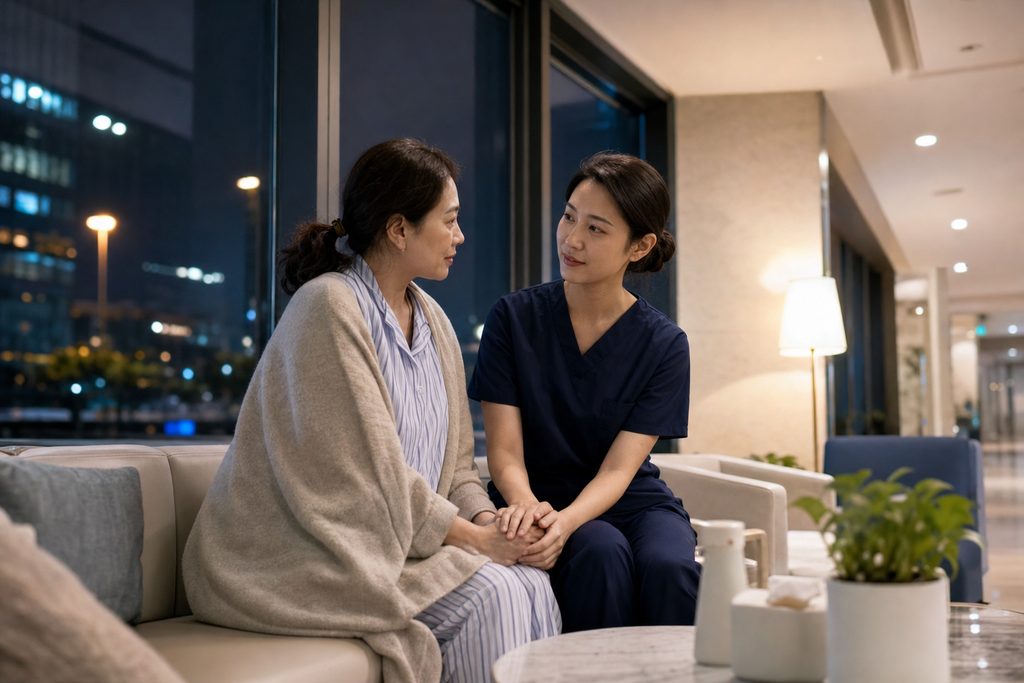
Our approach to night before surgery anxiety help China is built on a simple premise: eliminate the unknowns. The process begins the evening before your procedure. A bilingual companion arrives at your hospital room. This is not a brief check-in. This is a dedicated block of time designed to methodically dismantle every source of confusion.
We start with a schedule confirmation. We walk to the nursing station together, verify your surgery time, and clarify the pre-op fasting instructions. We translate the consent form line by line if needed. Then we address the emotional layer. We listen. We answer the questions you were too embarrassed to ask the surgeon. “Will the anesthesia make me say something embarrassing?” “What if I wake up during the procedure?” These are common, and they deserve direct, evidence-based answers. If your anxiety requires a higher level of clinical intervention, we can facilitate a video consultation with a psychologist through the hospital’s international department. We stay until you are calm, and we return before dawn to be there when you wake up. The service is not a product. It is a presence.
Frequently Asked Questions
Our companions are trained bilingual patient advocates. They are not licensed psychologists, and they will never attempt to deliver psychotherapy. But they are rigorously trained in medical terminology, hospital workflows, and de-escalation techniques. They know when to offer reassurance and when to escalate a concern to the clinical team. For patients who need formal psychological support, we coordinate directly with hospital-based mental health professionals.
Cost varies by hours required and hospital location. A dedicated bilingual companion for an overnight block typically starts from $200. If a clinical pre-surgery counseling service China cost is incurred through a hospital psychologist, that is billed separately by the hospital. We provide a clear quote before you commit. There are no hidden fees, and the coordination cost is transparent from the first consultation.
This happens. Fear makes people want to flee. Our role is not to convince you to have surgery. Our role is to slow everything down. We will sit with you, contact the surgeon if you wish, and ensure you have a full understanding of the medical consequences of postponing. You will never be pressured. You will be informed. If you decide to proceed, we stay. If you decide to wait, we help you navigate that conversation with the hospital safely.
A video call helps, but it cannot verify your patient wristband, fix a scheduling error at the nursing station, or physically walk to the pharmacy. Family calls often amplify anxiety because the family feels helpless. Our in-person support acts as a physical proxy for your family, handling the tangible tasks while your loved ones provide the emotional warmth from afar. The two work in tandem.
Your Next Step
Surgery abroad is a profound act of trust. You are placing your body in the hands of a system you may not fully understand. The hours before that trust is tested are the most psychologically vulnerable of the entire journey. You do not need to spend them alone, deciphering a foreign language through a fog of fear. A structured support system exists to carry you through the night and into the operating room with clarity. The path to a calmer surgical experience begins with a single conversation about your specific needs and timeline.
For more medical information and treatment options in China, visit chinamedservices.com (China Medical Services).
