Gastroscopy in China: Reflux and Ulcers Explained
Key Takeaways
- A gastroscopy at a top-tier Chinese public hospital typically runs $150–$400, versus $1,500–$3,500 in the United States — a gap driven by labor economics and volume, not shortcuts in care.
- China’s largest hospitals perform tens of thousands of endoscopies annually, and gastroenterology departments at Fudan-ranked hospitals are among the busiest in the world.
- The hard part is not the procedure. It is the logistics: public outpatient slots cannot be reserved from overseas, and almost nothing on site is in English.
- Before you book anything, understand that a gastroscopy is a diagnostic tool, not a treatment. What matters is who reads the images and what they recommend next.
In Canada, the median wait for a diagnostic endoscopy can stretch past 20 weeks in some provinces. At a major Shanghai gastroenterology center, the same procedure is often completed within days of arrival. Two systems, two very different clocks.
If you are searching for the gastroscopy cost in China because reflux or a suspected ulcer has been running your life, this guide is for you. We are not a hospital. We do not diagnose anyone. What we do is explain how the system actually works, what things cost, and where the friction points are — so you can decide with clear eyes.
The Problem: When Reflux and Ulcers Get Stuck in a Queue
Gastroesophageal reflux disease affects roughly 1 in 5 adults in Western countries, according to widely cited gastroenterology literature. Peptic ulcer disease, while less common than it was before routine H. pylori testing, still sends millions of people to clinics each year. Both conditions share a frustrating feature: they are manageable when diagnosed early, and miserable when diagnosis is delayed.
Delay is the norm in many public systems. A patient in the UK may wait weeks for a routine endoscopy referral. In parts of the US, the barrier is not time but money — an uninsured or high-deductible patient can face a $2,000–$4,000 bill for a procedure that takes fifteen minutes.
So people look elsewhere. And increasingly, they look at China.
Why China Delivers Results for Digestive Care
China’s top hospitals are not small operations. A single major center may see 10,000+ outpatients in a day. That scale has real consequences for how fast a gastroscopy can happen — and for how experienced the endoscopists are.
Clinical Volume Builds Skill
Endoscopy is a hands-on skill. The more procedures a gastroenterologist performs, the more subtle lesions they recognize. At Fudan-ranked hospitals, senior endoscopists routinely perform thousands of upper GI procedures a year. That is not a marketing claim — it is a function of patient volume.
For reflux and ulcer evaluation, this matters. Early gastric cancer and Barrett’s esophagus are easy to miss if the operator is inexperienced. High-volume centers catch more.
Technology at Scale
Chinese tertiary hospitals are equipped with high-definition and magnifying endoscopy systems, narrow-band imaging, and endoscopic ultrasound. These are the same platforms used in Europe and North America. The difference is throughput — equipment is used constantly, and the support staff who maintain it are specialists in their own right.
Cost Structure, Not Cost Cutting
Why is a gastroscopy so much cheaper in China? Three structural reasons. Physician salaries are lower relative to Western benchmarks. Hospital overhead is distributed across enormous patient volumes. And there is no insurance-negotiated price inflation layered on top.
| Location | Typical Gastroscopy Cost (Self-Pay) | Notes |
|---|---|---|
| United States | $1,500 – $3,500 | Varies widely; facility fees often separate |
| United Kingdom (private) | £800 – £1,800 | NHS wait can exceed 12 weeks |
| China — top public hospital | $150 – $400 | Includes sedation in most cases; biopsy extra |
| China — private international hospital | $500 – $1,200 | English-speaking staff, direct insurance billing |
These figures vary by hospital and case complexity. A simple diagnostic gastroscopy sits at the low end. If you need sedation, biopsies, H. pylori testing, or a therapeutic procedure, the number rises.
What a Gastroscopy in China Actually Involves
Here is the part most articles skip: the sequence.
Step one — records review. Before anyone books a procedure, a Chinese gastroenterologist needs your existing reports. Blood work, prior endoscopy images, medication list, symptom history. This can be done remotely through a written second opinion or a video consultation.
Step two — the appointment itself. This is where expectations need adjusting. Public hospital outpatient slots in China generally cannot be reserved from overseas in advance. Registration happens on the day, in person. For international patients, the practical route is the hospital’s international department or VIP channel, which does allow pre-arranged appointments — at roughly 1.5 to 2 times the standard fee.
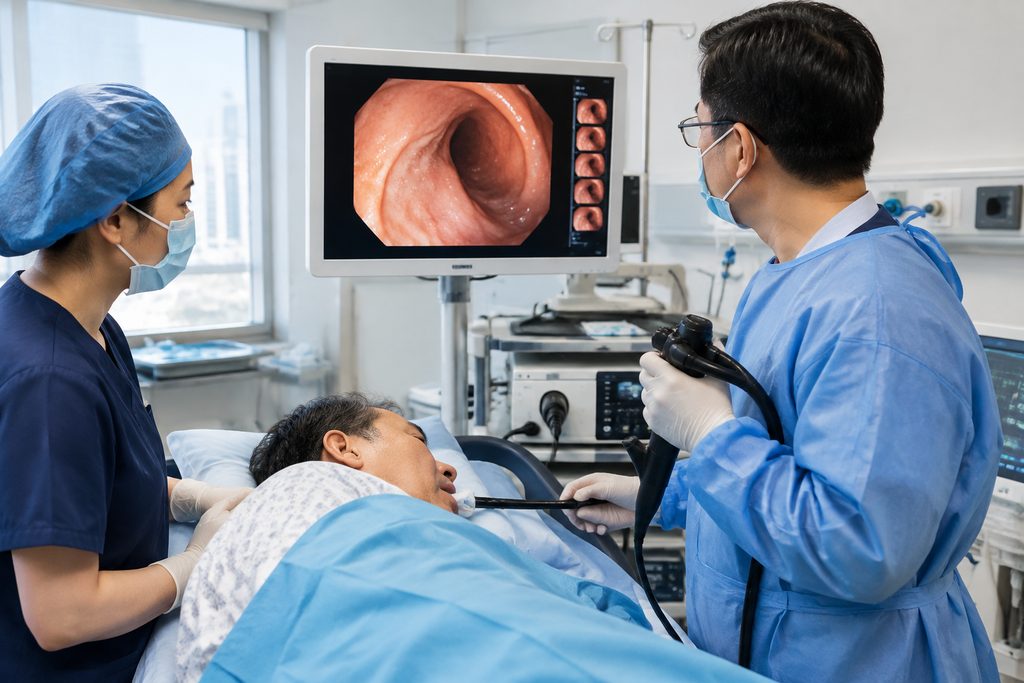
Step three — the procedure. Most diagnostic gastroscopies take 10–20 minutes. Sedation is common. Results are often available the same day or within 48 hours, depending on whether biopsies are taken.
Step four — the follow-up conversation. This is the one that determines your treatment path. If an ulcer is found, H. pylori testing and eradication therapy follow a well-established protocol. If reflux is confirmed without complications, management is usually lifestyle and medication. If something suspicious appears, biopsy results guide the next step.
How to Treat Stomach Ulcers in China — and What to Ask Before You Commit
Ulcer treatment itself is not exotic. The standard approach — proton pump inhibitors plus antibiotic therapy for H. pylori-positive cases — is the same protocol used worldwide, aligned with international gastroenterology guidelines. What differs is access speed and cost.
What you should evaluate before choosing a provider:
- Does the hospital have a dedicated gastroenterology department with published expertise, or is endoscopy handled by a general internal medicine unit?
- Will an English-speaking coordinator be present for the results consultation, or only for the procedure?
- If biopsies are taken, who reads the pathology, and how long do results take?
- What is the plan if the findings require follow-up — and can that follow-up happen remotely after you return home?
That last question matters more than most patients realize. A gastroscopy without a clear follow-up plan is an incomplete episode of care.
For patients comparing hospitals, our specialty rankings by department list the top centers for gastroenterology and related fields. If you are weighing Shanghai specifically, the Shanghai hospital guide covers the major public and international options side by side.
Practical Considerations for Medical Travel to China
Visa. For short-stay medical treatment, the applicable category is the S2 visa, with supporting documentation from the treating hospital. Family members accompanying a patient also apply under S2. Note that the M visa is for commercial and trade activities — it is not a medical visa. Requirements can change, so confirm current rules with the nearest Chinese embassy or consulate before applying.
Payment. Chinese public hospitals require prepayment for most services. International credit cards are accepted at larger hospitals and international departments, but not universally at smaller facilities. Private international hospitals often bill insurance directly.
Insurance and reimbursement. Most Western insurers do not reimburse treatment obtained in China without prior authorization. Check before you travel, not after. Some international health plans do cover overseas care with pre-approval.
Language. This is the single biggest practical barrier. Signage, registration systems, pharmacy instructions, and nursing communication are overwhelmingly in Chinese at public hospitals. Even a straightforward gastroscopy involves multiple touchpoints where misunderstanding is possible.
Records. Bring printed copies of everything. Digital files on your phone are useful, but Chinese hospitals frequently require physical documents for their own filing systems. Ask for a written report and image disc before you leave — you will need them for any follow-up at home.
Our team handles appointment coordination, bilingual accompaniment, and hospital communication for international patients. You can see how that works on our patient services page.
Frequently Asked Questions
At accredited tertiary hospitals, yes. The procedure itself carries the same low risk profile as anywhere else — minor bleeding or reaction to sedation in a small percentage of cases. The variables that matter are operator experience and equipment quality, both of which are strong at high-volume centers. Avoid unregulated clinics.
Not directly at a standard public outpatient clinic. Registration there happens on the day. Pre-arranged appointments are possible through hospital international departments or VIP channels, typically at higher cost. This is the route most international patients use.
At a top public hospital, expect $150–$400 for a diagnostic procedure. Private international hospitals run $500–$1,200. Both are substantially below US pricing. Final cost depends on sedation, biopsies, and whether additional testing is needed.
Biopsy results usually return within a few days. If further treatment is required, the gastroenterology team will outline options. For complex cases, multidisciplinary review is standard at major centers. Nothing is guaranteed — but you will leave with a clear diagnosis and a documented plan.
For short-stay medical treatment, the S2 visa is the applicable category, supported by hospital documentation. Rules vary by nationality and can change, so verify with your nearest Chinese embassy or consulate. The M visa does not apply to medical travel.
Your Next Step
A gastroscopy is a small procedure with an outsized role in your care. Getting it done quickly and getting the results read well is the whole point.
China Medical Services connects international patients with 340+ top-ranked hospitals across 37 cities. We are not a hospital and we do not provide diagnoses. We coordinate appointments, translate records, and make sure you understand what is happening at every step.
If you would like to talk through your situation — no obligation, no pressure — start with a free consultation.
This article is for general information only and does not constitute medical advice. Always consult a qualified physician regarding your individual condition.
For more medical information and treatment options in China, visit chinamedservices.com (China Medical Services).
