Cancer Screening in China: The Over-50 Checklist That Saves Lives
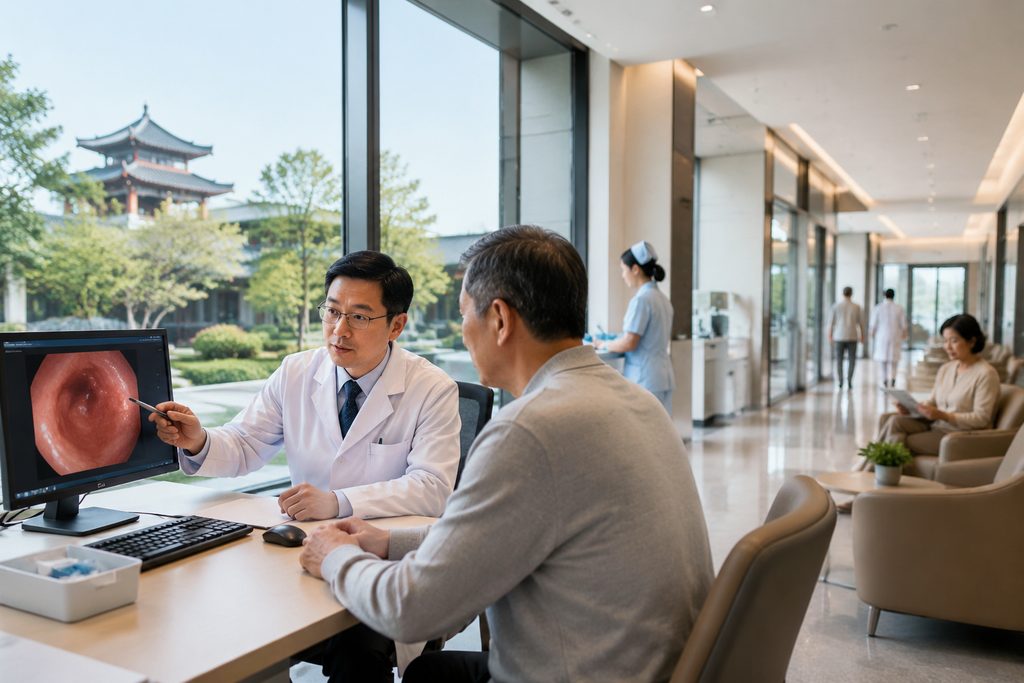
Cancer Screening in China: The Over-50 Checklist
What if the most important health decision you make this year isn’t a treatment, but a test you haven’t booked yet? For anyone over 50, cancer screening stops being optional. And a growing number of international patients are discovering that the cancer screening cost in China — often a fraction of Western prices — makes a thorough, hospital-grade workup genuinely achievable.
This guide walks you through what to screen for after 50, which tests actually matter, where to go, and what you’ll pay. No hype. Just the checklist and the numbers.
How This Actually Works, Step by Step
Here’s the real sequence, from your first email to holding your results. No mystery.
Step 1 — You send your history. Age, family history, prior screenings, current symptoms, medications. We translate everything into a Chinese medical summary.
Step 2 — A specialty team reviews. Based on your risk profile, the hospital’s preventive medicine or oncology department recommends which tests fit you. Not a generic menu — a matched set.
Step 3 — You get a written plan and quote. Itemized. You see exactly what each scan costs before committing.
Step 4 — Appointment coordination. We book through the hospital’s international department or VIP channel. Public general clinics can’t be reserved from overseas in advance — this is the workaround that actually functions.
Step 5 — You arrive, and a bilingual companion meets you. Registration, queueing, payment, wayfinding, translation. China’s top hospitals see 10,000+ outpatients a day. Without language support, it’s chaos.
Step 6 — Results and a follow-up consult. Most packages return findings within 3–7 working days. Abnormal results get routed to the right specialist.
What the Over-50 Checklist Actually Includes
Age 50 is when incidence curves bend upward for several cancers. The checklist below reflects what Chinese preventive medicine departments typically bundle for international patients in this age band.
- Low-dose CT chest — the single most valuable test for smokers and ex-smokers. Lung cancer screening guidelines worldwide converge here.
- Colonoscopy — gold standard from 45–50 onward. Detects and removes polyps in the same session.
- Gastroscopy — especially relevant given higher rates of gastric cancer in East Asia. Often paired with colonoscopy under light sedation.
- Abdominal ultrasound — liver, gallbladder, pancreas, kidneys.
- Mammography plus breast ultrasound for women; PSA for men, discussed with a physician.
- Thyroid and neck ultrasound — thyroid nodules are common and usually benign, but worth mapping.
- Cervical screening (HPV co-testing) for women.
- Blood panel — tumor markers, complete blood count, liver and kidney function, plus metabolic markers.
Not every item belongs in every package. A 52-year-old non-smoker and a 64-year-old with a father who died of colon cancer need different things. That’s why the review step matters more than the brochure.
Cancer Screening Cost in China: The Real Numbers
Prices vary by hospital tier, city, and how deep the imaging goes. Here’s a realistic range for international patients.
| Package Level | Typical Contents | Price Range (USD) |
|---|---|---|
| Basic | Blood panel, ultrasound, basic imaging | $300–$700 |
| Standard | Adds low-dose CT, gastroscopy or colonoscopy | $800–$1,500 |
| Comprehensive | Adds MRI, full endoscopy, tumor markers, cardiac workup | $1,500–$3,500 |
| Premium executive | Full-body MRI, PET-CT where indicated, same-day specialist consults | $3,500–$6,000+ |
Compare that to U.S. executive screening programs, which frequently start above $5,000 and can exceed $10,000 with imaging. For the question of how much does full body cancer screening cost in Shanghai, expect the comprehensive tier to land around $1,800–$3,500 at a top-tier public hospital’s international department, and somewhat higher at private international facilities.
One honest caveat: PET-CT is not a routine screening tool. It’s used when there’s a specific concern. Anyone selling it as a “just in case” scan for healthy adults is overselling.
A Realistic Timeline
People underestimate the lead time. Here’s what actually happens, with ranges.
| Stage | What Happens | Duration |
|---|---|---|
| Records review | Translation, specialty assessment, written plan | 3–7 days |
| Quote and confirmation | You approve the package and dates | 2–5 days |
| Appointment booking | International department scheduling | 1–3 weeks |
| Visa (S2) | Application with hospital invitation documents | 1–3 weeks |
| Travel and screening | Tests spread over 1–3 days | 2–4 days on site |
| Results | Report issuance, translation, consult | 3–10 working days |
Total realistic window from first contact to results in hand: 4–8 weeks. Rush cases exist, but don’t plan around them.
What Can Go Wrong — and What Happens Then
Honesty earns more trust than optimism. Here are the real failure modes.
An incidental finding that needs follow-up. Screening often surfaces something ambiguous — a nodule, a polyp, a slightly elevated marker. This is common and usually benign. The recourse: your report gets routed to the relevant specialist for a follow-up plan, which may mean a repeat scan in three to six months.
The appointment date slips. Top hospitals are busy. If a slot moves, we re-coordinate. This is exactly why the site’s patient consultation service exists — someone local absorbs the friction.
Visa timing doesn’t line up. S2 processing varies by consulate. Apply early. Never book flights before the visa is in hand.
Results arrive in Chinese. They will. Certified translation is part of the process, not an afterthought.
Is Cancer Screening in China Reliable? How to Judge a Provider
This is the question that stops people from booking. Fair enough.
China’s top-ranked hospitals — the ones appearing in the Fudan Hospital Rankings — operate imaging equipment and endoscopy suites comparable to major Western academic centers. Several are JCI-accredited. The variable isn’t the technology. It’s whether you land in the right department with the right coordination.
Three things to evaluate before you commit:
- Does the provider name the actual hospital and department? Vague promises about “top hospitals” mean nothing. You should know the facility before you pay.
- Is the quote itemized? A flat number with no breakdown hides padding.
- What happens after an abnormal result? Screening without a follow-up pathway is incomplete. Ask.
For a sense of which institutions rank where, browse the specialty rankings by department — oncology and gastroenterology listings are the relevant ones here.
Practical Considerations: Records, Visa, Payment, Follow-Up
Records. Bring prior imaging on disc or in the cloud, plus any pathology reports. Chinese specialists want baseline comparisons.
Visa. Medical travel to China uses the S2 visa, annotated for medical treatment purposes. Accompanying family members apply for S2 as well. Stays beyond 180 days fall under S1. Note that the M visa is strictly for commercial and trade activity — it is not a medical visa, despite what some outdated blogs claim. Requirements shift, so confirm current rules with your nearest Chinese embassy or consulate.
Payment. Public hospitals require prepayment; insurance reimbursement happens afterward. Private international hospitals often bill insurers directly. Confirm your coverage in writing before traveling.
Follow-up at home. Ask for your imaging on disc and full reports in English. Your home physician will need them.
Timing within China. Allow a buffer. Some tests require fasting, sedation, or a preparation day. Don’t schedule screening the morning after a long-haul flight.
Frequently Asked Questions
A comprehensive package at a top Chinese hospital typically runs $1,500–$3,500. Equivalent U.S. executive programs often exceed $5,000 and can pass $10,000 with advanced imaging. The gap widens further once you factor in hospital tier and city.
Several top-ranked facilities in Beijing offer strong preventive screening through their international departments, including well-known comprehensive hospitals and specialized cancer centers. The right choice depends on your risk profile and which tests you need — a lung-focused workup and a gastrointestinal workup may point to different departments.
The leading hospitals use modern imaging and endoscopy equipment, and many hold JCI accreditation. Reliability depends heavily on landing in the correct department with proper coordination and translated results. The technology is not the weak link; navigation is.
Yes. Medical travel uses the S2 visa, annotated for treatment purposes, with supporting documents from the hospital. Family members accompanying you apply under the same category. Processing generally takes one to three weeks.
Public hospital general clinics cannot be reserved from overseas in advance. Booking runs through the hospital’s international or VIP department, which is precisely the channel coordination services use. Expect one to three weeks of lead time.
Your Next Step
Screening after 50 isn’t about fear — it’s about catching things while they’re still small. The checklist is knowable, the costs are transparent, and the logistics are solvable with the right local support.
China Medical Services connects international patients with 340+ top-ranked hospitals across 37 cities, from Beijing to Shanghai and beyond. We are not doctors and we do not provide medical advice or treatment. What we do is handle the coordination — records, appointments, bilingual accompaniment, and clear pricing — so your energy goes toward your health, not the paperwork.
When you’re ready, start with a free consultation. No pressure, no obligation — just a conversation about what makes sense for you.
For more medical information and treatment options in China, visit chinamedservices.com (China Medical Services).
