Lung Screening for Smokers in China: Costs, CT Scans, and How Foreigners Book
Can I Get a Lung Screening for Smokers in China? Yes — Here’s the Real Cost and Process
Have you been smoking for 15, 20, or 30 years and started wondering whether it’s time to check what’s happening inside your chest? If you’ve searched for “can I get a lung screening for smokers,” you’re probably weighing two things: whether the scan is worth doing, and whether you can actually arrange it without jumping through impossible hoops. The short answer is yes — China offers low-dose CT lung screening at a fraction of Western prices, and foreigners can access it. The lung cancer screening cost China typically runs between $150 and $400 for a comprehensive package at a top-tier hospital, compared with $500 to $1,200 for an equivalent scan in the United States. But the process has specific steps, and skipping any of them leads to wasted days and frustration.
We coordinate medical care for international patients across China Medical Services‘ network of 340+ top-ranked hospitals in 37 cities. This article walks through exactly what a smoker’s lung screening involves, what it costs, where to get it, and the practical details most guides leave out.
How This Actually Works, Step by Step
You don’t just walk into a Chinese hospital and ask for a lung scan. The system runs on registration, prepayment, and specific departments. Here’s the real sequence.
Step one: you decide between a written second opinion, a video consultation, or going straight to a screening package. Most smokers simply want the scan itself — a low-dose CT of the chest. That means you’re booking an imaging appointment, not a specialist consultation, though many packages bundle both.
Step two: you send us your basic information — age, smoking history, any symptoms, and preferred city. We match you with a hospital that has lung screening availability for international patients. Not every public hospital accepts walk-in foreigners for routine imaging. The ones that do typically route you through their international medical department or VIP clinic.
Step three: we confirm the appointment date and the exact package contents. A standard smoker’s lung screening package includes a low-dose spiral CT, a radiologist’s written report, and often a brief consultation with a pulmonologist to review findings. Some hospitals add tumor marker blood tests. You’ll know the full list before you pay.
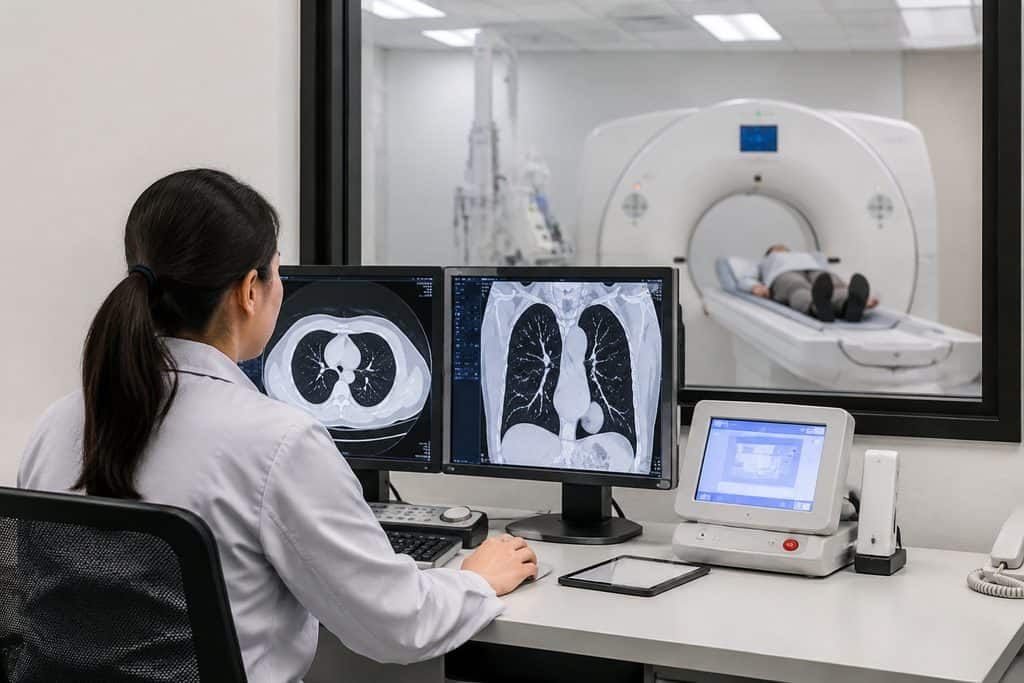
Step four: you arrive, we handle registration, payment, and escort you to the imaging department. The scan itself takes under five minutes. You lie on a table, hold your breath once or twice, and it’s done. Results typically come back within 24 to 48 hours, sometimes same-day at private international hospitals.
Step five: you review the report with the doctor. If something needs follow-up — a nodule, a suspicious shadow — the hospital will recommend either a repeat scan in 3 to 6 months or further diagnostic workup like a PET-CT or biopsy. That’s where the real decisions begin.
Low-Dose CT for Smokers: What the Scan Actually Detects
The reason a low dose ct scan for smokers Shanghai or Beijing is the standard tool comes down to one number: 20%. The National Lung Screening Trial in the United States found that annual low-dose CT screening reduced lung cancer mortality by 20% compared with chest X-rays in high-risk smokers. That’s not a marginal improvement. That’s one in five deaths prevented among people who got screened.
Low-dose CT uses roughly one-fifth the radiation of a standard diagnostic chest CT. For a long-term smoker, the trade-off is straightforward: the radiation risk is negligible compared with the risk of undetected lung cancer. The scan picks up nodules as small as 2 to 3 millimeters. Most nodules are benign — scar tissue, granulomas, old infections. But finding them early gives you options.
Who should actually get screened? The standard criteria come from the US Preventive Services Task Force: adults aged 50 to 80 with a 20 pack-year smoking history who currently smoke or quit within the past 15 years. A pack-year means one pack per day for one year. So two packs a day for 10 years equals 20 pack-years. Chinese hospitals generally apply similar criteria, though some screening packages accept younger patients with heavy smoking histories or family history of lung cancer.
Is lung screening for smokers available in China at the same clinical standard as Western countries? The short answer: at top-tier hospitals, yes. Machines matter. Look for hospitals using 64-slice or higher CT scanners, ideally with low-dose protocols and AI-assisted nodule detection. Several major Chinese hospital groups now run AI software on chest CTs that flags subtle nodules human radiologists might miss. That’s a genuine advantage over older Western scanners still in service at some community hospitals.
Lung Cancer Screening Cost China: What You’ll Actually Pay
Let’s talk numbers. The lung cancer screening cost China varies by city, hospital tier, and package contents. Here’s a realistic breakdown based on current pricing across our network.
| Package Type | What’s Included | Typical Cost (USD) |
|---|---|---|
| Basic low-dose CT | LDCT chest scan, radiologist report | $150 – $250 |
| Standard smoker screening | LDCT, pulmonologist consultation, tumor markers | $250 – $400 |
| Comprehensive package | LDCT, specialist consult, blood work, follow-up plan | $400 – $600 |
| US comparison (same scan) | LDCT chest, radiologist report | $500 – $1,200 |
Prices vary by hospital and case complexity. Private international hospitals in Shanghai and Beijing charge more than public hospital international departments. The $150 baseline assumes a public top-tier hospital’s VIP clinic. Add $50 to $100 for same-day results or English-language report translation.
Can foreigners get lung cancer screening in Beijing at public hospital prices? Yes, through international departments. But you can’t just show up. You need prior registration, and the international department typically charges a service premium over the standard Chinese patient rate. That premium buys you English-speaking staff, shorter queues, and report translation. Worth it for most international patients.
A Realistic Timeline
People underestimate how long the whole process takes. Here’s the honest version.
| Stage | What Happens | Duration |
|---|---|---|
| Day 1–3 | You contact us, share smoking history, choose city and hospital | 1–3 days |
| Day 3–7 | We confirm appointment slot and package details with hospital | 2–4 days |
| Week 2–4 | Visa processing (S2 visa for medical treatment) and travel booking | 1–3 weeks |
| Arrival day | Hospital visit, registration, scan, consultation | 1 day (often half-day) |
| Day 1–2 after scan | Radiologist report ready, reviewed with doctor | 24–48 hours |
| Week 2–4 after scan | If follow-up needed, schedule repeat scan or further workup | 2–4 weeks |
The forgotten waiting step is document translation. If you bring prior chest X-rays or CT scans from home, they need to be translated into Chinese for the radiologist to compare. That adds 1 to 2 days. And if you need a visa, the S2 visa — the correct category for medical treatment and private affairs — typically takes 1 to 3 weeks depending on your home country’s Chinese embassy or consulate. We provide the hospital invitation letter and supporting documents to include with your application.
What Can Go Wrong — and What Happens Then
Let’s be honest about failure modes. This is where most guides go soft, and we won’t.
First: the scan might be clear, but you still have symptoms. A low-dose CT is excellent for nodules and masses, but it won’t explain a chronic cough from acid reflux or postnasal drip. If your scan comes back clean and the cough persists, the pulmonologist will likely recommend a different workup — spirometry for COPD, a bronchoscopy, or an ENT evaluation. That’s not a failed screening. That’s a screening doing its job by ruling out the worst case.
Second: the scan finds a nodule. This happens in roughly 20 to 30 percent of heavy smokers. Most nodules are benign. But the report will classify the nodule by size, shape, and density. If it’s under 6 millimeters, the standard advice is a repeat scan in 6 to 12 months. If it’s larger or has concerning features, the hospital may recommend a PET-CT or biopsy. That’s a bigger decision, and you’ll want a specialist consultation before proceeding. We can arrange that, but we won’t push you toward it.
Third: you arrive and the hospital says your appointment was never confirmed. This happens more often than anyone likes to admit, especially at high-volume public hospitals. That’s why we always confirm twice — once when booking, once 48 hours before your visit. If the hospital still drops the ball, we reschedule same-day at a partner hospital where possible. If we can’t secure the appointment you booked, our coordination fee is fully refunded.
Fourth: the radiologist’s report comes back in Chinese. At public hospital international departments, English reports are standard. At some smaller hospitals, they’re not. We handle translation as part of our coordination service. Never accept a report you can’t read and verify.
Choosing Where to Get Screened: Public vs Private, Shanghai vs Beijing
The chest ct scan price China medical tourism market splits into two tiers. Public hospital international departments offer the best combination of clinical expertise and price. Private international hospitals offer speed, comfort, and direct insurance billing — at a premium.
Shanghai and Beijing dominate. Shanghai’s advantage is concentration: multiple top-tier hospitals with lung screening programs within a few kilometers of each other, plus a large English-speaking expat infrastructure. The low dose ct scan for smokers Shanghai option typically means Fudan-affiliated hospitals or Jiahui, a JCI-accredited private hospital with Western-trained radiologists.
Beijing’s advantage is sheer clinical depth. Peking Union Medical College Hospital and China-Japan Friendship Hospital run high-volume chest imaging departments. If your scan finds something concerning, Beijing offers more options for same-trip follow-up with top pulmonologists and thoracic surgeons. The trade-off: Beijing public hospitals are busier, and appointment lead times run longer.
What about other cities? Guangzhou, Chengdu, and Hangzhou all have excellent options at lower cost than Shanghai or Beijing. If you’re combining screening with travel, a city like Hangzhou gives you a top-tier hospital plus a more relaxed recovery environment. Our department rankings show which hospitals lead in respiratory medicine and thoracic imaging across all 37 cities in our network.
One common mistake: booking a “full body checkup” package and assuming it includes lung screening. Standard Chinese health checkup packages vary wildly. Some include chest X-rays but not low-dose CT. A chest X-ray misses small nodules that a CT catches. Always confirm the exact imaging modality before paying. If the package says “chest X-ray” or “DR chest,” that’s not the screening you want.
Practical Considerations: Visa, Records, Payment, and Follow-Up
Here’s what actually matters when you’re planning this.
Visa: You need an S2 visa for short-term medical treatment in China. Not an M visa — that’s for commercial and trade activities, and using it for medical travel creates problems at the border. The S2 visa allows stays up to 180 days, which is more than enough for a screening trip. Your accompanying family member applies for the same S2 category. We provide the hospital’s invitation letter and treatment confirmation to support your application. Approval is never guaranteed — that’s the embassy’s decision — but complete documentation significantly smooths the process.
Medical records: Bring any prior chest imaging on CD or USB, not just printed reports. Radiologists need the actual DICOM files to compare changes over time. Bring a list of medications, your smoking history in pack-years, and any family history of lung cancer. Write it down before you travel. Memory fails under stress.
Payment: Public hospitals require prepayment at registration. Bring a credit card that works internationally, or cash. Private international hospitals often bill insurance directly — check with your insurer before booking. Most international health insurance plans cover screening CT scans, but some exclude “routine screening” and only cover diagnostic scans for symptoms. Read your policy’s fine print.
Language: At top-tier international departments, English is spoken. At standard public hospital counters, it isn’t. That’s the single biggest friction point for foreign patients. Our bilingual medical companions handle registration, payment, queue management, and translation — from $300 per day. It’s the difference between a 45-minute visit and a four-hour ordeal.
Follow-up at home: Take your CT images and the English report back to your home physician. Chinese hospitals will give you a CD or USB with the full DICOM dataset. Your doctor at home can open it with free DICOM viewing software. If the report recommends a repeat scan in 6 months, set that reminder now. Lung nodules don’t care about borders.
Frequently Asked Questions
Yes. You don’t need a referral from a Western doctor to book a lung screening package at most Chinese hospital international departments. You book the package directly. However, if the scan finds something concerning, the hospital will refer you internally to a pulmonologist or thoracic surgeon for further evaluation. That referral happens within the same hospital system, usually within days.
Expect to pay $150 to $400 for a low-dose CT chest scan at a top-tier Chinese hospital, depending on whether it’s a public hospital international department or a private international hospital. The same scan in the US typically costs $500 to $1,200 without insurance. Chinese prices include the radiologist’s report; some packages also include a pulmonologist consultation and tumor marker blood tests.
You can pre-arrange the appointment through a coordination service like ours, but standard public hospital walk-in registration is not available to overseas patients before arrival. The practical route is: we contact the hospital’s international department, confirm a slot, and you arrive on that date. We can also assist with a proxy visit — registering on your behalf and confirming the appointment using your documents — but the scan itself requires your physical presence.
No. Most nodules found on low-dose CT in smokers are benign — old infections, scar tissue, or inflammatory changes. The report will classify the nodule by size and appearance. Small nodules under 6 millimeters usually just need a repeat scan in 6 to 12 months. Larger or irregular nodules may need a PET-CT or biopsy. The hospital will give you a specific follow-up plan; don’t panic before you have the radiologist’s full assessment.
You need an S2 visa, which covers short-term medical treatment and private affairs. The M visa is for commercial and trade activities and is not appropriate for medical travel. Your family member traveling with you also applies for an S2 visa. Processing takes 1 to 3 weeks depending on your home country. We provide the hospital invitation letter and supporting documents for your application, but final approval rests with the Chinese embassy or consulate.
Your Next Step
A lung screening for smokers is one of the highest-value medical tests you can get — it catches the deadliest cancer early, when treatment actually works. China offers the same low-dose CT technology as Western hospitals at a third to half the price, with top-tier radiologists and fast turnaround. The catch is logistics: registration, language, visa, and follow-up coordination.
That’s what we do. China Medical Services connects international patients with 340+ top-ranked hospitals across 37 Chinese cities. We’re not doctors — we’re the coordination layer between you and the medical expertise. We handle appointment booking, bilingual accompaniment, visa documentation, and report translation. We don’t promise outcomes; we promise a smoother process.
If you’re ready to find out what’s going on in your lungs, start with a free consultation. Tell us your smoking history and preferred city, and we’ll map out the exact
For more medical information and treatment options in China, visit chinamedservices.com (China Medical Services).
