Does PRP Hair Treatment Work? The Real Data Behind Platelet-Rich Plasma for Hair Loss
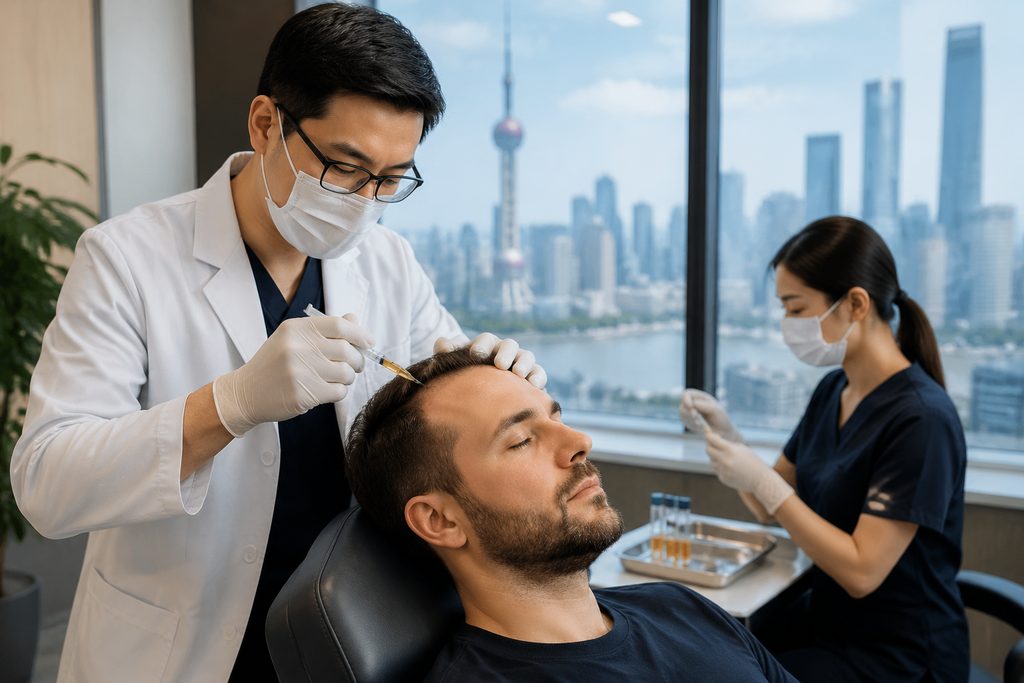
Does PRP Hair Treatment Work? The Short Answer
Yes — for the right patient. A 2019 meta-analysis in the Journal of Cosmetic Dermatology pooled data from 11 randomized controlled trials and found that PRP increased hair density by an average of 38 hairs per square centimeter compared to baseline. That is a modest, measurable improvement. Not a cure. Not a hair transplant replacement. But real, reproducible thickening in patients with androgenetic alopecia — the most common form of pattern hair loss affecting approximately 80 million men and 30 million women in the United States alone.
The caveat? Results vary enormously. Platelet concentration, injection technique, number of sessions, and the patient’s own biology all shift outcomes. Some patients see dramatic regrowth in 3 months. Others see almost nothing after 6 sessions. Understanding why — and whether the prp hair treatment cost China clinics quote reflects genuine value — is what separates a smart decision from an expensive experiment.
Who PRP Hair Treatment Is Right For — and Who It Isn’t
PRP works by concentrating platelets from your own blood to roughly 5–10 times baseline levels. Those platelets release growth factors — PDGF, VEGF, EGF, TGF-β — that signal dormant hair follicles to re-enter the growth phase. The key word is dormant. If the follicle is dead, no growth factor will resurrect it.
Good candidates typically include:
- Men and women with early-stage androgenetic alopecia (Norwood II–IV, Ludwig I–II)
- Patients with thinning hair but follicles still visible under dermoscopy
- People who cannot tolerate finasteride or minoxidil side effects
- Patients looking to slow shedding before or after a hair transplant
- Women with telogen effluvium triggered by stress, illness, or postpartum changes
Poor candidates — and this matters — include:
- Patients with completely bald scalp areas (no visible follicles, shiny skin)
- Active scalp infections, psoriasis, or seborrheic dermatitis flares
- Blood disorders, platelet dysfunction, or anticoagulant use that cannot be paused
- Active cancer or history of scalp radiation
- Unrealistic expectations: PRP will not restore a juvenile hairline
Being honest about who should not pursue PRP is what makes the rest of this guide credible. If your follicles are gone, no clinic in Shanghai or anywhere else can change that.
Is PRP Hair Treatment Effective? What the Evidence Actually Shows
The short version: yes, with conditions. A 2020 systematic review in Aesthetic Plastic Surgery evaluated 23 studies and concluded PRP is “significantly effective” for increasing hair density and shaft diameter in androgenetic alopecia. But “effective” means roughly 20–40% improvement in density — not a full head of hair.
Here is what the data says, specifically:
- Most studies show measurable improvement after 3–4 sessions spaced 3–4 weeks apart
- Maintenance sessions every 3–6 months are typically required to sustain results
- Combination therapy (PRP + minoxidil or PRP + microneedling) outperforms PRP alone in multiple head-to-head trials
- Response rates vary: roughly 60–70% of patients show visible improvement; 30–40% see minimal change
That last number deserves attention. If you are in the non-responder group, no amount of additional sessions will help. The biology simply is not there. This is why a proper pre-treatment consultation — including dermoscopy and a realistic assessment — matters more than the clinic’s marketing photos.
The Options, Compared: PRP vs. Alternatives for Hair Loss
PRP sits in a crowded field. Here is how it stacks up against the genuine alternatives for someone considering treatment — including what the prp hair treatment cost China landscape looks like relative to other interventions.
| Treatment | Mechanism | Approx. Cost (USD) | Effectiveness | Downtime | Maintenance |
|---|---|---|---|---|---|
| PRP injections | Growth factors from own platelets | $150–$500 per session (China: $80–$250) | Moderate, 60–70% response | None | Every 3–6 months |
| Minoxidil (topical) | Vasodilator, prolongs anagen | $10–$30/month | Moderate, lifelong use | None | Daily, permanent |
| Finasteride (oral) | 5α-reductase inhibitor | $15–$60/month | High for vertex/crown | None | Daily, permanent |
| Hair transplant (FUE) | Surgical follicle relocation | $3,000–$15,000 (China: $1,500–$6,000) | High, permanent for transplanted follicles | 5–10 days | None for transplanted area |
| Low-level laser therapy | Photobiomodulation | $500–$2,500 device | Low-to-moderate | None | 3×/week ongoing |
PRP occupies a specific niche: it is non-surgical, relatively affordable, and works synergistically with other treatments. For someone not ready for a transplant — or wanting to optimize the donor area before one — PRP makes sense. For someone with advanced baldness, a transplant is the only intervention that will produce meaningful coverage.
What “Prp Hair Treatment Cost China” Actually Buys You
Let us talk numbers. In the United States, a single PRP session typically runs $500–$1,000. In Western Europe, €300–€600. In China, the same procedure at a reputable hospital dermatology department or private international clinic ranges from $80 to $250 per session. That is a 60–80% cost reduction for the same biological product — your own blood, processed in a centrifuge.
But the price tag alone is not the point. What matters is the protocol. A proper PRP protocol looks like this:
- Blood draw (typically 10–20 mL)
- Double-spin centrifugation to isolate platelet-rich fraction
- Optional activation with calcium chloride
- Injections across the affected scalp — often 30–50 small injections per session
- Cooling or topical anesthetic beforehand
Some clinics in any country will cut corners: single-spin processing, no activation, fewer injection points, or diluted platelet concentrations. That is why the best prp hair clinic Shanghai searches so often lead to disappointment — patients chase the lowest price and get a diluted protocol. The question is not just “how much is prp for hair loss in China” but “what protocol does that price include.”
At China Medical Services, we have seen this pattern repeatedly. Patients arrive having already paid for PRP elsewhere with no results, and the records show a single-spin, low-platelet-yield protocol. The cost was low. The value was zero.
How Much Is PRP for Hair Loss in China? A Realistic Breakdown
Here is what a typical treatment course looks like at Chinese public hospital international departments and JCI-accredited private clinics:
| Item | Public Hospital (International Dept.) | Private International Clinic |
|---|---|---|
| Initial consultation + dermoscopy | $30–$80 | $50–$150 |
| Single PRP session | $80–$150 | $150–$250 |
| Full course (4 sessions) | $320–$600 | $600–$1,000 |
| Maintenance session (every 3–6 months) | $80–$150 | $150–$250 |
The variance comes from three things: platelet concentration technology (single-spin vs. double-spin systems), the clinician’s experience, and whether the clinic uses ultrasound guidance or manual injection. None of these guarantees results, but they shift the probability.
For patients considering book prp hair treatment Beijing searches, note that Beijing’s top dermatology departments — including those at Peking Union Medical College Hospital and the Air Force Medical Center — offer PRP through their international patient channels. The pricing is comparable to Shanghai. The difference is availability: Beijing’s public hospital international departments often have shorter wait times for dermatology than for surgical specialties.
Practical Considerations: What to Know Before You Fly
If you are traveling to China specifically for PRP hair treatment, the logistics are straightforward but not trivial.
Documentation. Bring any previous dermatology records, especially a confirmed diagnosis. If you have had prior PRP or microneedling, bring those records too. A good clinic will want to know what has already failed.
Visa. For medical treatment in China, the applicable short-stay visa category is the S2 visa, issued for private affairs including medical treatment. You will need supporting documents from the hospital — typically an invitation letter or treatment confirmation. Our team helps coordinate this documentation with the hospital’s international department. We cannot guarantee approval; that decision rests with the consulate.
Payment. Chinese public hospitals require prepayment or payment at the time of service. International departments accept credit cards and sometimes international insurance. Private international clinics in China — like United Family or Jiahui — often bill international insurers directly. PRP for cosmetic hair loss is rarely covered by insurance anywhere in the world, so expect to pay out of pocket.
Language. Top-tier Chinese hospitals see thousands of patients daily. Without Mandarin, navigating registration, payment, and the injection suite is genuinely difficult. This is where a bilingual medical companion changes the experience — not as a luxury, but as a practical necessity for many first-time visitors.
Follow-up. PRP requires ongoing sessions. If you are flying from Europe or North America, plan for the initial course (3–4 sessions over 3–4 months) or accept that you will need to return — or find a local provider for maintenance after the initial course in China.
Prp Hair Therapy Reviews Abroad: What Patients Actually Report
Reading prp hair therapy reviews abroad before committing is smart. But reviews are noisy. Here is what the aggregate patterns show — and what to discount.
Consistent themes in positive reviews: reduced shedding within 4–8 weeks, visible thickening around the 3-month mark, better texture and manageability, and satisfaction when expectations were set correctly upfront. Negative reviews cluster around two poles: patients with advanced baldness who expected regrowth, and patients who received low-quality protocols (single-spin, diluted PRP, too few sessions).
One thing to watch for in any review — Chinese or Western — is photographic evidence. Reputable clinics show standardized photos under consistent lighting. If a review claims dramatic regrowth but shows different angles, different lighting, or different hair lengths, discount it. And be wary of any clinic that promises a specific percentage improvement. No honest clinician will do that.
Frequently Asked Questions
Most patients need 3–4 sessions spaced 3–4 weeks apart before visible improvement. Some notice reduced shedding after the second session. If there is no change after 4 sessions, you are likely a non-responder and further sessions are unlikely to help.
The injections sting. Most clinics apply topical anesthetic cream 30–45 minutes before the procedure, which reduces discomfort significantly. Some patients describe the sensation as mild burning or pinching. The scalp may feel tender for 24–48 hours afterward.
This is a real possibility — roughly 30–40% of patients see minimal change. If you are in that group, the money is spent and the follicles did not respond. The responsible approach is to have a clear stopping rule before you start: agree with your clinician on what “no response” looks like and when to discontinue.
Yes, and this is one of the strongest uses of PRP. Injecting PRP into the recipient area after FUE can improve graft survival and accelerate healing. Some surgeons also inject PRP into the donor area. The combination is well-supported in the literature.
Sometimes. A session under $50 likely means single-spin processing, no activation, or minimal injection coverage. Reputable Chinese hospital dermatology departments and JCI clinics charge $80–$250 per session. Below that, scrutinize the protocol carefully.
Your Next Step
PRP works — for the right patient, with the right protocol, and with realistic expectations. It is not a miracle. It is a biological tool that shifts the odds in your favor if your follicles are still alive and your clinician is competent.
We are China Medical Services — a patient coordination team, not a hospital and not a medical practice. We help international patients identify reputable Chinese dermatology departments, understand what a given price actually includes, and coordinate the logistics of treatment in China. We do not diagnose, and we do not promise results. What we do is help you make an informed decision without navigating a foreign healthcare system alone. If you want to explore whether PRP in China makes sense for your specific situation, request a free consultation and our team will walk you through the options.
For more medical information and treatment options in China, visit chinamedservices.com (China Medical Services).
