Vascular Age Test in China: How to Book It in 2026
When 47-year-old Daniel from Rotterdam got his bloodwork back, every number sat inside the normal range. His LDL was fine. His blood pressure was fine. His father had still dropped dead of a heart attack at 54, and Daniel wanted to know what the standard panel was not telling him. A cardiologist in the Netherlands mentioned arterial stiffness testing — a way of measuring whether his arteries were biologically older than his birth certificate. The wait for a non-urgent vascular assessment in his city ran past five months. So he started searching for a vascular age test in China, and that search is what brought most readers to this page.
Vascular Age Test in China: The Short Answer
A vascular age test in China can be arranged within one to three weeks in most cases, and the vascular age test cost China providers quote typically lands between $150 and $600 depending on the hospital tier and how many measurements are bundled together. That range covers the core assessment — arterial stiffness, pulse wave velocity, and a carotid ultrasound — at a top-tier public hospital. Add a full cardiac workup with CT angiography and you are looking at $800 to $2,500.
The complication is booking. China’s best public hospitals do not sell appointments to overseas patients through a website checkout. Most outpatient registration happens on the day, in person, in Chinese. Getting a slot ahead of time usually means going through a hospital’s international department, and that is the part where most foreign patients need help.
The core takeaway: the test itself is fast, cheap by Western standards, and widely available at China’s top cardiovascular centers. The bottleneck is access and language, not medicine.
Who This Is Right For — and Who It Isn’t
Vascular age testing is a screening and risk-stratification tool. It estimates how stiff your arteries are and how that compares to a healthy person your age. Stiffer arteries correlate with higher cardiovascular risk, and the measurement can shift a treatment decision when standard risk scores sit in a gray zone.
Generally a reasonable fit if you:
- Have a family history of early heart attack or stroke
- Have borderline cholesterol or blood pressure that your doctor is unsure how to treat
- Have type 2 diabetes and want a fuller picture of vascular damage
- Are already in China for work, study, or another medical appointment
- Want a baseline number you can track over the next decade
Probably not worth the trip if you:
- Have known, symptomatic coronary artery disease — you need a cardiology workup, not a screening test
- Are pregnant, since some imaging components are avoided
- Have an active infection or uncontrolled arrhythmia on the day of testing
- Are looking for a single test to replace a proper cardiovascular evaluation. It does not.
And if you are symptom-free with normal risk factors, spending several thousand dollars on flights to get a $200 test is poor economics. Get it locally or wait until you have another reason to be in Asia.
The Options, Compared
There is more than one route to the same measurement, and they differ sharply in price and convenience.
| Route | Typical Cost (USD) | Booking Lead Time | English Support | Best For |
|---|---|---|---|---|
| Public tertiary hospital, standard outpatient | $150–$400 | Same-day queue, or 1–2 weeks via coordinator | Limited; interpreter needed | Cost-conscious patients already in China |
| Public hospital international / VIP department | $400–$900 | 3–10 days | Yes, dedicated staff | Patients who want a fixed appointment |
| Private international hospital (Shanghai, Beijing) | $600–$1,500 | 2–7 days | Yes, full English service | Insurance holders, families, short trips |
| Bundled medical tourism package | $1,200–$4,000+ | 2–4 weeks | Yes, end-to-end | Patients combining testing with a broader checkup |
Which column fits you depends on two things: how much you value a guaranteed appointment time, and whether you can navigate a Chinese hospital without an interpreter. The private route costs roughly double the standard public route, and the difference buys scheduling certainty and language, not better equipment.
How Is a Vascular Age Test Done, Exactly?
This is the part most articles skip, and it matters because the test is painless and quick — which surprises people who expect a stress test or a catheter.
The core measurement uses pulse wave velocity. Two or four pressure cuffs are placed on your arms and ankles, and a device records how fast the pressure wave travels between them. Faster means stiffer arteries. The whole thing takes ten to fifteen minutes, and you lie still while it runs. You may feel the cuffs tighten. That is it.
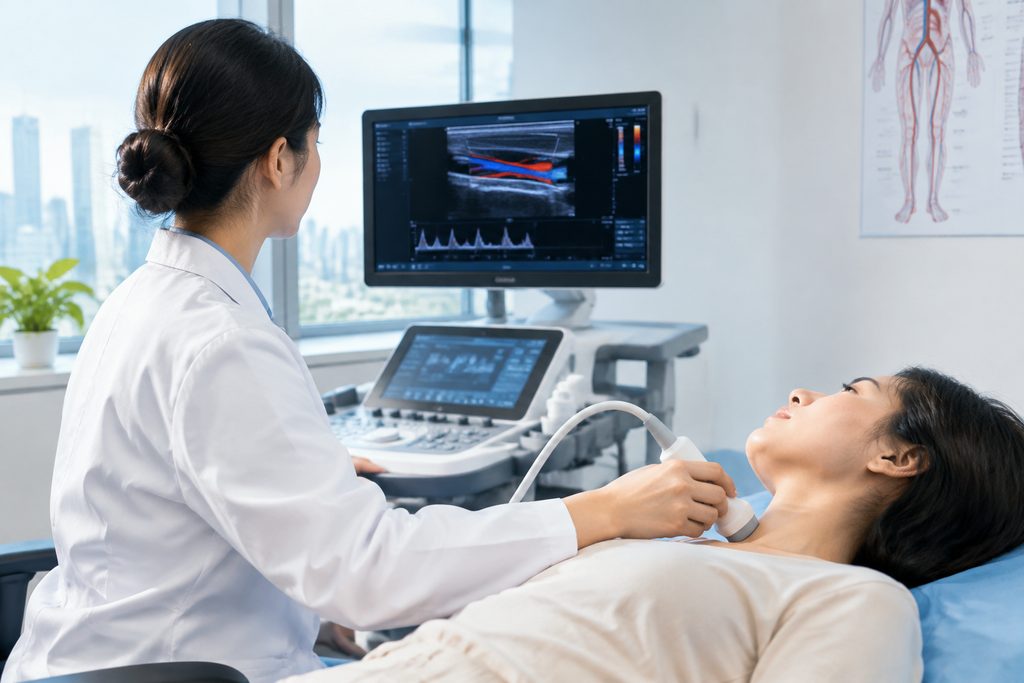
Most Chinese centers pair this with a carotid artery ultrasound, which uses the same sound-wave technology as a pregnancy scan. A technician moves a probe along your neck to measure the thickness of the artery wall and check for plaque. Twenty minutes, no needles, no contrast dye.
Some hospitals add ankle-brachial index testing, and a few offer advanced endothelial function assessment. If your physician wants a full picture, a coronary CT angiogram may be added — that one does involve an IV contrast line and a brief period inside a scanner.
Ask for the raw numbers, not just the conclusion. Pulse wave velocity in meters per second, carotid intima-media thickness in millimeters, and the calculated vascular age. Those figures let a cardiologist at home interpret the result independently.
What It Costs, and What Drives the Variance
Vascular age test cost China figures vary for four reasons: hospital tier, city, whether an interpreter is included, and how many tests are bundled.
At the low end, a standalone arterial stiffness measurement at a public hospital in a second-tier city might run $150 to $250. At a top cardiovascular center in Beijing or Shanghai, the same test bundled with carotid ultrasound and a specialist consultation lands around $400 to $700. Private international hospitals in Shanghai typically quote $600 to $1,500 because the fee includes English-speaking staff, shorter waits, and often direct insurance billing.
What is usually not included: flights, hotel, airport transfers, and follow-up appointments. A bilingual medical companion, if you want someone beside you for registration, payment, and translation, runs from $300 per day. Airport transfers are around $200 round-trip. Written second opinions from a top-hospital specialist, if you want your results reviewed formally afterward, run $300 to $500.
One useful detail: any consultation fee paid through a coordination service is typically credited in full toward on-the-ground coordination if you decide to travel within 90 days. That credit applies to the coordination fee only, never to hospital charges.
Practical Considerations: Records, Visas, and Payment
Bring your existing medical records in English or Chinese — recent bloodwork, any prior imaging, and a medication list. Chinese specialists work efficiently and will move faster if they are not starting from zero. If your records are in Dutch, German, or Arabic, get them translated before you travel.
On visas: the applicable category for short medical visits is the S2, which covers medical treatment and private affairs. Stays beyond 180 days fall under S1. Accompanying family members apply under S2 as well. The M visa is a commercial and trade category and has nothing to do with medical treatment — anyone telling you otherwise is misinformed. Requirements shift, so confirm current rules with the Chinese embassy or consulate in your country and bring the hospital’s supporting documents.
Payment at public hospitals is upfront. You pay, then claim reimbursement from your insurer afterward, and reimbursement depends entirely on your policy. Private international hospitals in Shanghai and Beijing often bill insurers directly, which is a real advantage if your plan covers overseas care. Check before you book, not after.
For hospital selection, the Fudan ranking is the reference Chinese physicians themselves use. It covers 45 specialties with top-10 lists, and the general hospital list is tiered from A++++ down to A rather than numerically ranked. Cardiovascular specialty rankings are a sensible starting point — you can browse specialty rankings by department to see which centers lead in cardiac care, and cross-reference with top-ranked hospitals grouped by city if you are deciding between Beijing and Shanghai.
Frequently Asked Questions
The standard components — pulse wave velocity and carotid ultrasound — are non-invasive and carry no meaningful risk. They use pressure cuffs and sound waves, not radiation or contrast dye. If a coronary CT angiogram is added, that involves contrast and a small radiation dose, and it should be discussed with a physician first. Hospital standards at China’s top-tier centers are comparable to Western academic hospitals.
Not easily through the standard public route. Registration, payment, and the test itself are conducted in Chinese, and same-day queues at large hospitals can be long. Booking a vascular age test in Shanghai or a vascular age test Beijing hospital booking through an international department, a private hospital, or a coordination service solves the language problem but costs more. Expect roughly double the standard public fee.
Packages vary widely. A typical one bundles the test itself, a specialist consultation, interpretation of results, and sometimes airport transfer and a night or two of accommodation. Some add a broader executive health screening. Prices range from roughly $1,200 to over $4,000. Read the inclusions carefully — many packages exclude flights, and a few exclude the physician consultation that makes the results meaningful.
Usually yes, if you bring the raw measurements and the imaging report. Chinese hospital reports are issued in Chinese, so request an English translation. Most cardiologists will accept pulse wave velocity and intima-media thickness values regardless of where they were produced, because the units are standardized. What they may question is the reference range used, so ask which normative database the hospital applied.
For a private international hospital, two to seven days is often enough. For a top public hospital’s international department, allow one to three weeks. If you are combining the test with other appointments or a full checkup, give yourself a month. Peak periods around Chinese New Year and the October holiday slow everything down.
Your Next Step
A vascular age test is a small, inexpensive window into a large question, and China’s top cardiovascular centers can deliver it faster and cheaper than most Western systems — provided you can get through the door. That access problem is exactly what we work on.
We are not a hospital and we do not diagnose or treat anyone. We coordinate: matching you to an appropriate center, arranging written second opinions or video consultations with Chinese specialists, handling appointment logistics, and providing bilingual companions on the ground so nothing gets lost in translation. You can start with a free consultation at our patient services page — describe your situation, and we will tell you honestly whether traveling to China makes sense for you or whether you are better served closer to home.
This article is for general information only and is not medical advice. Testing decisions, interpretation of results, and any treatment should be made with a qualified physician who knows your history.
For more medical information and treatment options in China, visit chinamedservices.com (China Medical Services).
