Blood Tests in China: Public or Private — What Foreigners Need to Know
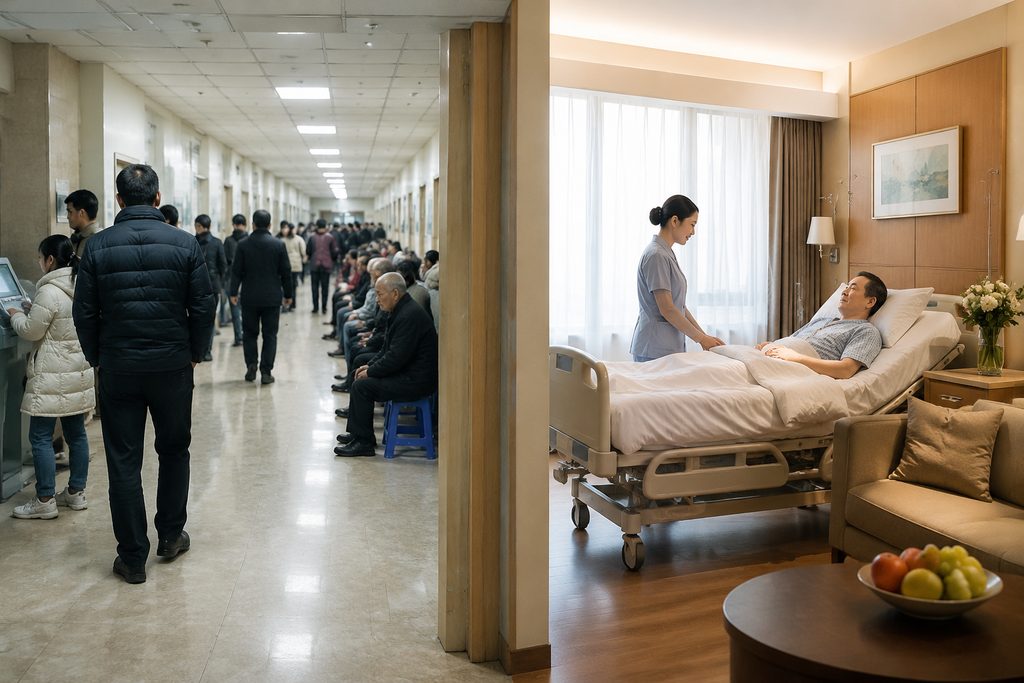
When 42-year-old Michael from Portland needed a full blood panel before his cardiology appointment in Shanghai, he assumed it would work like home. Walk into a lab, hand over insurance, get results in two days. Instead, he stood in a crowded public hospital corridor at 7 a.m., holding a paper slip printed entirely in Chinese, unsure which window to approach. Nobody spoke English. The queue stretched past a hundred people. He eventually got his test done — for about $18. But the cost of that confusion, and the three hours he lost, is exactly why so many international patients ask us the same question: should you use the public system or a private hospital for blood tests in China?
The short answer: both work, and both are safe. The difference comes down to price, speed, language, and how much coordination you want to handle yourself. A basic complete blood count (CBC) at a public hospital might run 50–120 RMB (roughly $7–17). The same panel at a private international hospital can cost $80–200. That gap is real. So is the difference in experience.
How This Actually Works, Step by Step
Here is the real sequence, whether you go public or private.
Step 1 — Decide what test you need and why. A blood test ordered by a doctor as part of a diagnosis is different from a self-requested wellness panel. Chinese hospitals largely expect a doctor’s order. If you just want to “check everything,” you may need to see a physician first, or use a private clinic that offers direct-access testing.
Step 2 — Choose your facility type. Public tertiary hospitals (the “Grade 3A” tier) have the largest labs and lowest prices. Private international hospitals — think United Family, Jiahui, Parkway — have English-speaking staff, shorter waits, and direct insurance billing.
Step 3 — Register and pay. Public hospitals require you to create a medical card (usually at a registration window or self-service kiosk), then pay upfront. Private hospitals handle registration at reception, often in English, and bill your insurer directly if you have coverage.
Step 4 — Get the draw. At public hospitals, you take a printed slip to the phlebotomy window. At private hospitals, a nurse comes to you or calls your name. Same needle, same vials, different atmosphere.
Step 5 — Collect results. Public labs often release results same-day or next-day, but the report is in Chinese and you may need to return in person or use a hospital app. Private hospitals typically email English reports within 24–48 hours.
What comes back matters. If you are coordinating care from abroad, our team can arrange for a written second opinion or video consultation so a Chinese specialist reviews those results and explains what they mean for your treatment plan.
Public vs Private: The Real Price and Experience Gap
This is where the numbers get interesting. China’s public hospital labs are heavily subsidized and run at enormous volume, which drives unit costs down. A private international hospital charges for convenience, English service, and a calmer environment.
| Factor | Public Grade 3A Hospital | Private International Hospital |
|---|---|---|
| Basic CBC panel | $7–17 | $80–200 |
| Comprehensive metabolic panel | $20–50 | $150–350 |
| English-speaking staff | Rare outside international departments | Standard |
| Wait time (walk-in) | 1–4 hours | 15–45 minutes |
| Results turnaround | Same day to 48 hours | 24–48 hours, emailed in English |
| Insurance billing | Pay upfront, claim later | Often direct billing |
| Appointment booking | Generally same-day queue | Advance booking available |
That price difference — sometimes tenfold — explains why some patients split the difference. They use public labs for routine monitoring and private clinics when they need speed or English communication.
A Realistic Timeline
Timelines depend heavily on whether you are already in China and whether you need a doctor’s order first.
| Stage | Public Hospital | Private Hospital |
|---|---|---|
| Booking (if required) | Same-day or 1–3 days ahead for international dept. | 1–5 days ahead |
| Registration and payment | 30–90 minutes | 10–20 minutes |
| Sample collection | 15–60 minutes wait | 5–15 minutes |
| Results ready | Same day to 2 days | 1–2 days |
| English translation | Not automatic; may need a service | Included |
| If you are flying in | Add visa (S2) processing: 4–10 business days | Same visa timeline applies |
Notice the step people forget: document translation. If you plan to show your results to a doctor back home, you may need certified English versions. Private hospitals provide these. Public hospitals usually do not.
What Can Go Wrong — and What Happens Then
Honest failure modes matter more than glossy promises.
You cannot find the right window. Public hospitals are vast, and signage is often Chinese-only. Solution: a bilingual medical companion can navigate registration, payment, and the lab for you — from $300/day.
Your results come back in Chinese. You need them translated for your home doctor. Private hospitals solve this. Public hospitals require you to arrange translation separately.
You need a specific test that isn’t routine. Some specialized assays (certain genetic panels, rare hormone tests) are only available at specific hospitals. We can help match you to the right facility through our department directory.
Your insurance won’t reimburse. Public hospital receipts may not meet your insurer’s documentation standards. Check before you test, not after.
Is It Safe, and Can Foreigners Actually Get Tested?
Yes on both counts. Chinese public hospital labs serving Grade 3A facilities operate under national quality standards, and many are accredited for international clinical trials. The equipment is modern. The reagents are regulated. For routine blood work, there is no meaningful safety gap between a top Chinese public lab and a Western hospital lab.
Foreigners can absolutely get blood tests in China. You need your passport, and you need to register at the hospital. Private international hospitals make this seamless. Public hospitals can do it too, especially their international or VIP departments — but the process assumes some Chinese language ability or a guide.
One nuance: some public hospitals restrict certain services to patients who have an existing doctor relationship there. For a simple blood draw, this is rarely an issue. For complex panels tied to a diagnosis, you may need a consultation first.
Practical Considerations: Payment, Language, and Follow-Up
Payment at public hospitals is almost always upfront and in cash, card, or mobile payment (Alipay, WeChat Pay). Foreign cards sometimes fail. Bring a backup method.
Language is the single biggest friction point. Even in Beijing and Shanghai, most public hospital lab staff do not speak English. If you are booking a private blood test in Shanghai, you will find English service at Jiahui, United Family, and Parkway. Outside major cities, private options thin out fast.
Follow-up matters too. A blood test is a data point, not a diagnosis. If your results are abnormal, you will want a physician to interpret them. Our team can coordinate a video consultation with a Chinese specialist ($100–300) or arrange a written second opinion from a top hospital expert ($300–500) so you understand what the numbers mean before you make any decisions.
For patients planning broader care in China, it helps to start with a clear picture of the hospital landscape. Our guide to top-ranked Chinese hospitals by city shows which facilities offer international departments, and the specialty rankings help you find the right department for your condition.
Frequently Asked Questions
A basic CBC at a public Grade 3A hospital typically runs $7–17. A comprehensive metabolic panel runs $20–50. At a private international hospital, expect $80–200 for a CBC and $150–350 for a broader panel. Prices vary by hospital, city, and test complexity.
Yes. Your passport is sufficient for registration at both public and private hospitals. Private international hospitals handle this routinely; public hospitals may require you to visit a registration window in person, and English support varies.
For routine testing at accredited hospitals, yes. Grade 3A public hospital labs follow national quality standards, and many private hospitals hold JCI accreditation. The main risks are communication errors and documentation issues, not lab safety.
Yes. Private international hospitals in Shanghai — including Jiahui, United Family, and Parkway — accept advance bookings, often online or by phone, with English-speaking staff. Public hospitals generally do not offer advance booking for routine lab work.
It depends on your policy. Most international insurers reimburse after you pay upfront, provided you submit itemized receipts and English reports. Direct billing is available at some private hospitals. Confirm with your insurer before testing.
Your Next Step
Blood tests in China are affordable, safe, and accessible to foreigners — the real variable is how much coordination you want to handle yourself. Public hospitals offer unbeatable prices; private hospitals offer speed, English, and simplicity. Most international patients end up using both, depending on the situation.
At China Medical Services, we connect international patients with 340+ top-ranked hospitals across 37 cities. We do not provide medical care or diagnose conditions. We handle the logistics — appointment coordination, bilingual medical companions, written second opinions, and video consultations with Chinese specialists — so you can focus on your health instead of the paperwork. When you are ready, start with a free consultation and we will help you figure out which path fits your case.
For more medical information and treatment options in China, visit chinamedservices.com (China Medical Services).
