Cancer Screening in China: Follow-Up Plan for International Patients
Key Takeaways
- Cancer screening cost China runs roughly $300–$1,500 for a comprehensive package — often a fraction of US pricing for the same imaging and lab work.
- China’s top-ranked hospitals see enormous daily volumes, which means experienced radiologists and fast turnaround on results.
- The real challenge isn’t the scan — it’s the follow-up. Public hospitals rarely pre-book overseas patients, and abnormal findings need a specialist plan, not just a report.
- Before committing to any screening trip, understand the visa category, the payment flow, and how you’ll handle a positive result.
The follow-up gap nobody warns you about
Here’s what most people miss. A screening package is a snapshot. The value comes from what happens after — who reads the images, who decides whether that lung nodule needs a biopsy, and who tracks you six months later.
That’s the part we help patients think through before they book a flight.
Why Cancer Screening in China Attracts International Patients
Three structural reasons. None of them are marketing claims.
Volume means experienced eyes
A major Chinese tertiary hospital may process thousands of outpatient visits in a single day. Radiology departments at institutions like those ranked in the Fudan Top 100 read an extraordinary number of scans annually. Repetition builds pattern recognition. For screening, where the whole game is catching something small, that matters.
Compare that to a small regional clinic in a country with a fraction of the population density. The difference isn’t talent — it’s exposure.
Equipment and speed
Low-dose CT, high-resolution MRI, PET-CT, and endoscopy suites are standard at top-tier hospitals. Results often come back faster than many Western systems because the workflow is centralized. You may complete imaging and labs in a single day.
Cancer screening cost China advantage
This is the headline most readers come for. Labor economics, hospital efficiency, and sheer volume keep prices low without cutting corners on the machines themselves.
| Screening Item | Typical China Range (USD) | Typical US Range (USD) |
|---|---|---|
| Basic package (bloodwork, ultrasound, chest X-ray) | $300–$500 | $1,500–$3,000 |
| Comprehensive package (adds low-dose CT, tumor markers) | $600–$1,000 | $3,000–$6,000 |
| Advanced package (adds MRI, PET-CT, endoscopy) | $1,000–$1,500+ | $5,000–$10,000+ |
Prices vary by hospital and case complexity. Private international hospitals sit at the higher end but offer English-speaking staff and direct insurance billing.
What Screening Actually Covers
Packages differ. Know what you’re buying.
A standard comprehensive screening typically includes a full blood panel, tumor markers (CEA, AFP, CA-125, and others depending on sex and risk), abdominal ultrasound, chest imaging, and a physical exam. Higher-tier packages add low-dose CT for lung screening, mammography or breast ultrasound, colonoscopy or gastroscopy, and MRI.
Not every package fits every person. A 40-year-old with no family history needs a different panel than a 60-year-old smoker. This is where a written second opinion before you travel can save money and confusion — you send your history, and a Chinese specialist tells you which tests are actually worth doing.
Building a Follow-Up Plan That Works
This is the section that separates a useful trip from an expensive one.
Say your CT shows a small pulmonary nodule. In many systems, you’d get a report, a vague “come back in a year,” and a lot of anxiety. A proper follow-up plan looks different.
- Immediate review: A pulmonologist or oncologist reviews the images the same week, not months later.
- Clear next step: Either a defined re-scan interval, a PET-CT, or a biopsy — with reasoning explained.
- Named contact: Someone who owns your case file and can be reached if you’re back home.
- Documentation: English-language records you can hand to your doctor at home.
Here’s the honest part. Public hospitals do not usually pre-book overseas patients for routine follow-up. You generally need to be physically present, register on the day, and see the specialist in person. That’s the standard rule, not a policy aimed at foreigners.
If you want a specialist locked in ahead of time, that runs through the hospital’s international or VIP department. Expect pricing roughly 1.5 to 2 times the standard channel. It buys you a senior doctor and English support — not a different standard of medicine.
Structuring the Trip: A Realistic Timeline
Most patients we work with follow a staged approach rather than flying in blind.
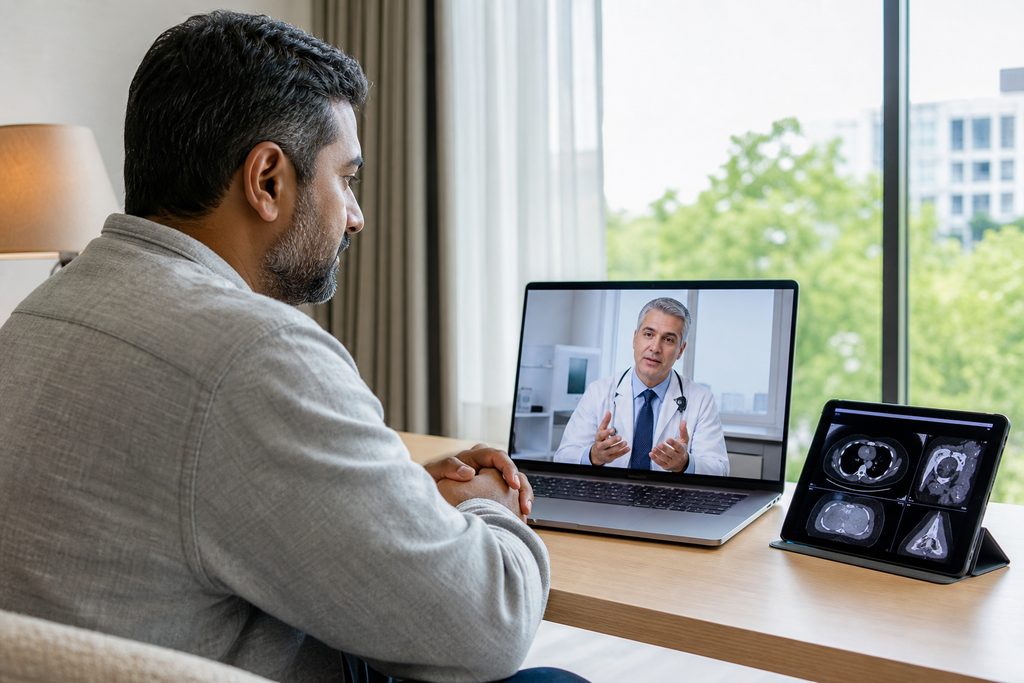
Weeks 1–2: Gather existing reports. Get a written second opinion or video consultation so you know what’s actually needed. A video consultation with a standard international department runs $100–$300; a top-specialist session runs $500–$800.
Weeks 3–4: Confirm the hospital and screening package. Apply for the S2 visa, which is the applicable short-stay category for medical treatment and private affairs. Rules shift, so always check the latest requirements from your local Chinese embassy or consulate. Bring the hospital’s supporting documents.
Days 1–3 in China: Arrive, complete registration, and run the screening. Many packages finish within one to two days.
Days 4–7: Results review. If everything is clear, you get documentation and a recommended re-screening interval. If something needs attention, this is when the follow-up plan gets built — and possibly when you extend your stay.
Any consultation fee you paid earlier can be credited in full toward on-the-ground coordination if you proceed within 90 days. It’s a one-time credit against the coordination fee, never against hospital charges.
Comparing Your Options Honestly
China isn’t the only choice, and it isn’t right for everyone.
If you have a known cancer diagnosis and need treatment, screening isn’t your task — you need an oncology workup. If you have a complex genetic risk profile, a Western center with a dedicated hereditary cancer program may be a better fit. If you simply want convenience and English at every step, a private international hospital in China (or at home) may suit you better than a public tertiary hospital, even at higher cost.
Where China shines: cost-effective comprehensive imaging, fast turnaround, and access to high-volume radiology and endoscopy. Where it demands patience: registration queues, language barriers, and the reality that public hospitals won’t hold your hand.
That last point is the one we’re most direct about. A bilingual medical companion — from $300 per day — handles registration, queuing, payment, wayfinding, and translation. It doesn’t guarantee you’ll see a specific named doctor. Nobody honest can promise that.
Practical Considerations Before You Book
A few concrete logistics.
Visa: S2 is the short-stay category used for medical treatment. Stays beyond 180 days fall under S1. Accompanying family members also apply under S2. The M visa is for commercial and trade activities and has nothing to do with medical care — don’t let anyone tell you otherwise.
Payment: Public hospitals require prepayment. Insurance is typically reimbursed afterward, not settled at the counter. Private international hospitals often bill insurers directly. Bring a card that works internationally and check your daily transaction limits before you travel.
Records: Request English-language reports. You’ll want them for your doctor at home and for any future screening comparison.
Follow-up after returning home: Get the imaging on a CD or USB drive, plus a written summary. Your home physician can then compare future scans against a real baseline.
For a broader look at how hospital selection works, our ranking of top hospitals by city groups facilities by tier, and the specialty rankings page lists the leading departments for oncology and related fields.
Frequently Asked Questions
Yes, at accredited hospitals. Top-tier public and JCI-accredited private hospitals follow international imaging and sterilization standards. The bigger risk isn’t safety — it’s communication. Without language support, understanding your results and next steps becomes genuinely difficult.
A basic package can finish in half a day. Comprehensive packages with CT, MRI, and endoscopy usually take one to two days, sometimes three if scheduling is tight. Add time for the results consultation, which may fall on a separate day.
Yes, through a hospital’s international department or a coordination service. Standard public-hospital registration typically can’t be pre-booked from overseas. Appointment coordination starts from $300, and if the appointment shown in your order can’t be secured, the fee is refunded in full.
The hospital will recommend a next step — repeat imaging, a biopsy, or a specialist consultation. This is exactly why a follow-up plan matters before you travel. You may need to extend your stay, so build flexibility into your flights and visa timing.
Rarely for routine screening. Some international policies reimburse diagnostic testing abroad, but you’ll usually pay upfront and claim afterward. Confirm coverage with your insurer before booking, and keep every receipt and report.
Your Next Step
Screening is only as good as the plan behind it. Get the imaging, understand the result, and know exactly what happens next — that’s the standard worth holding any provider to.
We’re China Medical Services, a coordination service connecting international patients with 340+ top-ranked hospitals across 37 cities. We’re not a hospital and we don’t diagnose or treat anyone. We help with hospital matching, appointment coordination, bilingual companionship, and visa guidance.
If you’d like to talk through your situation, you can start with a free consultation — no pressure, just a conversation about what makes sense for you.
This article is for general information only and is not medical advice. Screening recommendations depend on your personal risk factors. Please consult a qualified physician before making any medical decision.
For more medical information and treatment options in China, visit chinamedservices.com (China Medical Services).
