Blood Test Results in China: How Fast Foreigners Get Them Back
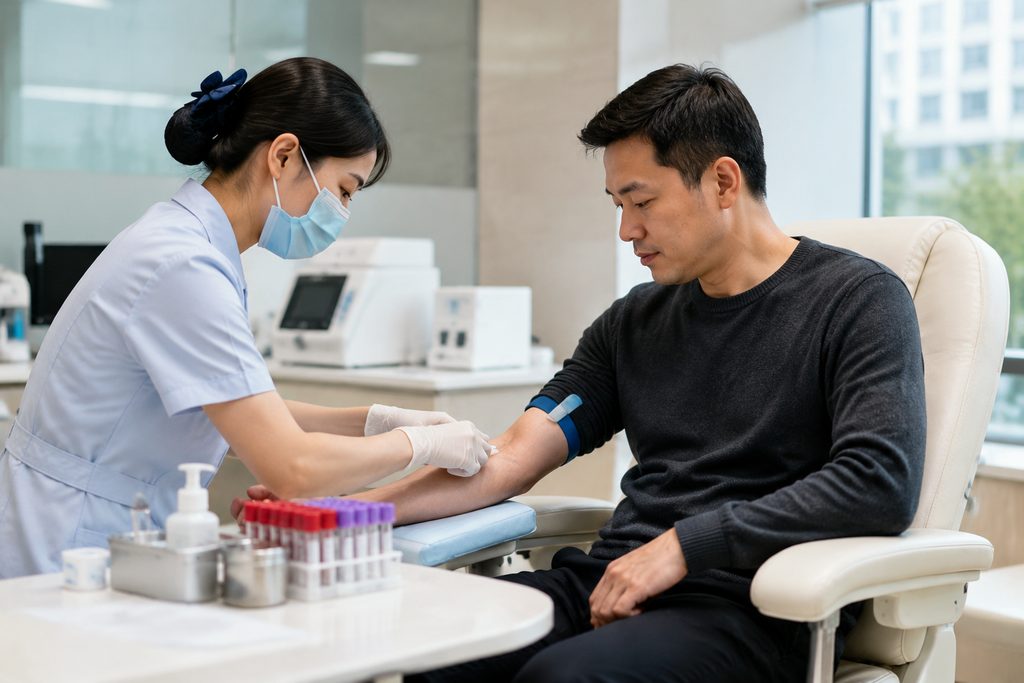
A blood test is a simple thing. A needle, a few vials, a lab machine. What makes it complicated in China is everything around it — where you go, how you pay, whether anyone speaks English, and how long you wait for a piece of paper that a doctor back home may or may not accept.
So let’s start with the plain answer. In a Chinese public hospital, routine blood work often comes back the same day — sometimes within two to four hours for basic panels like a complete blood count or a metabolic panel. In a private international clinic, results for common tests are frequently ready in 24 to 48 hours, often delivered in English. Specialized tests — hormone panels, tumor markers, genetic sequencing, autoimmune antibodies — take longer. Days, sometimes one to two weeks.
That’s the short version. The longer version involves cost, reliability, language, and the practical question of whether you should even bother getting tested in China if you’re just passing through. We’ll walk through all of it.
How This Actually Works, Step by Step
Here’s the real sequence, from the moment you decide to get a blood test to the moment you’re holding a result you can use.
Step one: decide where. You have two realistic paths. A public tertiary hospital (the big, busy, government-run facilities) or a private international clinic. Public hospitals are cheaper. Private clinics are easier. That trade-off shapes everything that follows.
Step two: registration. At a public hospital, you generally cannot book a routine outpatient blood draw from overseas in advance. You show up, register on-site, and get a queue number. This is the standard rule across most public hospitals, and it’s the single biggest surprise for foreign patients. Private international clinics work differently — you can usually book an appointment online or by phone, and some accept direct insurance billing.
Step three: the draw itself. A phlebotomist takes your samples. At a public hospital, expect minimal English. At a private clinic, English-speaking staff are standard.
Step four: the lab. Routine tests run on automated analyzers, often multiple times a day. Specialized tests may be batched or sent to a reference lab.
Step five: results. This is where the timelines diverge sharply. We’ll get into specifics below.
Turnaround Times by Test Type and Facility
Not all blood tests are equal. A basic panel and a genetic sequencing test are not in the same universe when it comes to processing time. Here’s a realistic breakdown.
| Test Type | Public Hospital | Private International Clinic |
|---|---|---|
| Complete blood count (CBC) | 2–4 hours, often same day | Same day to 24 hours |
| Basic metabolic panel | Same day | Same day to 24 hours |
| Lipid panel, liver function | Same day to next morning | 24 hours |
| Thyroid function (TSH, T3, T4) | 1–2 days | 24–48 hours |
| Hormone panels (testosterone, estradiol) | 2–3 days | 2–3 days |
| Tumor markers (CA-125, PSA, CEA) | 2–4 days | 2–4 days |
| Autoimmune antibodies (ANA, ANCA) | 3–7 days | 3–7 days |
| Genetic / molecular testing | 1–3 weeks | 1–2 weeks |
These ranges assume a normal workflow. Holidays, weekends, and heavy patient volume can push things back. Chinese public hospitals see enormous daily patient volumes — some top-tier facilities handle over 10,000 outpatient visits a day — and lab queues reflect that reality.
One more thing worth knowing: “same day blood test results Beijing clinic” is a real search people make, and the answer depends heavily on which clinic. A private clinic in Beijing’s Chaoyang district with its own on-site lab can turn around a CBC in a few hours. A public hospital draw at 4 p.m. might mean you collect results the next morning instead.
A Realistic Timeline
Let’s map this out for a foreign patient starting from zero. The timeline below assumes you’re already in China or arriving soon, and you want blood work done as part of a broader medical visit.
| Stage | What Happens | Realistic Duration |
|---|---|---|
| Before arrival | Decide on facility type; if private clinic, book appointment online | 1–7 days ahead |
| Day of visit | Registration, queue, consultation, blood draw | 1–3 hours at public hospital; 30–60 min at private clinic |
| Routine results | CBC, metabolic panel, lipids | Same day to next morning |
| Specialized results | Hormones, tumor markers, antibodies | 2–7 days |
| Translation (if needed) | Converting Chinese report to English for your home doctor | 1–3 days |
| Genetic / advanced testing | Sequencing, molecular diagnostics | 1–3 weeks |
That translation step is the one people forget. A Chinese lab report is in Chinese. If you need it for a doctor back home, someone has to translate it accurately — including reference ranges, which can differ between laboratories and countries. Budget a few extra days for that.
What Can Go Wrong — and What Happens Then
Things go sideways. Here’s what actually happens and what you do about it.
You can’t find the results. At a public hospital, results are often collected from a specific window or printed from a self-service kiosk. If you don’t read Chinese, finding that kiosk is a genuine challenge. The fix: ask at registration where results are collected, or have someone accompany you.
The results come back in Chinese only. This is the norm, not the exception. Private international clinics usually provide bilingual reports. Public hospitals generally do not. You’ll need a translation service, and it needs to be accurate — a mistranslated reference range is worse than no translation.
Your home doctor won’t accept them. Some clinicians are fine with translated foreign lab reports. Others want the test redone locally. This isn’t a reflection on Chinese lab quality — it’s about liability, standardization, and unfamiliar reference ranges. Ask your home doctor in advance what they’ll accept.
A test gets delayed. Equipment issues, reagent shortages, or a sample that needs repeating can add days. If a result is urgent, say so at the time of the draw. Urgency flags exist but aren’t applied automatically.
The clinic you chose doesn’t offer the test. Not every facility runs every assay. A small clinic may send your sample to a reference lab, adding transit time. Confirm availability before you go.
Is Blood Testing in China Reliable for Foreigners?
This is the question underneath all the others. And the honest answer is: at accredited facilities, yes.
China’s top-tier public hospitals and JCI-accredited private international hospitals run laboratories that meet international standards. Many participate in external quality assessment programs. The equipment — automated analyzers, immunoassay platforms, sequencing machines — is the same technology used in Europe and North America. Several Chinese hospitals rank among the top 5% of the country’s 35,000+ hospitals, and their lab capabilities reflect that standing.
The variables that affect reliability aren’t the machines. They’re pre-analytical factors: how the sample is handled, how long it sits before processing, whether the correct tube was used. These are the same variables that affect lab accuracy everywhere in the world.
What does differ is transparency. In some countries, you can look up a lab’s accreditation status easily. In China, that information is less accessible to foreign patients. If this matters to you — and for some patients it does — a private international clinic with visible JCI accreditation is the safer choice.
Cost, meanwhile, is where China stands out. A complete blood count at a public hospital might cost the equivalent of a few US dollars. A broader panel rarely exceeds $30–$50. Even at private international clinics, where prices are higher, a routine panel typically runs $50–$150. For context, the same panel without insurance in the United States can cost several hundred dollars. That gap is a big part of why “blood test cost China” is something people search for.
Practical Considerations: Records, Payment, and Follow-Up
A few things to sort out before you go.
Payment. Public hospitals require prepayment. You pay out of pocket, then seek reimbursement from your insurer afterward — and not all insurers reimburse foreign lab work. Private international clinics often bill insurance directly, which removes that headache. Confirm your coverage before booking.
Records. Bring your existing medical records, including prior blood work. Comparison matters. A single result in isolation tells a doctor far less than a trend over time.
Visa timing. If you’re traveling to China specifically for medical evaluation, the S2 visa is the applicable short-stay category for medical treatment and private affairs, subject to the latest embassy or consulate requirements and supporting hospital documents. Family members accompanying you apply under the same category. Processing takes time — build it into your schedule. Note that the M visa is for commercial and trade activities and has nothing to do with medical treatment.
Follow-up at home. Get your results translated and, if possible, reviewed by a Chinese specialist before you leave. A written second opinion can contextualize the numbers in ways a raw report cannot. For patients weighing whether a test result warrants deeper investigation, starting with a remote review is often the most efficient path — you can explore how that works through our consultation and coordination service.
If you’re trying to choose a facility, our guide to private international hospitals covers English-language services and insurance billing, while the top hospitals directory lists public tertiary facilities by city.
Frequently Asked Questions
For routine panels like a CBC or metabolic panel, same-day results are common at public hospitals — often within two to four hours. Private international clinics typically deliver results within 24 to 48 hours. Specialized tests such as hormone panels, tumor markers, or autoimmune antibodies take two to seven days, and genetic testing can take one to three weeks.
At private international clinics in Shanghai, yes — online or phone booking is standard, and English-speaking staff are available. At public hospitals, routine outpatient blood draws generally cannot be pre-booked from overseas; you register on-site. For anything tied to a specialist consultation or hospital admission, coordination support can help navigate the registration and queueing process.
At accredited facilities, yes. Top-tier public hospitals and JCI-accredited private clinics use internationally standard equipment and quality controls. The main practical differences are language, report format, and whether your home doctor will accept a foreign lab report — which is a question worth asking your doctor before you travel.
At public hospitals, a routine panel often costs the equivalent of a few US dollars, and broader panels rarely exceed $30–$50. Private international clinics charge more — typically $50–$150 for a routine panel — but include English-language service and often direct insurance billing. Final cost varies by hospital and the specific tests ordered.
Private international clinics usually provide bilingual reports. Public hospitals generally issue Chinese-language reports only. If you need an English version for a doctor back home, arrange a professional translation — including reference ranges, which can differ between laboratories.
Your Next Step
The core message is simple: blood testing in China is fast and affordable, but the experience depends heavily on where you go and whether anyone helps you navigate the language and logistics. Routine results can be in your hands the same day. Specialized tests take longer, and translation adds a few more days.
We’re China Medical Services. We connect international patients with hospitals across 37 cities and 340+ top-ranked facilities, and we coordinate the practical details — appointments, bilingual accompaniment, records, and follow-up. We don’t provide medical care, and we don’t promise specific outcomes. What we do is make the process navigable.
If you’re planning a medical visit and want to understand your options before committing to anything, a no-pressure conversation is a reasonable place to start.
For more medical information and treatment options in China, visit chinamedservices.com (China Medical Services).
