Genetic Diagnosis Confirmation Service China: Verifying Inherited Condition Testing Results
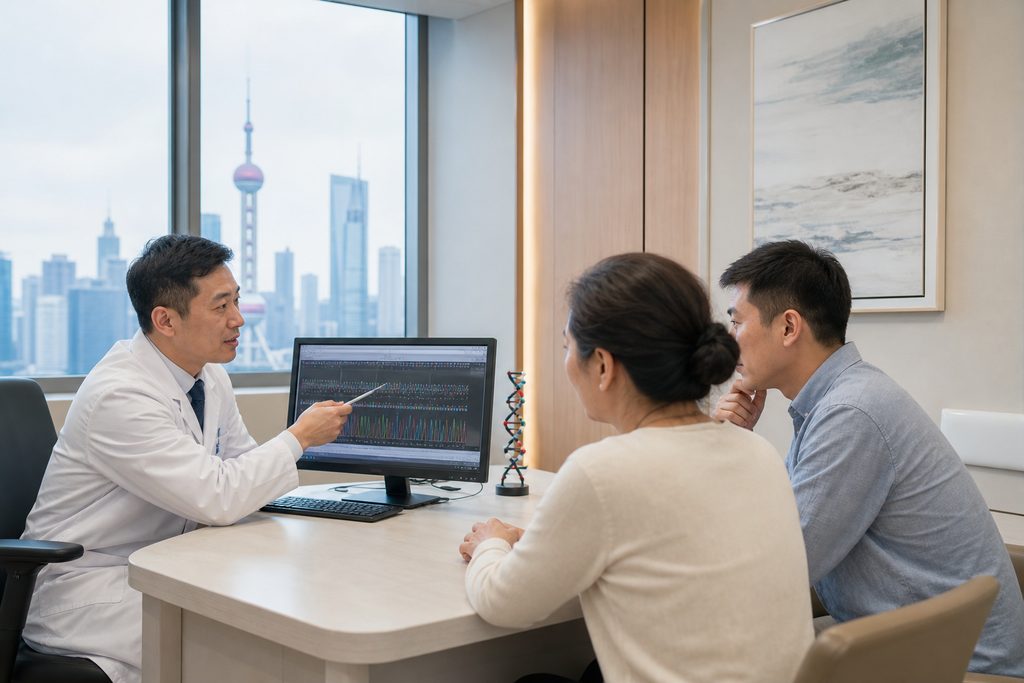
Key Takeaways
- A genetic testing second opinion in China starts from $300 for written expert review — a fraction of Western costs — and can be credited toward in-person care coordination within 90 days.
- China’s top-tier hospitals run genetic panels at volumes that dwarf most Western labs. Sheer repetition sharpens interpretive accuracy, especially for rare variants.
- Language barriers and hospital registration systems make independent verification nearly impossible. Without local coordination, you risk receiving raw data with no clinical interpretation.
- Confirmation is not just about re-running a test. It is about having an experienced clinical geneticist interpret your existing results against population-specific databases and your family history.
The Problem: A Diagnosis That Does Not Sit Right
You received a genetic test result. Maybe it came from a lab in your home country. Maybe it was done during a health screening while traveling. The report says you carry a pathogenic variant for hypertrophic cardiomyopathy. Or Lynch syndrome. Or BRCA2. But something feels off. The lab’s methodology section is vague. The variant classification seems rushed. You have read stories — approximately 30% of variants in some public databases were later reclassified, according to a 2018 study in Genetics in Medicine. That number haunts you. You need to know if this result is real before you schedule a prophylactic surgery or tell your siblings to get tested. You are searching for a genetic testing second opinion China cost estimate because you have heard the country’s genomics infrastructure is massive. You are right to look here. But you are also right to be cautious.
Getting a genetic diagnosis confirmed across borders is not like getting a second read on an X-ray. The data files are complex. The interpretive frameworks vary by population database. A variant flagged as “likely pathogenic” in a European reference panel might be a benign polymorphism in an East Asian population. If your ancestry is mixed or non-European, the risk of misclassification climbs. This is not theoretical. A 2016 paper in the New England Journal of Medicine documented multiple cases where Black patients received false-positive hypertrophic cardiomyopathy diagnoses because their benign variants were absent from predominantly white control databases. The consequences were real: unnecessary ICD implants, years of anxiety, family cascade testing that rippled outward from a wrong call. Confirming a genetic diagnosis means confronting these database biases directly. China’s genomic databases are among the largest in the world for East Asian populations. That is a structural advantage you cannot access anywhere else.
Who We Are
We are China Medical Services. We are not a hospital. We do not run genetic tests, interpret variants, or give medical advice. Our team is the operational layer between you and China’s top clinical genetics departments. We handle hospital matching, appointment coordination with international departments, bilingual medical companion services, and the logistical scaffolding that makes cross-border genetic consultation possible. When you ask us about a genetic testing second opinion China cost, we give you a transparent range and explain exactly what each service tier includes. We do not promise cures. We do not guarantee a specific diagnosis. We connect you with the expertise to get answers.
Why Genetic Diagnosis Confirmation in China Delivers Results
Volume Creates Interpretive Precision
Clinical geneticists at major Chinese centers review thousands of variant classifications annually. A specialist at Peking Union Medical College Hospital‘s clinical genetics department might interpret over 3,000 cases per year. Compare that to a genetic counselor at a mid-sized Western hospital who might handle 200. Volume matters when the task is recognizing edge cases — variants of uncertain significance that sit in gray zones between benign and pathogenic. The more you see, the sharper your judgment becomes. This is not speculation. It is the same principle that makes a cardiac surgeon who performs 400 procedures a year more skilled than one who does 50. Genetic interpretation is a cognitive skill honed by repetition.
Chinese labs also contribute heavily to public variant databases like ClinVar. BGI Genomics alone has submitted tens of thousands of variant interpretations. When you seek confirmation here, you are tapping into a system that has seen the rare presentations, the atypical inheritance patterns, the variants that do not behave like the textbooks say they should. That experience matters when your result is ambiguous.
Population-Specific Reference Databases Change Everything
Your genetic test result was interpreted against a reference database. If that database is predominantly European — and many still are — your result carries a built-in error risk if your ancestry is not fully European. China has built some of the world’s largest population-specific genomic databases. The China Metabolic Analytics Project, for instance, aggregates data from millions of individuals. When a Chinese clinical geneticist reviews your raw data, they can cross-reference it against allele frequencies from populations that might better match your background. A variant that looks rare and dangerous in a European database might appear at 2% frequency in an East Asian cohort. That reclassification changes everything: from pathogenic to benign in one data point.
This is not just relevant for patients of Asian descent. Many Western patients have mixed ancestry they are unaware of. A confirmation service that only checks against one population database is incomplete by design. The best hospital for genetic diagnosis confirmation Shanghai offers — and we can connect you with — will run your data against multiple reference panels. That thoroughness is what you are paying for.
The Cost Structure Makes Sense
Let us address the genetic testing second opinion China cost directly. A written second opinion from a top-tier clinical geneticist in China runs from $300 to $500. A video consultation with a specialist costs $500 to $800. Compare this to the United States, where a genetic counseling session alone can bill at $250 to $500 without any re-analysis of raw data. A full reinterpretation by a clinical geneticist at a major US academic center can exceed $2,000. The price difference is not about lower quality. It is about structural economics: lower physician salaries, higher patient volumes, and hospital systems designed for throughput rather than margin maximization. The clinical expertise is equivalent. The cost is not.
But there is a caveat. The $300 written opinion covers the interpretation. It does not cover re-running the genetic test itself. If your original lab report is incomplete, if the raw sequencing data files are unavailable, or if the testing methodology was flawed, you may need a new test. That costs more. We help you understand which path applies before you spend anything.
What You Need to Know Before Going Alone
Trying to confirm genetic test results abroad service China offerings without local support hits several walls. These are not minor inconveniences. They are structural barriers that can waste weeks of your time and produce results you cannot use.
- Hospital Registration Systems Are Not Built for Foreigners: Public hospitals in China use real-name registration tied to a Chinese ID number or a local phone number. International patients fall outside this system. The international department is the correct entry point, but it is not a simple walk-in. Appointments require advance coordination, translated medical records, and often a deposit. Without a local coordinator, you will spend days navigating a system not designed for you.
- Raw Genetic Data Is Not Automatically Shared: Many labs in Western countries will not release raw sequencing files — FASTQ or BAM files — directly to patients. They will send a PDF report. A meaningful confirmation requires the raw data. Getting it released often requires a formal request from another clinical institution. We handle that institutional-to-institutional transfer. You cannot easily do it as an individual.
- Interpretation Without Clinical Context Is Worthless: A Chinese geneticist reviewing your data needs more than the variant call. They need your full clinical phenotype: your symptoms, family history, imaging results, biochemical markers. Translating these records accurately into English and then into the clinical terminology Chinese physicians expect is a specialized task. Machine translation fails on medical nuance. A bilingual medical companion ensures nothing is lost.
How We Help You Navigate This
You contact us with a clear question: can I trust genetic testing results China delivered to me, and if not, how do I verify them? We start with a free consultation. You tell us what test was done, what the report says, what concerns you have. We do not charge for this initial conversation. We need to understand your case before we can recommend a path.
If a written second opinion is appropriate, we coordinate with a clinical genetics department at a top-ranked hospital. We translate your existing report and clinical history into the format Chinese physicians expect. We handle the institutional request for your raw data files if needed. The geneticist reviews everything and produces a written report. That report is translated back into English by a medical translator, not a generalist. You receive a document you can take to your home physician.
If a video consultation makes more sense — for complex cases where back-and-forth discussion is valuable — we arrange a live session with a specialist. A bilingual medical companion joins the call to ensure nothing is lost in translation. You can ask the questions that keep you up at night. Is this variant really pathogenic? What surveillance is actually warranted? Should my children be tested? The consultation is recorded with your permission so you can review it later.
For patients who decide to travel to China for in-person evaluation, our VIP end-to-end coordination covers everything: visa guidance for the S2 medical visa, airport transfer, hotel recommendations near the hospital, appointment scheduling, and a bilingual companion who stays with you throughout the hospital visit. The cost of any prior remote consultation is credited in full toward this coordination service within 90 days. You do not pay twice for the same expertise pathway.
Throughout this process, we never interpret results ourselves. We are not clinicians. We are the infrastructure that connects you to clinicians. That distinction matters. It keeps our role clear and your medical decisions in the hands of qualified professionals.
Frequently Asked Questions
Most lab results are accurate. But accuracy is not the same as clinical validity. A lab can correctly identify a genetic variant and still classify it wrong if the reference database is mismatched to your ancestry. Approximately 1 in 5 variants of uncertain significance are reclassified within five years as databases grow. If your result will drive a major medical decision — surgery, medication, family planning — confirmation is a reasonable step. It is not paranoia. It is due diligence.
You do not attempt it alone. The verification process requires institutional communication, medical record translation, and clinical consultation — all in Chinese. Our bilingual medical companions handle every language touchpoint. You interact with us in English. We handle the Chinese-language interface with the hospital. The final report you receive is in English. The language barrier is real, but it is solvable with the right support structure.
You receive a written report explaining the disagreement, the evidence behind the reclassification, and the clinical implications. This report is signed by a qualified clinical geneticist at an accredited hospital. You take it to your home physician for discussion. We do not advise you to act on it without local medical guidance. A disagreement does not automatically mean the Chinese opinion is correct — but it gives you a documented second perspective from a high-volume center. That is what you came for.
An in-person specialist consultation coordination fee starts from $800. A full VIP coordination package — including airport transfer, hotel booking assistance, appointment scheduling, and bilingual companion services — ranges from $5,000 to $8,000 depending on case complexity and duration. These fees cover our coordination labor. Hospital charges for any new genetic testing, imaging, or procedures are separate and paid directly to the hospital. We provide estimates before you commit. No surprises.
Most will, especially if it comes from a hospital listed on the Fudan University national ranking — China’s equivalent of the U.S. News hospital rankings. Our partner hospitals include institutions ranked among China’s top tier. The reports are issued in English, follow international reporting standards, and include the interpreting physician’s credentials. If your doctor has specific questions, we can arrange direct physician-to-physician communication. Acceptance is rarely an issue when the source institution is clearly identified and accredited.
Your Next Step
A genetic diagnosis can reshape your life. It can dictate surveillance schedules, surgical decisions, and family conversations that are among the hardest you will ever have. Before you act on a result, you deserve certainty — or at least the highest level of confidence that current science can provide. Confirming that result through a high-volume Chinese clinical genetics center is a practical, evidence-backed way to get that confidence. The cost is measured in hundreds of dollars. The value is measured in avoided unnecessary interventions and years of peace of mind.
If you want to understand your specific options, reach out for a free consultation. We will review your case, explain which confirmation pathway fits, and give you a clear cost estimate. No pressure. No commitment. Just a conversation about how to get the clarity you need. Visit our patient coordination page to start.
For more medical information and treatment options in China, visit chinamedservices.com (China Medical Services).
