Full Body MRI Preventive Screening China: Proactive Health Surveillance
Key Takeaways
- A full body MRI in China typically costs between $800 and $2,500 USD, a fraction of the $3,000 to $10,000+ often charged in the U.S. for similar preventive scans.
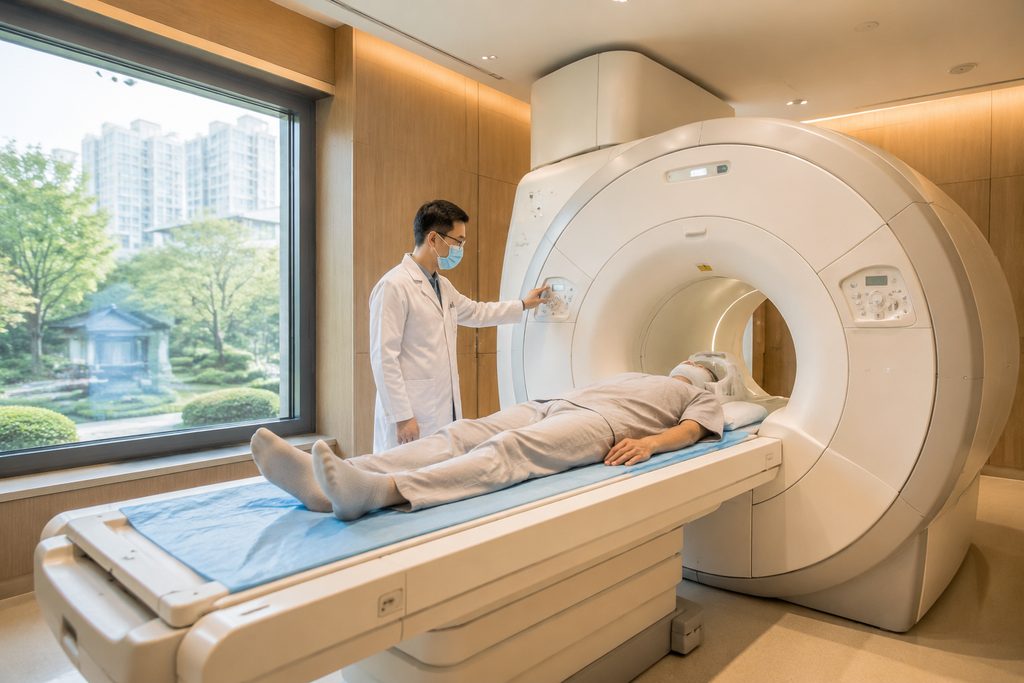
- China’s top-tier hospitals operate some of the world’s fastest 3T MRI machines, capable of completing a head-to-knee scan in under 40 minutes without compromising image clarity.
- Navigating a public hospital independently as a non-Mandarin speaker remains the single biggest barrier; registration portals and consent forms are rarely available in English.
- Preventive screening is not a diagnosis. An abnormal finding on a whole-body scan often requires targeted follow-up imaging, which can trigger anxiety if you lack expert guidance to interpret the results.
The Problem: Late Diagnosis Doesn’t Knock First
Most cancers grow silently. The World Health Organization reports that nearly 10 million people died from cancer in 2020, and roughly one-third of those deaths were linked to late detection. That is the brutal math of reactive medicine. You feel fine. Your bloodwork comes back normal. But standard annual physicals are not designed to hunt down early-stage tumors hiding in dense tissue or retroperitoneal spaces. A standard chest X-ray misses small pulmonary nodules. Ultrasound depends heavily on the operator’s skill. By the time a symptom appears—a lump, unexplained weight loss, persistent pain—the biological window for minimally invasive intervention may have already closed.
This is where the concept of proactive health surveillance shifts the paradigm. Instead of waiting for the body to sound an alarm, you scan the entire torso—brain, spine, abdomen, pelvis—in a single session. The technology is not new. Magnetic resonance imaging has been around for decades. But the application of MRI as a screening tool for asymptomatic, apparently healthy individuals is now gaining traction globally. And China has quietly become a hub for it.
Who We Are
We are not a hospital. We do not perform scans, read films, or issue clinical reports. Our team at China Medical Services acts as your logistical bridge to China’s top 5% of hospitals—the 340+ institutions ranked by Fudan University or accredited by JCI. We handle the friction. That means we match your health profile to the right radiology department, coordinate your appointment through official international patient channels, and place a bilingual medical companion by your side on the day of the scan. We do not sell access. We sell case management. The distinction matters.
What Does a Whole Body MRI Scan Detect?
The primary search intent behind this question is simple: “Is it worth my money?” A whole-body diffusion-weighted MRI sequence screens for solid tumors, vascular malformations, and structural abnormalities. It excels at detecting brain lesions, spinal disc degeneration, liver hemangiomas, renal masses, and pelvic cysts. It is less effective for hollow organs. The stomach, colon, and lungs—organs filled with air or peristaltic motion—still require endoscopic evaluation or low-dose CT for optimal screening. No single scan sees everything. But a full body MRI casts a wide net. It can spot an acoustic neuroma before it steals your hearing. It can catch a pancreatic lesion years before jaundice sets in.
Many of our clients combine a full body MRI with a coronary CT angiogram and a colonoscopy. That triad covers the three big killers: cancer, heart disease, and colorectal neoplasia. The scan itself is radiation-free. No ionizing radiation. No contrast dye in most screening protocols. You lie still for 35 to 45 minutes while the machine sequences through multiple stations. The hardest part? Staying motionless.
Full Body MRI Cost China: Breaking Down the Numbers
The full body mri cost China varies sharply by city, hospital tier, and magnet strength. A public Grade A tertiary hospital in Guangzhou might charge $700 to $900 for a basic head-to-pelvis protocol. A private international hospital in Shanghai running a 3T Siemens Vida with AI-assisted reconstruction could bill $2,200 to $2,500. That price often includes a same-day preliminary read by a radiologist. It rarely includes a formal written second opinion unless you request one separately—our team can arrange that through a top specialist for $300 to $500.
| Country | Price Range (USD) | Typical Wait Time | Magnet Strength |
|---|---|---|---|
| United States | $3,000 – $10,500 | 2–6 weeks | 1.5T / 3T |
| United Kingdom (Private) | £2,500 – £4,000 | 3–8 weeks | 1.5T / 3T |
| China (Public Hospital) | $700 – $1,200 | 3–7 days | 1.5T / 3T |
| China (Private International) | $1,800 – $2,500 | 1–3 days | 3T |
These figures reflect self-pay rates. Insurance rarely covers preventive full body MRI screening anywhere in the world—it is considered an elective wellness scan. China’s structural cost advantage comes from lower radiologist labor costs and high patient throughput. A single 3T machine in a major Shanghai hospital might scan 40 to 60 patients per day. That volume drives down the per-unit cost without sacrificing image quality. The radiologists reading your scan likely interpret more cross-sectional studies in a week than many Western counterparts see in a month.
Best Preventive Health Screening Shanghai: Where Volume Meets Precision
Shanghai has emerged as the epicenter for best preventive health screening Shanghai programs. The city hosts 18 of the Fudan-ranked Top 100 hospitals, and several have dedicated international medical centers designed for foreign patients. These centers offer bundled executive health checkup packages that go well beyond a single MRI scan.
A typical executive health checkup package China price ranges from $1,500 to $5,000. What do you get? A 3T whole-body MRI, a low-dose chest CT, abdominal and thyroid ultrasound, full blood panel including tumor markers, echocardiogram, and a specialist consultation to synthesize the results. Some packages add a treadmill stress test and a virtual colonoscopy. The entire process—from check-in to final report—can be completed in 4 to 6 hours. In many Western systems, scheduling these tests individually would take months of fragmented appointments.
The speed does not mean sloppiness. It reflects operational design. These hospitals built their screening centers around a one-stop model. You move from phlebotomy to imaging to cardiology in a single morning. A nurse navigator escorts you between stations. The report is compiled by a multi-specialty team before you leave the building. This is not concierge medicine for the ultra-wealthy. It is simply how China’s high-volume system organizes preventive care.
Is Full Body MRI Screening Safe in China?
The short answer: yes, when done in an accredited hospital. The longer answer requires nuance. Is full body mri screening safe in China depends entirely on where you go. A 3T MRI machine manufactured by Siemens, GE, or Philips operates under the same physics in Shanghai as it does in Boston. Magnetic fields do not change at different longitudes. The risk lies not in the hardware but in the clinical decision-making that surrounds the scan.
China’s top-tier hospitals follow international imaging protocols. They screen you for metal implants, pacemakers, and renal function before you enter the bore. The gadolinium-based contrast agents used in some enhanced scans carry a small risk of nephrogenic systemic fibrosis in patients with severely impaired kidney function—this risk is well-documented globally and Chinese radiologists screen for it. The bigger safety question is interpretive. A full body MRI will find things. Incidentalomas. Tiny lung nodules. Liver cysts. Most are benign. But if the radiologist over-reports or the patient lacks a trusted physician to contextualize the findings, the emotional toll can be severe. This is why we always recommend that screening results be reviewed by a specialist who knows your full history—not just read off a printed report in a language you do not speak.
How to Book Full Body Cancer Screening China Without the Headache
Booking a scan directly as an international patient is the hard way. Most public hospital websites operate exclusively in Mandarin. The online registration systems require a Chinese ID number or a local phone number. Even if you manage to secure an appointment, you will arrive to find signage, consent forms, and technician instructions entirely in Chinese characters. The MRI technologist will tell you to hold your breath in Mandarin. If you breathe at the wrong moment, the sequence is ruined and must be repeated.
This is where the distinction between booking and coordinating becomes critical. You can book full body cancer screening China through a hospital’s international department, but that only secures a time slot. It does not ensure that a radiologist will explain the findings to you in English. It does not guarantee that abnormal results will be escalated to the right specialist within the same hospital system. Our team fills that gap. We do not just book the scan. We prepare your translated medical history, brief the radiology department on your specific concerns, and place a bilingual companion in the control room who can relay instructions in real time. After the scan, we arrange a consultation—either in person or via video—with a specialist who can tell you what matters and what does not.
What You Need to Know Before Going Alone
- Visa Requirements: Medical screening falls under the S2 visa category—a short-term private visit visa endorsed for medical purposes. You need an invitation letter from the hospital. Obtaining that letter without a local contact can take weeks of back-and-forth emails with an administrative office that may not respond in English.
- Payment Systems: Public hospitals require upfront payment via Chinese debit card, UnionPay, or cash. International credit cards are often rejected at the cashier counter. Private international hospitals accept Visa and Mastercard, but public ones rarely do. Daily withdrawal limits on foreign cards at Chinese ATMs can cap at around $400 to $700.
- Medical Records and Follow-Up: Your MRI images will be delivered on a CD or USB drive. The written report will be in Chinese unless you specifically request an English translation—and even then, the translation quality varies wildly. If the scan finds something suspicious, you need a pathway to a specialist. Without local coordination, you are left searching the internet for an English-speaking oncologist in a city you do not know.
How We Help You Navigate This
These barriers are not signs of a broken system. They reflect a system built for a domestic population of 1.4 billion people. It works efficiently for locals. It is impenetrable for outsiders. That is the gap we exist to close.
We start with a consultation. You tell us what worries you—family history of pancreatic cancer, a smoking history, unexplained fatigue. We match your profile to the right hospital. If you need a high-resolution brain and spine protocol, we might recommend a neurology-focused center. If you want a comprehensive executive package, we steer you toward a hospital in Shanghai or Beijing with a dedicated international screening floor. We handle the invitation letter for your S2 visa. We confirm the appointment and send you a pre-scan checklist in English. On the day of the scan, a bilingual medical companion meets you at the hospital entrance. They handle registration, translate the screening questionnaire, and stay with you until the final image is acquired. After the scan, we coordinate the radiologist read and, if needed, a follow-up consultation with a specialist. If you later decide to pursue treatment in China, any coordination fees you have already paid are credited in full toward the on-the-ground service package.
One thing we never do: promise that a scan will save your life. No honest organization can. A full body MRI is a tool. A powerful one. But it is only as useful as the clinical judgment that interprets its findings and the care pathway that follows.
Frequently Asked Questions
No. MRI excels at solid organ imaging but struggles with mucosal surfaces. Early-stage stomach, colon, and esophageal cancers are better screened via endoscopy. Lung cancer screening still relies on low-dose CT. Think of the full body MRI as a broad net, not a microscope.
A head-to-knee protocol on a modern 3T machine takes 35 to 45 minutes. The bore is roughly 70 centimeters in diameter. If you have known claustrophobia, discuss it with the radiologist beforehand. Some centers offer mild sedation. Others have wider-bore machines. We can match you to a facility that accommodates your comfort level.
You will need targeted follow-up imaging. A liver lesion might require a contrast-enhanced MRI. A lung nodule might need a dedicated chest CT. The hospital will recommend next steps. We can coordinate those follow-ups and arrange a specialist consultation—either immediately in China or via video consultation once you return home. The key is not to panic. Most incidental findings are benign.
Gadolinium-based contrast agents carry a very low risk of allergic reaction and a rare risk of nephrogenic systemic fibrosis in patients with severe kidney failure. Screening protocols often skip contrast unless a prior scan showed something that needs characterization. You will be screened for kidney function before any contrast is administered. This is standard practice worldwide.
Your Next Step
Preventive screening is a personal decision. It is not right for everyone. But if you have a family history that keeps you up at night, or if you simply want a baseline scan while you are healthy, China offers a combination of speed, technology, and cost that is hard to match elsewhere. You do not need to navigate it alone. When you are ready to explore your options, we are here to build the pathway—honestly, transparently, and without pressure.
For more medical information and treatment options in China, visit chinamedservices.com (China Medical Services).
