Sleep Quality Check in China: How It Works and What It Costs
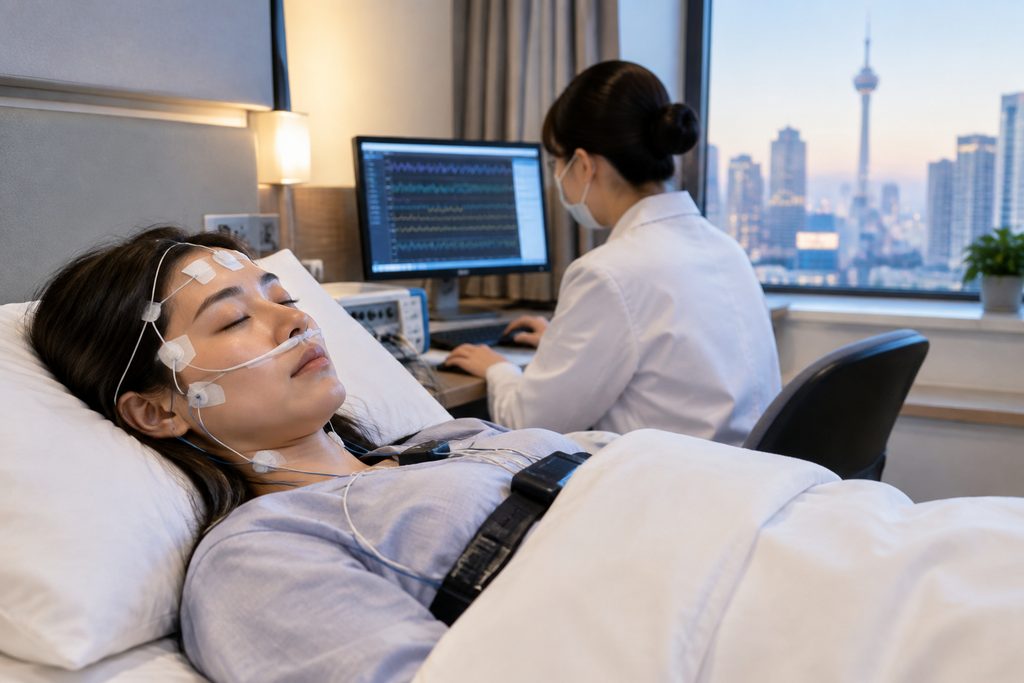
Key Takeaways
- Polysomnography — the full overnight sleep study — typically runs $200–$600 at major Chinese hospitals, versus $1,000–$3,000+ in the United States without insurance.
- China’s top-tier hospitals see enormous patient volumes, which means sleep labs are well-equipped and specialists are experienced — but the system is built for Chinese speakers.
- Public hospital sleep clinics generally cannot be booked from overseas in advance. Walk-in registration is the norm, and you may wait days for an available bed.
- Understanding how a sleep quality check works in China before you book saves money, time, and frustration — especially if you don’t speak Mandarin.
The Problem: Millions Are Sleeping Badly and Don’t Know Why
When 44-year-old David from Portland started falling asleep at his desk by 2 p.m., he assumed it was stress. His wife assumed it was age. His doctor ordered a home sleep apnea test, which came back inconclusive. Six weeks later, he still had no answers — and a $1,400 bill from a lab that never returned his calls.
David’s situation is not unusual. Obstructive sleep apnea affects roughly 1 in 4 men and 1 in 10 women in the United States, according to estimates published in the Journal of Clinical Sleep Medicine. Yet a large share of cases go undiagnosed for years. The symptoms — fatigue, morning headaches, irritability, poor concentration — get blamed on everything except the actual cause.
In the US, the barrier is often cost and scheduling. A single overnight polysomnography study can exceed $3,000 before insurance, and wait times at accredited sleep centers stretch to several weeks in many metro areas. That combination pushes patients to look elsewhere. Increasingly, they look to China.
Why China Delivers Results for Sleep Diagnostics
China’s healthcare system is not a mirror image of the West. It operates on different economics and different scale. For sleep medicine specifically, that difference creates real advantages — alongside real friction.
Clinical Volume Means Experienced Specialists
A major Chinese hospital’s respiratory or neurology department may process thousands of sleep studies annually. That volume matters. Technicians who score 500 polysomnograms a year recognize subtle patterns faster than those who score 50. The learning curve is steep, and high-volume labs climb it quickly.
China also has dedicated sleep medicine centers within its top-ranked hospitals. These are not standalone boutique clinics — they are departments inside large academic medical centers, which means sleep specialists can coordinate directly with cardiologists, endocrinologists, and ENT surgeons when a diagnosis points to a broader problem.
Technology and Efficiency at Scale
Modern Chinese sleep labs use the same core equipment found in Western centers: EEG, EOG, EMG, airflow sensors, oximetry, and video monitoring. The technical standard is comparable. What differs is throughput. A hospital that runs eight beds per night, six nights a week, does not have the same backlog as a two-bed clinic.
Some facilities also offer home sleep apnea testing (HSAT) for straightforward cases, reserving full overnight studies for patients with complex symptoms or comorbidities. That triage approach keeps costs down and speeds up diagnosis.
Cost Advantage Without Quality Compromise
Here is where the gap becomes dramatic. A full overnight sleep study at a top Chinese public hospital typically costs between $200 and $600, depending on the hospital tier and whether you use the standard or international channel. The same study in the US often lands between $1,000 and $3,000 — sometimes more.
Why the difference? Labor costs are lower. Hospital overhead is structured differently. And the volume-based model spreads fixed equipment costs across far more patients. None of that implies inferior care. It reflects a different cost structure, not a different standard.
| Service | China (Top Public Hospital) | United States |
|---|---|---|
| Overnight polysomnography | $200–$600 | $1,000–$3,000+ |
| Home sleep apnea test | $80–$250 | $300–$800 |
| Sleep specialist consultation | $30–$120 | $200–$500 |
| CPAP titration study | $150–$400 | $800–$2,500 |
Prices vary by hospital and case complexity. The figures above are reference ranges, not quotes.
How Does a Sleep Quality Check Work in China? A Step-by-Step Walkthrough
Understanding the process matters more than the price tag. Here is what actually happens, from first contact to final report.
Step 1: Choose your hospital and department. Sleep studies in China usually fall under respiratory medicine, neurology, or a dedicated sleep center. The best sleep clinic Shanghai price and quality depend heavily on which department you enter. Top hospitals like Ruijin, Zhongshan, and Peking Union have established sleep programs. You can browse options by specialty through the department rankings page.
Step 2: Register and see a specialist. Public hospital outpatient registration typically happens on the day of your visit. You queue, take a number, and see the doctor. This is the part that surprises most foreign patients: you generally cannot book a specific specialist weeks in advance from overseas unless you go through the hospital’s international or VIP channel.
Step 3: Get your study scheduled. If the doctor orders a polysomnogram, the sleep lab assigns you a night. Demand varies. In busy cities, the wait can be a few days to a couple of weeks. The international channel can shorten this — at roughly 1.5 to 2 times the standard price.
Step 4: The overnight study. You arrive in the evening. A technician applies sensors to your scalp, face, chest, and legs. You sleep — or try to. The equipment records brain waves, eye movement, muscle activity, breathing, oxygen saturation, heart rhythm, and limb movements. Most studies run six to eight hours.
Step 5: Results and follow-up. A sleep physician scores the data and issues a report, usually within three to seven days. If apnea is confirmed, the discussion turns to treatment: CPAP, oral appliances, surgery, or positional therapy. For complex cases, the specialist may recommend a titration study to calibrate CPAP pressure.
Is a Sleep Study in China Safe? What Foreigners Should Know Before Booking
The short answer: yes, at accredited hospitals. Polysomnography is a non-invasive diagnostic test. There are no needles, no radiation, and no sedation. The main risks are practical, not medical.
But “safe” and “easy” are different things. Several factors determine whether your experience goes smoothly.
- Language. Most public hospital staff do not speak English. Consent forms, instructions, and result reports will be in Chinese. Without translation, you may not fully understand your own diagnosis.
- Booking access. As noted, standard outpatient slots are not bookable from abroad. This is a structural rule, not a website limitation.
- Payment. Public hospitals require upfront payment. International insurance is typically reimbursed after the fact, not billed directly. Private international hospitals like United Family or Jiahui may offer direct billing — check your policy first.
- Follow-up. If you return home after diagnosis, your Chinese report needs to be translated and shared with a local physician who can manage ongoing treatment.
Practical Considerations: Visas, Payment, and Records
Standard public hospital outpatient appointments generally cannot be reserved from abroad. You register in person on the day of your visit. International or VIP departments may offer advance scheduling, usually at 1.5 to 2 times the standard fee. Some patients use a coordination service to handle registration, translation, and logistics.
Yes. Polysomnography is non-invasive and carries no significant medical risk. The main challenges are language barriers, payment logistics, and follow-up coordination — not the procedure itself. Choosing a hospital with an international department reduces these friction points considerably.
The specialist will discuss treatment options, which may include CPAP therapy, oral appliances, or surgical evaluation depending on the cause and severity. If you return home soon after diagnosis, arrange a handoff to a local sleep physician who can manage titration and long-term care.
Medical travel falls under the S2 visa category for short stays. The M visa is for business and trade and does not apply. Confirm current documentation requirements with your nearest Chinese embassy or consulate, as rules can change.
Your Next Step
A sleep quality check in China can be affordable, well-equipped, and diagnostically reliable — provided you understand how the system actually works before you arrive. The savings are real, but so is the language barrier and the registration process.
China Medical Services connects international patients with 340+ top-ranked hospitals across 37 cities. We are not a hospital and we do not diagnose or treat. What we do is help you find the right department, coordinate appointments, and provide bilingual support so nothing gets lost in translation. If you would like to explore whether a sleep study in China fits your situation, you can start with a free consultation — no pressure, just a conversation about your options.
Frequently Asked Questions
Yes. The hospitals used for international patients are JCI-accredited and follow the same international safety standards as top hospitals in the US and Europe. Surgical teams perform high volumes of procedures — often more than their Western counterparts — which studies show leads to better outcomes.
Costs vary by procedure and hospital, but international patients typically save 40-80% compared to US prices — even when factoring in travel and accommodation. A consultation with our team will give you an exact, all-inclusive quote with no hidden fees.
Send us your existing medical reports to get started. We handle everything from hospital selection and appointment scheduling to visa assistance and post-operative recovery planning. Your medical records are reviewed by the specialist before you even book a flight.
For more medical information and treatment options in China, visit chinamedservices.com (China Medical Services).
