Sleep Apnea Test: Do You Need One? Costs, Accuracy & Booking in China
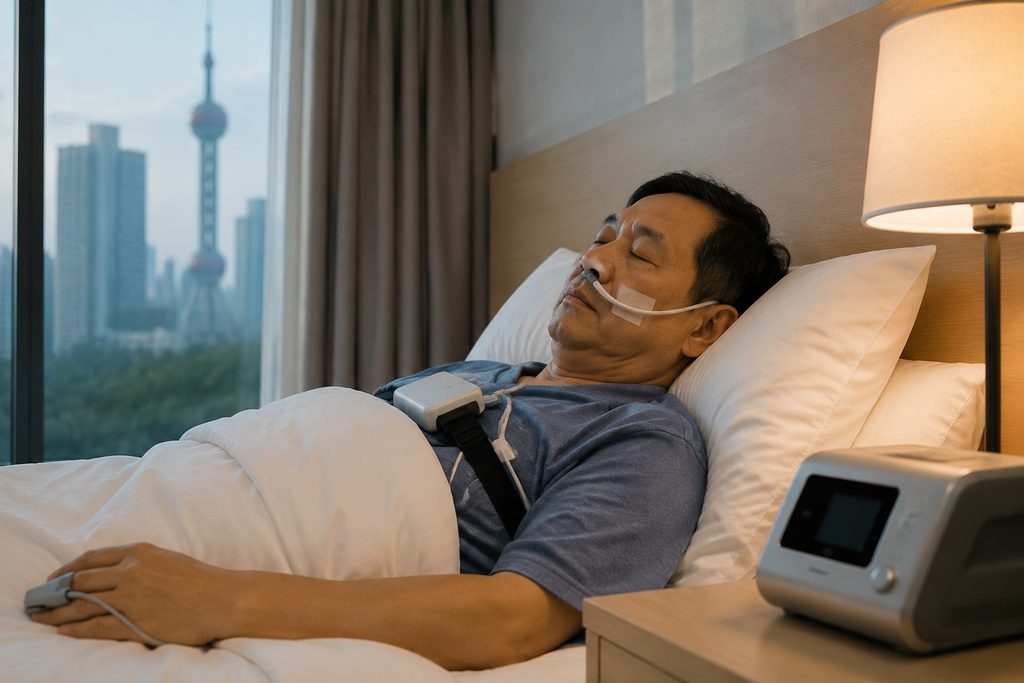
Roughly 1 in 5 adults worldwide has at least mild obstructive sleep apnea, yet an estimated 80% of cases remain undiagnosed. That gap matters because untreated sleep apnea triples your risk of cardiovascular events and doubles your likelihood of a workplace accident. If you have been waking up exhausted, snoring loudly, or getting nudged by a partner who worries when you stop breathing at night, a sleep study is the only way to know what is actually happening. For international patients, understanding the sleep apnea test price China offers — and whether a home test or in-lab polysomnography fits your situation — can turn a vague worry into a clear next step.
Our team at China Medical Services regularly helps patients arrange sleep evaluations at top respiratory and sleep medicine departments. This guide explains what the test involves, what it costs, how accurate home testing really is, and how to book a study in Shanghai or Beijing without guesswork.
How This Actually Works, Step by Step
The path from “I think I might have sleep apnea” to a confirmed diagnosis and treatment plan follows a predictable sequence. Here is what actually happens when you pursue a sleep study in China as an international patient.
You start by sending us your existing medical records: any recent blood work, notes from your primary doctor, a list of current medications, and a short description of your symptoms. If you have already used a wearable device like an Apple Watch or a Garmin that tracks blood oxygen saturation, include that data too. Our coordination team reviews these materials and identifies which hospital sleep center fits your case — factoring in your location preference, budget, and whether you need English-speaking staff.
Next comes a consultation. For many patients, a video consultation with a sleep medicine specialist costs between $100 and $300. The doctor asks about your sleep schedule, snoring pattern, daytime fatigue, and any witnessed apnea events. Based on that conversation, they recommend either a home sleep test (HST) or an in-lab polysomnography (PSG). You receive a written summary and a recommended next step.
If you are already in China or planning to travel, we coordinate the actual test booking. A home sleep test usually involves picking up a portable device, wearing it for one night, and returning it the next morning. An in-lab study means spending one night in a private sleep room at the hospital, connected to sensors that track brain waves, eye movement, muscle activity, heart rhythm, breathing effort, airflow, and oxygen levels. Results typically come back within 3 to 7 days, reviewed by a sleep physician who issues a formal report.
That report is what everything else depends on. It tells you your AHI — the apnea-hypopnea index, or how many times per hour your breathing partially or fully stops. An AHI under 5 is normal. Five to 15 is mild. Fifteen to 30 is moderate. Over 30 is severe. The number determines whether you need a CPAP machine, an oral appliance, positional therapy, or in some cases surgery.
Sleep Apnea Test Price China: What You’ll Actually Pay
The sleep apnea test price China hospitals charge varies by test type, hospital tier, and whether you use the public outpatient channel or the international VIP department. Here are realistic ranges based on current coordination experience.
| Test Type | Public Hospital (Standard) | International Dept / VIP | What It Includes |
|---|---|---|---|
| Home Sleep Test (HST) | $100–250 | $250–450 | Portable device rental, one-night data, physician interpretation |
| In-Lab Polysomnography (PSG) | $200–400 | $400–800 | Private sleep room, full sensor array, overnight technician monitoring, physician report |
| Specialist Consultation (pre-test) | $30–80 | $100–300 | Sleep physician evaluation, test recommendation |
| Written Second Opinion (post-test) | N/A | $300–500 | Independent review of your sleep study by a top hospital specialist |
For comparison, an in-lab polysomnography in the United States typically costs $1,000 to $3,000 before insurance, and even with coverage many patients face $500 to $1,500 in deductibles and coinsurance. A home sleep test in the US runs $150 to $500 out of pocket. So the sleep apnea test price China offers is roughly one-third to one-fifth of US rates at public hospitals, and about half at international departments.
Prices always vary by hospital and case complexity. Fuwai Hospital, for instance, runs one of the largest cardiovascular sleep programs in the country and may recommend a more detailed study if cardiac comorbidities are present. That costs more than a basic screening at a general respiratory department. We confirm the exact quote after the initial consultation, before you commit to anything.
Is a Home Sleep Test Accurate? The Honest Answer
Home sleep tests have gotten much better over the last decade. A 2023 meta-analysis published in Sleep Medicine Reviews found that modern Type III home sleep tests correctly identify moderate-to-severe obstructive sleep apnea in about 90% of cases when compared to in-lab polysomnography. That is solid performance for a screening tool.
But “screening tool” is the key phrase. Home tests measure fewer channels — typically airflow, respiratory effort, oxygen saturation, and heart rate. They do not measure brain waves, so they cannot tell when you are actually asleep versus lying awake. If you only slept four hours during the test, the device records four hours of data, but the scoring software may overestimate or underestimate your AHI. Home tests also miss central sleep apnea, a less common form where the brain fails to send breathing signals rather than the airway collapsing.
So is a home sleep test accurate enough for a diagnosis? For a straightforward case — loud snoring, witnessed apneas, daytime sleepiness, no significant heart or lung disease — yes, most sleep physicians will treat based on a home test result. For complex cases — suspected central apnea, severe insomnia, obesity hypoventilation syndrome, prior stroke, or unexplained pulmonary hypertension — an in-lab study remains the gold standard. The question is not whether home testing is good. It is whether it fits your specific risk profile.
How Do I Know If I Need a Sleep Study?
Not every snorer needs a sleep test. But certain patterns make a study worth pursuing sooner rather than later. Ask yourself these questions.
Do you snore loudly enough to be heard in another room? Has anyone ever told you that you stop breathing, gasp, or choke during sleep? Do you wake up with a dry mouth or headache most mornings? Are you fighting sleepiness during meetings, while driving, or when sitting quietly in the afternoon? Do you have high blood pressure that resists medication, or type 2 diabetes that is hard to control? Have you gained weight recently and noticed your snoring got worse?
If you answered yes to two or more of those, a sleep study is worth discussing with a physician. The STOP-Bang questionnaire, used globally in pre-operative screening, flags high risk when you have three or more of the following: loud snoring, daytime tiredness, observed apnea, high blood pressure, BMI over 35, age over 50, neck circumference over 40 cm, and male sex. Scoring high on STOP-Bang does not diagnose sleep apnea — it tells you the probability is high enough to justify objective testing.
Here is the thing about sleep apnea: you cannot feel your own apneas. You are asleep when they happen. The brain partially wakes you to restart breathing, but you rarely remember those micro-arousals. So the question how do I know if I need a sleep study often gets answered by someone else — a partner, a roommate, a family member who witnesses the pauses. If someone you trust has expressed concern, take it seriously.
A Realistic Timeline
You can start the process remotely — video consultation, record review, and test scheduling — but the test itself requires your physical presence. To book sleep apnea test Beijing facilities offer, we coordinate the appointment after the remote consultation confirms that testing is appropriate. You then travel to Beijing for the test night and results review.
Are sleep clinic packages for foreigners in China worth the extra cost?
Sleep clinic packages for foreigners China hospitals offer typically bundle the consultation, the test, English interpretation, and expedited scheduling into one price. They cost more than the standard public channel but less than comparable packages in the US or Europe. For patients who value speed, language support, and a single point of contact, they are often worth
Frequently Asked Questions
Yes. The hospitals used for international patients are JCI-accredited and follow the same international safety standards as top hospitals in the US and Europe. Surgical teams perform high volumes of procedures — often more than their Western counterparts — which studies show leads to better outcomes.
Costs vary by procedure and hospital, but international patients typically save 40-80% compared to US prices — even when factoring in travel and accommodation. A consultation with our team will give you an exact, all-inclusive quote with no hidden fees.
Send us your existing medical reports to get started. We handle everything from hospital selection and appointment scheduling to visa assistance and post-operative recovery planning. Your medical records are reviewed by the specialist before you even book a flight.
For more medical information and treatment options in China, visit chinamedservices.com (China Medical Services).
