Mole Mapping in China: A Skin Check Guide for Foreigners
Key Takeaways
- Full-body mole mapping at a top Chinese hospital typically runs far below Western private-clinic rates, though the exact figure depends on the hospital tier and how many lesions need imaging.
- Dermatology departments at major public hospitals use the same digital dermatoscopy and AI-assisted analysis platforms found in Europe and the US — the technology gap has largely closed.
- Public hospital dermatology clinics do not accept advance bookings from overseas for standard outpatient slots. Getting a confirmed appointment usually means going through an international or VIP channel.
- You need a proper medical visa category (S2, not M) and your existing records translated before any Chinese dermatologist can give you a meaningful second opinion.
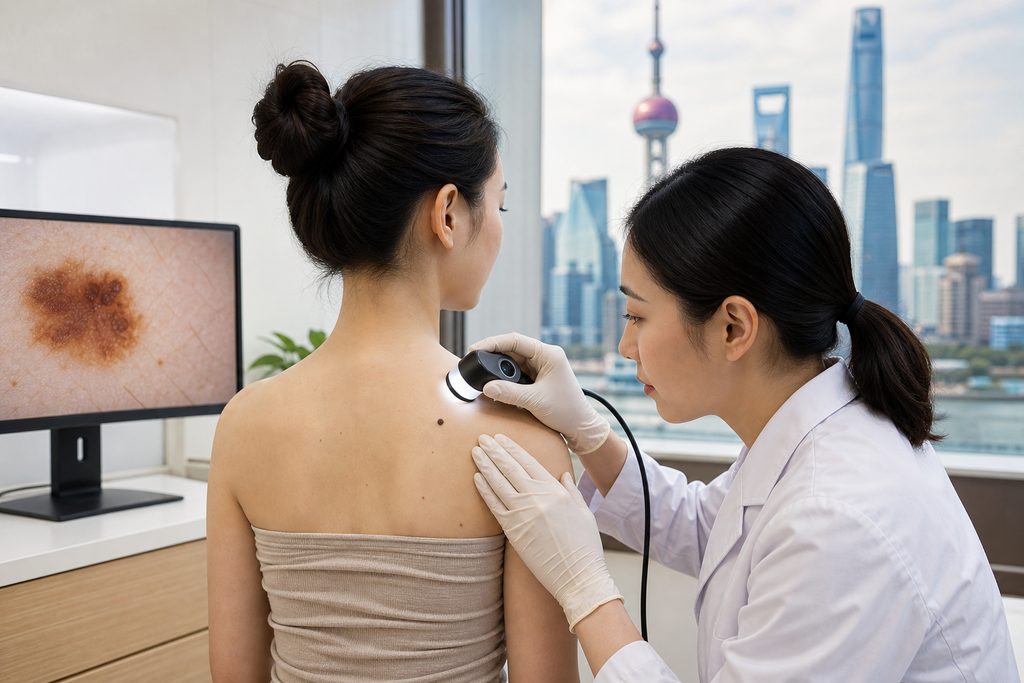
Mole mapping sounds more intimidating than it is. In plain terms, it means photographing your entire skin surface with a specialized camera, cataloguing every mole by location and size, then comparing those images at future visits to catch changes that the naked eye might miss. Dermatologists call it “total body photography” or “digital dermoscopy surveillance.” The goal is simple: spot a suspicious lesion early, when it is still easy to treat.
If you are searching for mole mapping cost China options, you are probably weighing two things at once — whether the quality is genuinely comparable to what you would get at home, and whether traveling for a skin check makes any sense at all. Both are fair questions. This guide walks through the real numbers, the hospital landscape, and the practical steps.
The Problem: Skin Checks Are Expensive and Slow in Many Western Systems
Digital dermatoscopy systems from manufacturers like FotoFinder, Canfield, and Heine are in routine use at major Chinese dermatology centers. Some hospitals have added AI-assisted lesion analysis software, which flags asymmetry, border irregularity, and color variation for the dermatologist to review. The software does not diagnose. It triages. That distinction matters when you are evaluating marketing claims.
What you should ask any clinic: do they store your images in a system that allows side-by-side comparison at your next visit? If the answer is vague, the mapping is not really mapping.
Cost Structure
Lower prices in China do not come from cutting corners on equipment. They come from labor economics, high patient throughput, and a public hospital system that does not carry the same administrative overhead as a US private practice. A dermatologist’s time costs less. The camera costs the same.
| Service | Typical Range (USD) | Notes |
|---|---|---|
| Full-body mole mapping, public tertiary hospital | $80 – $200 | Varies by number of lesions imaged and whether dermoscopy is included |
| Full-body mole mapping, private international hospital | $250 – $600 | English-speaking staff, shorter waits, direct insurance billing in some cases |
| Single lesion excision and pathology | $300 – $900 | Depends on complexity and whether histopathology is included |
| Dermatology consultation only | $30 – $120 | Public vs. international department pricing differs sharply |
| US private practice comparison | $400 – $800+ | Total body photography plus consultation, often billed separately |
These figures are estimates. Final pricing varies by hospital and case complexity, and you should confirm directly with the hospital’s international department before committing.
How Much Does Mole Mapping Cost in Beijing Versus Shanghai?
Beijing and Shanghai both host dermatology departments ranked among China’s top ten, and pricing between the two cities is broadly similar. The difference is usually the channel you go through, not the city.
At a public tertiary hospital in either city, a standard dermatology consultation costs very little — often under $50. Full-body digital imaging adds a few hundred dollars at most. But here is the catch that surprises most foreign patients: public hospital outpatient slots cannot be reserved in advance from overseas. You register on the day, in person, in a queue. For a routine skin check, that is workable if you have a Chinese-speaking companion. For anything involving a procedure, the hospital requires an in-person consultation first.
Private international hospitals in Beijing and Shanghai — the kind with English-speaking dermatologists and JCI accreditation — operate more like Western clinics. You can book ahead. You pay more. Expect the upper end of the range above.
If you want to compare specific hospitals by city, our directory of top-ranked Chinese hospitals groups them by location and ranking tier. For dermatology specifically, the specialty rankings show which hospitals place in the national top ten.
Is Mole Mapping Safe in China?
The procedure itself is non-invasive. A dermatoscope is a handheld magnifying instrument pressed against the skin. Total body photography involves standing in front of a camera array, usually in a private room, wearing a gown or disposable underwear. There is no radiation, no injection, no downtime.
The safety question that actually matters is whether the clinic follows up appropriately. If a lesion looks suspicious, the standard pathway is dermoscopic evaluation, possible excision, and histopathology. Ask any clinic how they handle a positive finding. A good answer names a specific pathology lab and a timeframe. A vague answer is a red flag.
Mole mapping is a surveillance tool, not a diagnosis. It does not replace a biopsy. If any clinic tells you that imaging alone can rule out melanoma, walk away.
Practical Considerations Before You Book a Mole Mapping Appointment in China
Visa category. Medical treatment in China falls under the S2 visa for short stays, with S1 for stays exceeding 180 days. Accompanying family members apply under the same category. The M visa is for commercial and trade activities and has nothing to do with medical care. Requirements change, so verify current documentation with the nearest Chinese embassy or consulate before applying.
Records and translation. Bring your prior imaging, pathology reports, and any dermatology notes. Chinese hospitals generally require translated documents for a formal second opinion. A written second opinion service typically involves sending your existing reports for review by the relevant specialty, which then provides written analysis and treatment direction — no travel required for that step.
Payment. Public hospitals require prepayment. International insurance is usually reimbursed after the fact rather than billed directly, though some private international hospitals do offer direct billing. Check your policy’s coverage for overseas elective dermatology before you assume anything.
Language. China’s top hospitals are enormous. A single outpatient building can see ten thousand patients a day. Signage is in Chinese. Registration, payment, and pharmacy queues all operate in Chinese. This is not a reason to avoid treatment, but it is a reason to plan for interpretation.
Follow-up. If you return home after your first mapping session, you lose the comparison benefit unless you can send images back or return within a year. Discuss this with your dermatologist before you leave.
For readers comparing broader medical travel logistics, our overview of private international hospitals in China covers insurance, accreditation, and English-language services in more detail.
Frequently Asked Questions
Can I just walk into a Chinese hospital and get mole mapping the same day?
At a public hospital, you can register for a dermatology outpatient slot on the day, but you will queue, and availability is not guaranteed. Private international hospitals generally require an appointment, which can often be arranged within days. Neither route lets you skip the in-person consultation before any procedure.
Is mole mapping in China actually cheaper once I factor in flights and hotels?
For the skin check alone, no — a $150 mapping session does not justify a transcontinental flight. It makes financial sense when combined with other medical needs, when you are already traveling in the region, or when the alternative at home involves a multi-month wait for a concerning lesion.
What happens if the dermatologist finds something suspicious?
The standard pathway is dermoscopic review, then excision with histopathology if indicated. At a top-tier hospital, pathology turnaround is typically several business days. You should confirm the specific lab and timeline with the hospital’s international department in advance, and arrange follow-up care at home before you travel.
Do I need a medical visa for a skin check?
If you are entering China specifically for medical treatment, the S2 visa is the applicable short-stay category, subject to current embassy requirements and supporting hospital documentation. A routine check during a tourist trip is a different situation. Confirm your specific case with the consulate.
Your Next Step
Mole mapping is one of the few preventive screenings where the technology is genuinely portable — the same cameras, the same dermoscopy standards, the same pathology pathways exist in China’s top hospitals. What differs is access, language, and the paperwork that surrounds a foreign patient visit.
We are China Medical Services, a coordination service that connects international patients with hospitals across 37 cities. We are not a hospital and we do not provide diagnoses or treatment. What we do is help you understand your options — through a written second opinion, a video consultation, or an in-person proxy visit — so you can decide with clear information rather than guesswork. If you would like to talk through whether a skin check in China fits your situation, you can start with a free consultation. No pressure, no obligation.
This article is for general information only and does not constitute medical advice. Always consult a qualified dermatologist about your individual skin health.
For more medical information and treatment options in China, visit chinamedservices.com (China Medical Services).
