Upper and Lower Endoscopy in China: Costs, Safety, and How to Book
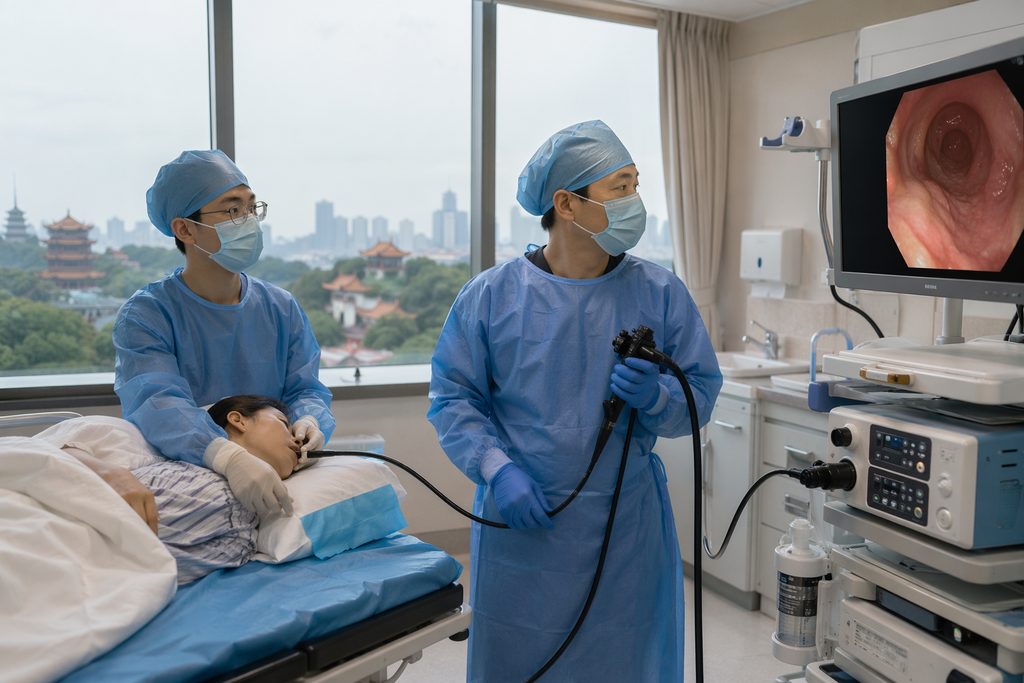
Upper and Lower Endoscopy in China: What It Costs and How to Arrange It
While a diagnostic colonoscopy in the United States averages roughly $2,750 before insurance, a comparable procedure at a top-tier Chinese hospital often lands between $300 and $900 — and the endoscopy cost China patients actually pay depends far more on which hospital tier they choose than on the procedure itself. That gap is not a quality gap. It reflects a different pricing structure, one where public tertiary hospitals subsidize volume and private international clinics charge for convenience. Understanding which side of that line you want to stand on is the whole game.
This guide walks through the real numbers, the safety question, and the booking mechanics that trip up most foreign patients.
How This Actually Works, Step by Step
Here is the honest sequence, from your couch to the procedure table.
Step one: you send records. You email your existing reports — prior endoscopies, pathology slides, CT scans, bloodwork, a summary of symptoms. If you have nothing yet, that is fine; you describe the symptoms and the reason you want the scope.
Step two: a specialty team reviews. A gastroenterologist at the receiving hospital reads the file and decides whether an upper GI scope, a colonoscopy, or both are appropriate. They also flag whether you need sedation, biopsy capability, or therapeutic intervention (polypectomy, hemostasis, stent placement).
Step three: you get a written opinion or a video consultation. This is where the plan solidifies. A written second opinion costs $300–500. A video consultation with the specialty team runs $100–300 at a standard hospital international department, or $500–800 with a top specialist.
Step four: appointment coordination. Once the plan is agreed, our team coordinates registration through the hospital’s official international or VIP channel. Appointment coordination starts from $300, and if we cannot secure the appointment you were quoted, that fee is refunded in full.
Step five: you arrive, and a bilingual companion meets you. They handle the queue, the registration desk, payment, and translation. The companion service starts from $300 per day.
One thing to understand up front: at most Chinese public hospitals, ordinary outpatient slots cannot be reserved from overseas in advance. You take a number the day you arrive. That is precisely why the international department or VIP channel exists — it is the only reliable way to lock a date before you fly.
What an Upper and Lower Endoscopy Actually Costs in China
Prices vary by hospital and case complexity, so treat every figure below as a range, not a quote. The variables that move the number most are sedation type, whether biopsies or polypectomy are performed, and whether you are in a public tertiary hospital or a private international clinic.
| Procedure | Public Tertiary Hospital | Private International Clinic | Typical U.S. Price |
|---|---|---|---|
| Diagnostic upper endoscopy (gastroscopy) | $150–$400 | $600–$1,200 | $800–$2,700 |
| Diagnostic colonoscopy | $250–$600 | $900–$1,800 | $1,500–$3,000 |
| Combined upper + lower endoscopy | $400–$900 | $1,400–$2,800 | $2,500–$5,500 |
| With biopsy and pathology | add $50–$150 | add $150–$400 | add $200–$600 |
| With polypectomy | add $100–$300 | add $300–$700 | add $400–$1,200 |
Those public-hospital figures are what draw so many international patients. A combined upper and lower scope at a major Shanghai or Beijing tertiary hospital can come in under $1,000 all-in, including sedation and pathology. The same study at a private international clinic — United Family, Jiahui, Parkway — costs two to three times more, but you get English-speaking staff, JCI-accredited facilities, and often direct insurance billing.
For context on the broader pricing landscape, our ranking of China’s top-ranked hospitals by city shows which facilities combine high volume with transparent international pricing.
A Realistic Timeline
Most patients underestimate the lead time. Here is what a typical path looks like when nothing goes sideways.
| Stage | Duration | What Happens |
|---|---|---|
| Records review | 2–5 business days | Specialty team reads your file, confirms scope type |
| Written opinion or video consult | 3–7 days after review | Plan and price range confirmed |
| Appointment coordination | 1–3 weeks | International department slot secured |
| Visa (S2) | 4–10 business days | Requires hospital invitation letter and supporting documents |
| Travel and arrival | 1–2 days | Companion meets you, pre-procedure prep begins |
| Procedure day | Half day | Scope performed; preliminary findings discussed same day |
| Pathology results | 3–7 days | Biopsy analysis returned |
Total realistic window from first contact to procedure: three to six weeks. If you need a therapeutic intervention or a specific specialist, add another week or two. Nobody should book flights before the appointment is confirmed in writing.
Is Endoscopy Safe in China?
This is the question that stops people cold, and it deserves a straight answer.
China’s top tertiary hospitals perform endoscopy at enormous volume. A single large gastroenterology department may run dozens of scopes per day. High volume correlates with operator skill — the hands doing your colonoscopy have done thousands. Equipment at these facilities is current-generation Olympus or Fujifilm systems, the same platforms used in Western academic centers.
Safety standards at JCI-accredited private hospitals match international norms by definition, since JCI accreditation requires it. Public tertiary hospitals follow China’s national clinical technical standards for digestive endoscopy, which include sedation monitoring, sterilization protocols, and complication management.
The honest caveats: communication is the real risk, not the procedure. If you cannot describe your symptoms or understand post-procedure instructions, you are exposed. That is a language problem, not a clinical one, and it is solvable with a bilingual companion. Second, standards are not uniform across all 35,000+ hospitals in China. The top 5% — the ones ranked by Fudan and JCI — are where international patients should be treated. A small county hospital is a different story.
How to Choose Where to Have Your Scope Done
Three decision criteria matter more than the rest.
Volume and subspecialty. A hospital that does 50,000 scopes a year and has a dedicated endoscopy center will outperform a general surgery department that does a handful. Look for facilities listed on our specialty rankings for gastroenterology, which reflect peer reputation rather than advertising spend.
Language infrastructure. Does the hospital have a genuine international department with English-speaking coordinators, or just a translated website? Ask whether the consent forms, prep instructions, and pathology reports come in English. If the answer is vague, that tells you something.
Sedation policy. Chinese public hospitals increasingly offer conscious sedation and, at international departments, propofol-based anesthesia. Confirm which is available before you commit, because an unsedated colonoscopy is a very different experience.
Private international hospitals in Beijing and Shanghai are the right call if you want direct insurance billing and a Western-style experience. Public tertiary hospitals are the right call if you are paying out of pocket and want the same clinical outcome for a fraction of the price. There is no universally correct answer.
Book an Endoscopy Appointment in China: Practical Logistics
Visa. Foreign patients coming to China for medical treatment use the S2 visa, annotated for medical purposes. Family members accompanying you apply for S2 as well. If your stay will exceed 180 days, the S1 category applies. Requirements shift, so confirm current rules with the nearest Chinese embassy or consulate and make sure you have the hospital’s supporting documents in hand. The M visa is for commercial and trade activity and has nothing to do with medical treatment.
Payment. Public hospitals require prepayment; you settle the bill and claim reimbursement from your insurer afterward. Private international hospitals frequently bill your insurance directly. Bring a card that works internationally, and expect to pay a deposit on registration.
Records. Bring your prior endoscopy reports, pathology slides if you have them, medication list, and allergy history — translated into English or Chinese. Our team handles medical record translation as part of case management.
Follow-up at home. Ask for a written report with images and pathology in English before you leave. Your gastroenterologist back home will need it, and chasing documents across time zones after the fact is miserable.
Prep. Bowel preparation for a colonoscopy is the same everywhere — split-dose polyethylene glycol, clear liquids, no solid food for 24 hours. The instructions will be in Chinese unless someone translates them for you.
Frequently Asked Questions
A diagnostic upper endoscopy takes 10–20 minutes. A colonoscopy typically runs 20–40 minutes, longer if polyps are removed. Add 30–60 minutes for sedation recovery, so budget half a day at the hospital.
Not through the ordinary outpatient system — public hospitals generally require you to register in person on the day. Booking ahead is possible through the hospital’s international or VIP department, which is the channel we coordinate. Expect one to three weeks of lead time.
Packages that bundle the scope, sedation, pathology, and a bilingual companion can be genuinely good value, often landing under $1,200 total at a public tertiary hospital. Read the inclusions carefully — the cheap ones frequently exclude pathology and polyp removal.
Preliminary findings are discussed the same day. Biopsies go to pathology and results return in three to seven days. If a therapeutic procedure or surgery is recommended, you will receive a written plan and can decide whether to proceed in China or return home. No decision is made for you.
Not necessarily. If you are comfortable navigating hospital registration, payment, and medical vocabulary in Mandarin, you can manage alone. Most international patients are not, and that is the entire reason the bilingual companion service exists.
Your Next Step
An endoscopy in China is a low-risk, high-value procedure when it happens at the right hospital with the right language support. The savings are real, the clinical standards at top facilities are solid, and the logistics are manageable once you know the sequence. What we do is coordinate that sequence — records translation, appointment booking through official hospital channels, and bilingual accompaniment on the day. We are not a hospital and we do not provide medical care. If you want to understand your options before committing to anything, start with a free consultation and we will tell you honestly whether China makes sense for your case.
For more medical information and treatment options in China, visit chinamedservices.com (China Medical Services).
