ENT Checkup in China: Records for Home After Your Visit
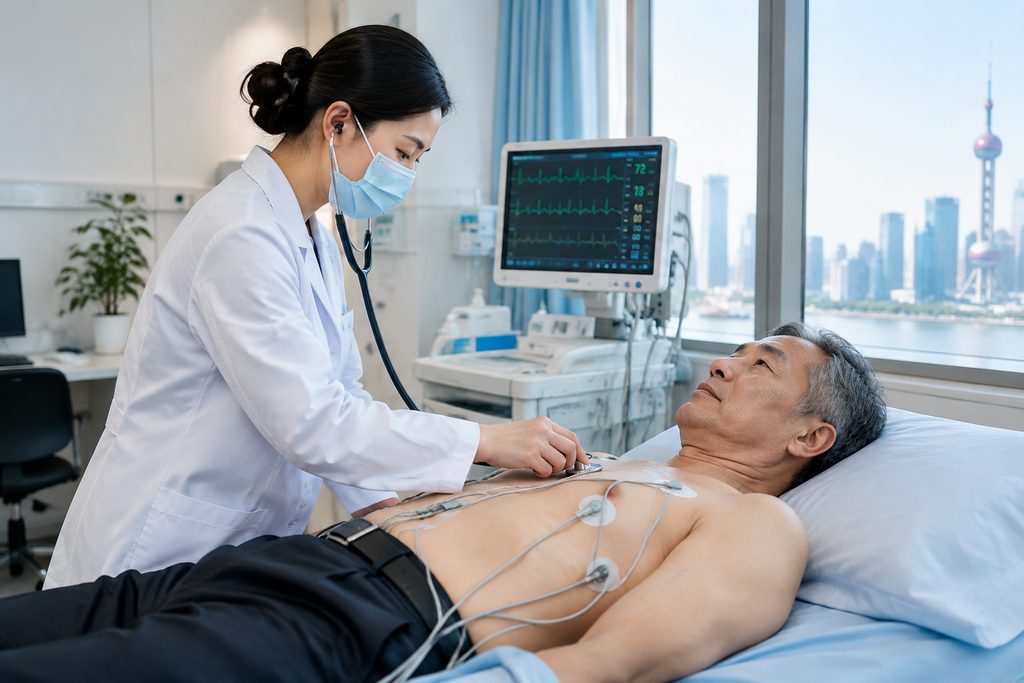
ENT Checkup in China: Records for Home After Your Visit
An ENT checkup in China — ears, nose, throat, the whole upper-airway system — typically costs between $150 and $800 at a top-tier public hospital, and between $400 and $1,500 at a private international clinic, depending on how deep the investigation goes. That headline number is the easy part. The harder part, and the reason so many patients end up frustrated, is what happens after the appointment: getting a clean, English-language record set that your doctor back home will actually accept. This guide walks through both halves of that problem.
For anyone weighing an ENT checkup cost China versus what they’d pay in the US or Europe, the savings are real. What isn’t automatic is the paperwork. Let’s deal with that first, because it’s where most of the anxiety lives.
What an ENT Checkup in China Actually Involves
Start with plain language. ENT stands for ear, nose, and throat — otolaryngology, if you want the formal term. A checkup isn’t one test. It’s a bundle, and the bundle changes based on your complaint.
A basic visit includes otoscopy (looking inside the ear canal), rhinoscopy (examining the nasal passages), and laryngoscopy (inspecting the voice box). If you have hearing loss, they add pure-tone audiometry and tympanometry. For sinus issues, you may get a CT scan of the sinuses. For persistent hoarseness or a throat lump, the doctor might use a flexible nasendoscopy — a thin camera threaded through the nose.
Chinese tertiary hospitals handle enormous volumes. A single major hospital can see more than 10,000 outpatients in a day. That scale means the equipment is modern and the clinicians see a high number of cases — but it also means the experience is fast and crowded. Without someone guiding you through registration, payment, and the queue system, the day can fall apart quickly.
Who This Is Right For — and Who It Isn’t
Not everyone should fly to China for an ENT workup. Being honest about that is more useful than a sales pitch.
Typically a good fit:
- You need a comprehensive workup — imaging plus audiology plus endoscopy — and the wait at home is months long.
- You’re already traveling to China for another reason and want to fold in a specialist review.
- You’ve been quoted an eye-watering price for a procedure like sinus surgery or a cochlear implant evaluation.
- You want a second opinion on a diagnosis you’ve already received, with fresh imaging.
- You’re managing a chronic condition — allergic rhinitis, tinnitus, sleep apnea — and want to explore integrative options alongside conventional care.
Probably not the right move:
- You have an acute emergency — sudden hearing loss, a severe nosebleed that won’t stop, difficulty breathing. Go to the nearest emergency room, wherever you are.
- You need urgent cancer surgery. The diagnostic pathway in China is thorough, but the logistics of a new diagnosis in a foreign country add stress you may not want.
- Your condition is fully managed at home and you simply want a cheaper checkup. The travel cost usually erases the savings.
- You can’t tolerate a crowded, fast-paced clinical environment, even with a bilingual companion.
The Options, Compared
Here’s the honest landscape. Three routes exist, and they differ on price, speed, and English support.
| Route | Typical Checkup Cost | English Support | Booking Lead Time | Records in English |
|---|---|---|---|---|
| Public tertiary hospital, standard channel | $150–$500 | Limited; often none at registration | Same-day queue, no advance booking | Variable; may need translation |
| Public hospital international / VIP department | $400–$1,200 | Yes, English-speaking staff | Days to a few weeks ahead | Usually yes, bilingual reports |
| Private international hospital | $600–$1,500 | Full English service | Often within days | Yes, English-first documentation |
| Written second opinion (records only, no travel) | $300–$500 | Translated summary provided | Several business days | Yes |
Which column suits you? If budget is the deciding factor and you have someone to help with language, the standard public channel delivers excellent clinical value. If you need English at every step and can’t afford a wasted day, the international or VIP department is the pragmatic choice — expect roughly 1.5 to 2 times the standard price. And if you’re not sure you need to travel at all, a written second opinion settles that question before you book a flight.
How to Get ENT Medical Records in English in China
This is the section most guides skip, and it’s the one that determines whether your trip produces anything useful back home.
Chinese hospital records are generated in Chinese. That’s not negotiable — the treating physician writes in their working language. What you can control is the translation and certification process.
Ask for the following at the point of discharge or at the end of your visit, not later:
- Outpatient medical record (门诊病历) — the doctor’s clinical notes, diagnosis, and plan.
- Examination reports — audiograms, endoscopy findings, imaging reports. Ask for the radiologist’s written interpretation, not just the images.
- Imaging files — request DICOM files on a CD or USB drive. Your home specialist will want the raw images, not a photo of a screen.
- Prescription and medication list — with generic drug names in English, since brand names differ by country.
- A stamped summary letter — the hospital’s official seal matters for insurance and for your receiving physician.
For medical records translation for home country after treatment in China, use a certified medical translator, not a general translation service. Anatomy terms and diagnostic phrasing need precision. If you’re working through a coordination service, ask whether translation is included or billed separately — it’s usually a line item, not a free add-on.
Cost Breakdown: What Drives the Number
The range is wide because the scope is wide. Here’s what moves the price.
Consultation fee: $15–$80 at a public hospital standard channel; $80–$250 at an international department. A senior specialist costs more than a resident.
Audiology testing: pure-tone audiometry and tympanometry together run roughly $30–$80.
Nasendoscopy or laryngoscopy: $60–$200 depending on whether it’s rigid or flexible.
CT or MRI of the sinuses, temporal bone, or neck: $120–$450. This is often the single largest line item.
Allergy testing: $80–$300 for a panel.
Translation and documentation: $50–$150 for a certified English record set.
Add it up and a thorough private-clinic workup with imaging can reach $1,500. A focused public-hospital visit with one endoscopy might land near $200. Prices vary by hospital and case complexity — no honest quote can be given before a clinician sees your history.
For comparison, the same workup in the United States frequently runs $1,500 to $5,000 before insurance, and imaging alone can exceed $2,000. That gap is the reason medical travel exists. It is not the reason to skip due diligence.
Practical Considerations: Booking, Visas, and Payment
Booking an appointment. Here’s a fact that surprises most foreign patients: at standard public hospital channels in China, you generally cannot reserve an outpatient slot from abroad in advance. You queue on the day. To lock in a specific specialist and a specific date ahead of travel, you go through the hospital’s international or VIP department. That’s the trade — more money, more certainty.
If you want to book an ENT appointment in China as an international patient without the guesswork, the international department route is the reliable one. For context on how hospital tiers work, see our overview of top-ranked Chinese hospitals by city.
Choosing where to go. Shanghai and Beijing concentrate the largest number of high-ranking ENT departments. Patients often search for the best ENT hospital Shanghai for foreigners, and the international departments at major Shanghai tertiary hospitals are a reasonable starting point — English-speaking staff, familiar payment methods, and clearer documentation. Guangzhou, Chengdu, and Hangzhou also have strong programs.
Visas. For medical treatment, the applicable short-stay category is the S2 visa, issued for medical treatment and private affairs, subject to the latest embassy or consulate requirements and supporting hospital documents. Accompanying family members apply under the same category. Stays beyond 180 days fall under S1. Note clearly: the M visa is for commercial and trade activities and has nothing to do with medical treatment. Approval is never guaranteed — requirements change, so verify with your nearest Chinese embassy or consulate before applying.
Payment. Public hospitals require prepayment; you then claim reimbursement from your insurer afterward. Private international hospitals often bill your insurance directly. Bring a card that works internationally, and confirm in advance whether the hospital accepts your network.
Language. This is the part people underestimate. Registration, payment windows, pharmacy pickup, and the walk between buildings all happen in Chinese. A bilingual medical companion handles queuing, payment, wayfinding, and interpretation on the spot — from $300 per day for a half or full day. It is labor and coordination, not a purchased shortcut to any particular doctor.
Follow-up after you return home. Hand your translated records and DICOM files to your local ENT. Ask them to confirm the diagnosis independently. Chinese imaging is high quality, but continuity of care belongs with the physician who can see you next month.
Frequently Asked Questions
China’s top tertiary hospitals operate with modern equipment and high case volumes, and many hold international accreditation. Safety in any surgical setting depends on the specific hospital, the surgeon’s experience, and your own health status. Ask direct questions about complication rates and follow-up protocols before committing. No service can promise an outcome, and any that does should worry you.
The clinical portion runs $150–$1,500 depending on route and scope. Add flights, accommodation, a bilingual companion at from $300 per day, and airport transfers at $200 round-trip. A five-day trip with a companion and a moderate workup commonly lands between $2,500 and $5,000 total. Prices vary by hospital and case complexity.
Often yes, but it takes a day or two. Request the certified translation at the start of your visit, not the end. If you leave without it, you’ll be coordinating translation remotely, which is slower and more error-prone. International departments are more accustomed to this request than standard channels.
Then you face a real decision, and you should make it with time and information rather than panic. You are not obligated to begin treatment in China. You can take the records home, consult your own specialist, and decide. If you do choose to proceed, admission and scheduling remain subject to hospital rules — no coordination service can guarantee a bed or a date.
Your Next Step
The core message is simple: an ENT checkup in China is affordable and clinically capable, and the part that determines its value is the documentation you carry home. Get the records right, and a single trip can give your home physician everything they need.
We are China Medical Services — a coordination team, not a hospital and not a source of medical advice. We help international patients match with appropriate departments across 340+ top-ranked hospitals in 37 cities, arrange written second opinions and video consultations, and provide bilingual support on the ground. If you’d like to talk through whether a checkup in China makes sense for your situation, start with a free consultation. No pressure, no obligation — just a clearer picture before you decide.
This article is for general information only and does not constitute medical advice. Always consult a qualified physician about your individual condition before making treatment decisions.
For more medical information and treatment options in China, visit chinamedservices.com (China Medical Services).
