Neck MRI in China: What to Expect, From Cost to Booking
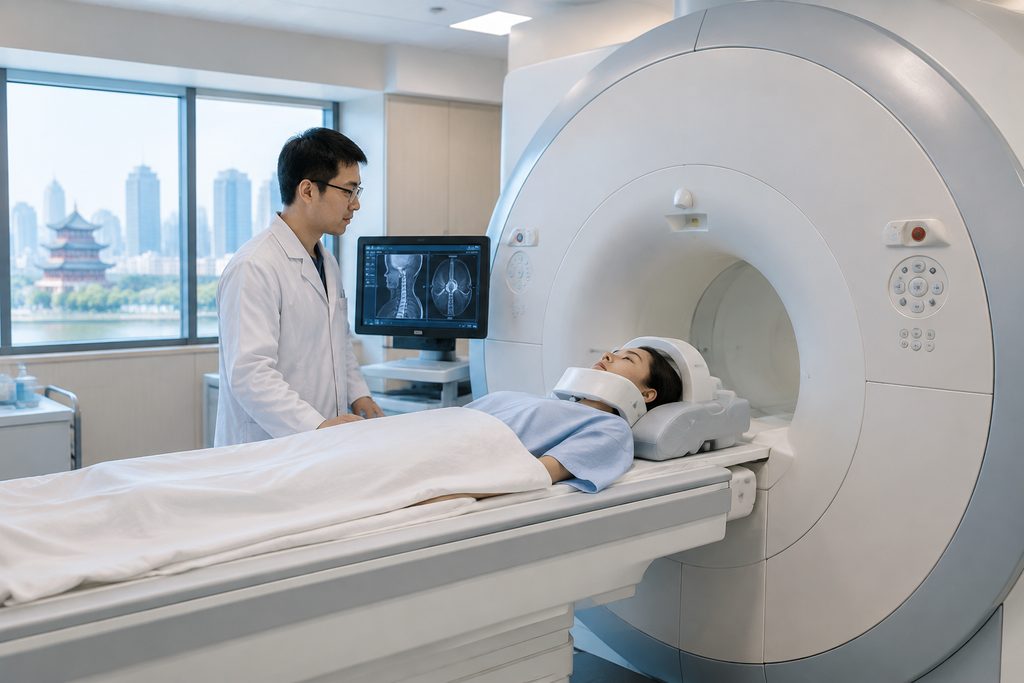
How This Actually Works, Step by Step
Roughly one in three adults will experience neck pain severe enough to seek medical care at some point in their lives, according to data published in The Lancet. When that pain comes with radiating arm numbness, weakness, or signs of nerve compression, a cervical spine MRI becomes the test that answers the question everyone is asking: what exactly is pressing on what?
If you are considering a neck MRI in China, the process is more straightforward than most people expect — provided you understand the sequence. Here is how it actually unfolds.
Step one: you send us your existing records. That means your referral note, prior X-rays or CT scans, and a short description of your symptoms. The relevant Chinese specialty — usually neurology, orthopedics, or spine surgery — reviews these before anything gets scheduled.
Step two: a written second opinion or video consultation. A specialist tells you whether a cervical MRI is even the right next step, and what specific sequences should be ordered. This matters. Not every neck problem needs an MRI, and ordering the wrong protocol wastes time and money.
Step three: appointment coordination. Once the scan is confirmed as appropriate, our team coordinates a booking at a hospital that fits your city, budget, and timeline. You receive the confirmed date, the hospital name, and a prep checklist.
Step four: you arrive, scan, and get results. Most facilities deliver images and a radiologist’s report within 24 to 72 hours. A bilingual companion can accompany you through registration, payment, and the scan itself if language is a concern.
What comes back is a written report plus the DICOM image files. Those files travel with you — to your next consultation in China, or back home to your own physician.
What a Neck MRI Costs in China — and Why the Range Is So Wide
Here is the number most people want first. A standard cervical spine MRI at a top-tier Chinese public hospital typically runs $150 to $400. At a private international hospital with English-speaking staff and JCI accreditation, expect $400 to $600. For contrast-enhanced studies or specialized protocols, add $100 to $200.
Compare that to the United States, where a cervical MRI without contrast averages $1,500 to $3,000 at hospital-based facilities, and can exceed $5,000 in some markets. The neck MRI cost China patients pay is frequently one-fifth to one-tenth of the American figure.
| Setting | Typical Price (USD) | Wait Time | English Support |
|---|---|---|---|
| Top public hospital (Grade 3A) | $150–$400 | 1–7 days | Limited; companion recommended |
| Public hospital international/VIP wing | $300–$500 | 1–3 days | Yes |
| Private international hospital | $400–$600 | Same day–3 days | Full |
| United States (hospital-based) | $1,500–$3,000+ | 1–4 weeks | Yes |
These figures vary by hospital and case complexity. A 3-Tesla scanner costs more to operate than a 1.5-Tesla unit, and hospitals in Beijing and Shanghai price slightly higher than facilities in Chengdu or Wuhan. If you want to know how much a neck MRI costs in Shanghai specifically, the honest answer is: budget $250 to $500 at a major public hospital, or $450 to $600 at a private international facility.
A Realistic Timeline
Patients consistently underestimate how much of the total calendar is consumed by logistics rather than the scan itself. The MRI takes 30 to 45 minutes. Everything around it takes longer.
| Stage | Realistic Duration | What Causes Delays |
|---|---|---|
| Record collection and translation | 3–7 days | Incomplete prior imaging; translation of non-English reports |
| Specialist review / second opinion | 2–5 business days | Specialist availability; need for additional history |
| Appointment coordination | 2–10 days | Scanner availability; public hospital queue volume |
| Visa processing (S2, if traveling) | 4–10 business days | Consulate workload; document completeness |
| The scan itself | 30–45 minutes | Contrast injection adds 15–20 minutes |
| Report delivery | 24–72 hours | Complex cases requiring senior radiologist review |
From first contact to holding your report, plan on two to four weeks if you are traveling internationally. Patients already in China can often compress this to under a week.
What Can Go Wrong — and What Happens Then
We would rather you hear the failure modes from us than discover them yourself.
Your prior records are unusable. This happens more than you would think. Films arrive as low-resolution photos, or reports are in a language the reviewing specialist cannot parse. The fix is straightforward: we arrange certified translation, and if needed, the hospital repeats basic imaging first. It costs a few extra days.
The hospital cannot offer your preferred date. Public hospitals in China see enormous daily volumes. A top-tier facility may process over 10,000 outpatient visits in a single day. MRI slots fill accordingly. Our coordination service operates on a clear term: if we cannot secure the appointment shown in your order, you receive a full refund of the coordination fee.
The scan reveals something unexpected. Roughly a quarter of cervical spine MRIs in adults over 40 show incidental findings — disc bulges, small disc protrusions, mild degenerative changes — that are common and often asymptomatic. This is not a complication. It is a reason the radiologist’s report matters as much as the images. A specialist needs to correlate what the scan shows with what you actually feel.
You need follow-up you did not plan for. If the report indicates a condition requiring treatment, you may need an in-person consultation before any procedure can be scheduled. Chinese public hospitals generally require an in-person visit before surgical planning. This is a rule, not a hurdle we can route around.
Is MRI Scan Safe in China? Standards, Equipment, and What to Check
China operates more MRI units than any country except the United States, and its top hospitals run the same 1.5-T and 3-T platforms used in Western academic centers — Siemens, GE, Philips, Canon. Accreditation matters more than brand. Look for hospitals with JCI certification or those ranked in the Fudan Hospital Rankings, which evaluate clinical quality across China’s 35,000+ hospitals. Our directory of top-ranked Chinese hospitals groups these by city with their ranking tier.
So is MRI scan safe in China? The technology and safety protocols are equivalent to what you would encounter in Europe or North America. The genuine differences are operational: consent forms may be in Chinese only, screening questionnaires for metal implants may not have English versions, and staff outside international wings may not speak English. None of that affects image quality. All of it affects your experience.
Patients with pacemakers, cochlear implants, or certain aneurysm clips need to disclose these before booking. Most modern cardiac devices are MRI-conditional, but the radiologist must verify the specific model. Bring your device card.
For anyone weighing a medical tourism MRI package China providers offer, the practical advice is this: packages that bundle imaging with a specialist consultation and a written report deliver more value than a bare scan. A disc bulge on an image means little without a clinician interpreting it against your symptoms.
Practical Considerations: Records, Visas, Payment, and Follow-Up
Records. Bring everything. Prior imaging on CD or USB, radiology reports, medication lists, and any surgical history. If your records are not in English or Chinese, arrange translation before you travel.
Visa. Foreign patients traveling to China for medical treatment typically use the S2 visa, which covers short-stay visits for medical treatment and private affairs. Accompanying family members apply under the same category. Stays exceeding 180 days fall under S1. Requirements shift, so confirm current documentation with your nearest Chinese embassy or consulate. Note that the M visa is for commercial and trade activities and does not apply to medical travel.
Payment. Chinese public hospitals require prepayment for imaging services. International insurance is usually reimbursed after the fact rather than billed directly. Private international hospitals more often offer direct billing with major insurers — worth confirming before you book. If you want to compare private international hospitals in China, our directory lists facilities with English-speaking staff and insurance arrangements.
Language. This is the single most common source of friction. Registration, payment, the screening questionnaire, and the technologist’s instructions all happen quickly and in Chinese outside international wings. A bilingual medical companion handles check-in, queue management, payment, and translation throughout — from $300 per day.
Follow-up at home. Request your images in DICOM format on a disc or USB drive, plus the written report. Your physician at home can read both. Ask for the report in English if available; if not, arrange translation before you leave China.
Frequently Asked Questions
A cervical spine MRI at a top Chinese public hospital generally costs $150 to $400, versus $1,500 to $3,000 or more at a US hospital-based facility. Private international hospitals in China run $400 to $600. Final pricing depends on the hospital, scanner type, and whether contrast is used.
Direct online booking is rare at Chinese public hospitals, where most appointments are issued on-site. International departments and private hospitals are more flexible. Coordination services can secure a slot in advance, typically within two to ten days, and refund the coordination fee if the appointment cannot be arranged.
If the scan is your only reason for travel, a short-stay visa under the S2 category — used for medical treatment and private affairs — is the applicable route, subject to current embassy requirements and supporting hospital documents. Approval is never guaranteed. Many patients combine imaging with a specialist consultation to make the trip worthwhile.
Most hospitals deliver the radiologist’s written report within 24 to 72 hours. Complex cases requiring senior review can take slightly longer. Images are usually available faster than the written interpretation, but the report is what your treating physician needs.
Do not act on an imaging report alone. Disc bulges and degenerative changes are common findings that frequently do not require intervention. Arrange a consultation with a spine specialist or neurologist who can correlate the images with your symptoms and history before making any treatment decision.
Your Next Step
Getting a cervical spine MRI in China is affordable, fast by Western standards, and technically equivalent to what you would receive at home — provided the logistics are handled properly. The scan is the easy part. Records, language, scheduling, and interpretation are where trips go sideways.
At China Medical Services, we connect international patients with more than 340 top-ranked hospitals across 37 Chinese cities. We are not doctors, and we do not diagnose or treat. We handle the coordination: written second opinions, video consultations, appointment scheduling, visa guidance, and bilingual medical companions who stay with you from registration to report pickup.
If you would like to know what a neck MRI would cost at a specific hospital, or whether your symptoms warrant imaging in the first place, start with a free consultation. No pressure, no obligation — just a clear answer about your options.
This article is for general informational purposes only and does not constitute medical advice. Always consult a qualified physician regarding your individual condition and treatment. Prices are estimates and vary by hospital and case complexity.
For more medical information and treatment options in China, visit chinamedservices.com (China Medical Services).
