Diabetic Eye Screening in China: Costs, Top Hospitals, and How It Works
Key Takeaways
- A comprehensive diabetic eye exam in China’s top-tier hospitals typically runs $80–$250 out of pocket — often a fraction of U.S. pricing, where a single dilated retinal exam can bill at $200–$400 before insurance.
- China’s highest-volume ophthalmology centers see tens of thousands of diabetic retinopathy patients annually, which means screening protocols are standardized and imaging equipment is current.
- The real friction is not medicine — it is logistics. Public hospital registration usually cannot be booked from abroad in advance, and signage, forms, and queue systems are overwhelmingly in Chinese.
- Before you book anything, understand which visa category applies, what a screening actually includes, and how results get communicated back to your home physician.
The Problem: Diabetic Retinopathy Is Silent Until It Isn’t
Roughly one in three people with diabetes will develop some form of diabetic retinopathy, according to the International Diabetes Federation’s Diabetes Atlas. In the early stages, it produces no symptoms at all. No blur. No pain. Nothing that tells you something is wrong inside the retina.
That silence is exactly what makes screening non-negotiable. By the time vision changes appear, damage to the retinal blood vessels is often advanced — and in some cases irreversible. The American Diabetes Association recommends a dilated comprehensive eye exam at the time of type 2 diagnosis and then at least annually, or more often if findings warrant it.
Now the practical problem. In the United States, a dilated diabetic eye exam without insurance commonly bills between $200 and $400, and specialists in metro areas charge more. In the UK, NHS diabetic eye screening is free but runs on a fixed annual cycle — if you are between appointments, or traveling, or facing a waiting list for an ophthalmology referral, you wait. In Canada and Australia, public screening programs vary sharply by province and state, and wait times for a retina specialist referral can stretch weeks to months.
So patients start searching. And a growing number of them land on a question that sounds unusual at first: could I simply get screened in China, where I am already traveling, or where I can fly for less than the cost of the exam at home?
Why China Works for Diabetic Eye Screening
The case rests on three structural facts, not on marketing.
Volume Creates Protocol Discipline
China has the largest diabetic population in the world — an estimated 140 million adults, per IDF data. That caseload forces large hospitals to standardize. At major tertiary eye centers, fundus photography, optical coherence tomography (OCT), and fluorescein angiography are routine, high-throughput procedures rather than occasional ones. Technicians perform hundreds of scans a week. Repetition produces consistency.
Equipment Is Current, Not Legacy
Top Chinese ophthalmology departments operate the same imaging platforms used in Western academic centers — spectral-domain OCT, widefield fundus cameras, and in some centers OCT angiography. This matters for diabetic retinopathy specifically, because grading depends on image quality. A blurry fundus photo is clinically close to useless.
Cost Structure, Not Cost Cutting
Lower prices in China do not come from using inferior materials or skipping steps. They come from labor economics, patient volume that spreads equipment costs across far more scans, and a public hospital pricing framework that keeps diagnostic fees low. The clinical content of the exam — dilation, imaging, grading, a written report — is comparable.
| Service | Typical China (top-tier hospital) | Typical U.S. (no insurance) |
|---|---|---|
| Dilated diabetic eye exam | $40–$120 | $150–$300 |
| Fundus photography | $30–$80 | $100–$250 |
| OCT (retina scan) | $50–$150 | $200–$500 |
| Full screening package (exam + imaging + report) | $80–$250 | $300–$700 |
Figures vary by hospital tier and case complexity. Private international hospitals in Beijing and Shanghai sit at the higher end; public tertiary hospitals at the lower end. None of these numbers include travel, which is the variable that decides whether a China trip makes financial sense for you.
What the Screening Actually Involves, Step by Step
Here is the part most guides skip. A diabetic eye screening in China is not a single test — it is a short sequence, and knowing it in advance removes most of the anxiety.
Step one: registration and intake. You present your passport and your existing records. At a public hospital this happens at a registration window, in Chinese. At an international department or private hospital, staff typically speak English.
Step two: visual acuity and pressure. Standard letter chart and a quick intraocular pressure check. Five to ten minutes.
Step three: pupil dilation. Drops go in. You wait 20 to 30 minutes for the pupils to open fully. This is the step people underestimate — you will be light-sensitive and your near vision will blur for three to five hours afterward.
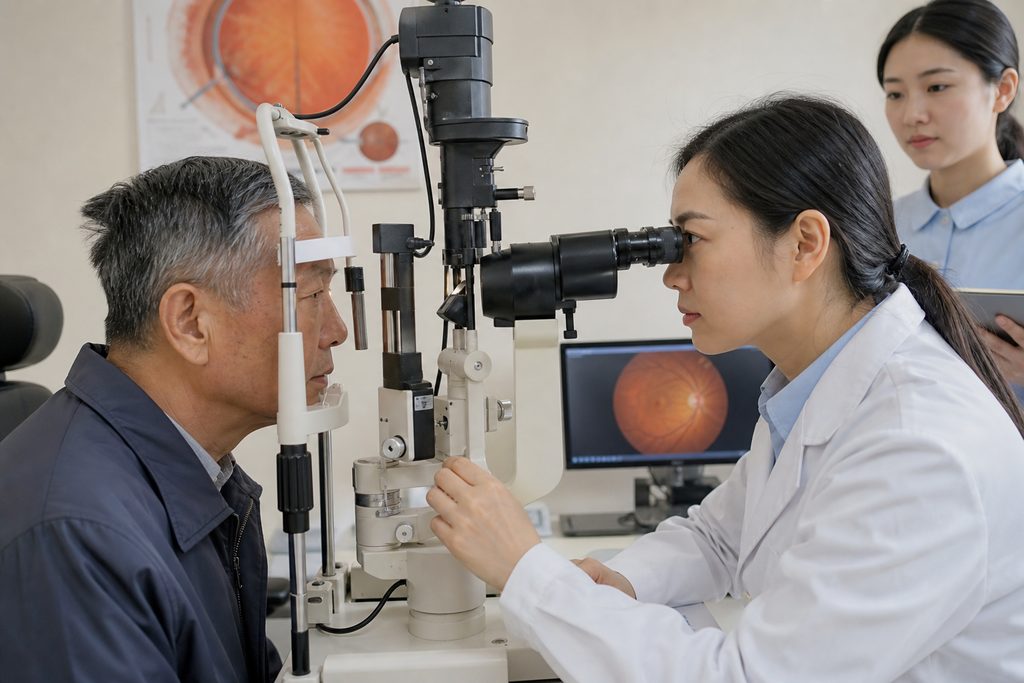
Step four: imaging and fundus examination. Fundus photography captures the retina. If anything looks suspicious, the ophthalmologist may add OCT to assess retinal thickness and fluid, or fluorescein angiography to map blood vessel leakage.
Step five: grading and report. The ophthalmologist grades the findings — no retinopathy, mild, moderate, severe non-proliferative, or proliferative — and writes up a report. At international departments, an English-language summary is usually available on request.
So how long does diabetic retinopathy screening take? Budget two to three hours door to door at a busy public hospital, and 60 to 90 minutes at a private international clinic. The imaging itself is fast. The waiting, dilation, and paperwork are what consume the time.
Choosing a Hospital: What Actually Matters
The phrase “best eye hospital in Shanghai for diabetic retinopathy” gets searched a lot, and the honest answer is that “best” depends on what you need. A routine screening and a complex proliferative retinopathy case require different levels of subspecialty care.
For screening alone, what matters is straightforward: a hospital with a dedicated retina or vitreoretinal subspecialty, current OCT equipment, and a workflow that can produce a readable report the same day. Most tertiary hospitals in major cities meet this bar.
For anything beyond screening — macular edema requiring injections, proliferative disease needing laser or surgery — subspecialty depth becomes the deciding factor. China’s Fudan University Hospital Rankings publish specialty reputation rankings across 45 disciplines, including ophthalmology, listing the top 10 hospitals nationally in each. That is a far more reliable starting point than any single review site.
Two structural notes. First, public hospitals in China generally cannot be booked from overseas in advance for standard outpatient slots — registration happens on the day, in person. Second, if you want to lock in a specific appointment time with a senior specialist and English-speaking staff, that typically means the hospital’s international or VIP department, where prices run roughly 1.5 to 2 times the standard channel. Neither path is better. They serve different needs.
If you are weighing options across cities, our specialty rankings by department map the top hospitals for ophthalmology and 44 other disciplines, and the Fudan Top 100 hospital directory groups them by city so you can match a hospital to your travel route.
Is Diabetic Eye Screening in China Safe for Foreigners?
Yes, with caveats that are logistical rather than clinical.
The screening procedures themselves — dilation, fundus photography, OCT — are non-invasive and carry minimal risk anywhere in the world. The main medical caution is the dilation drops, which are contraindicated in certain cases of narrow-angle glaucoma. That is why you disclose your full eye history at intake.
The genuine challenges are these. Language: outside international departments, almost nothing is in English, and a hospital with 10,000+ daily outpatient visits is not a place to navigate by guesswork. Records: if you want your home ophthalmologist to act on the findings, you need a translated written report, not a verbal summary. Continuity: screening is a snapshot. Diabetic retinopathy management is a longitudinal process, and one exam in China does not replace your annual cycle at home.
None of these are reasons to avoid screening. They are reasons to plan the logistics before you fly.
Practical Considerations: Visas, Payment, and Follow-Up
Visa category. Foreign nationals traveling to China for medical treatment typically use the S2 visa, which covers short-stay private affairs including medical treatment, with accompanying family members applying under the same category. Stays exceeding 180 days fall under S1. Requirements and supporting documents are set by the latest embassy or consulate guidance and generally include an invitation or documentation from the receiving hospital. Note that the M visa is for commercial and trade activities and is not the medical treatment category.
Payment. Public hospitals in China require prepayment for most services, with insurance reimbursement handled afterward in your home country. Private international hospitals more often offer direct billing with international insurers. Bring a card that works internationally, and expect to pay at the point of service.
Insurance and reimbursement. Check with your insurer before traveling. Many Western plans reimburse overseas medically necessary care at out-of-network rates, but screening is often classified as preventive and may be excluded. Get the answer in writing.
Records. Carry your diabetes history, recent HbA1c, current medications, and any prior retinal imaging on a USB drive or in cloud storage. Comparative imaging is far more useful to a grader than a single new scan.
Follow-up. Request the report in English before you leave the hospital. Ask specifically for the retinopathy grade and the imaging files. Then send both to your home ophthalmologist so the screening slots into your existing care cycle rather than replacing it.
Frequently Asked Questions
A full screening package — dilated exam, fundus photography, and a written report — generally runs $80 to $250 at top-tier hospitals, with OCT adding $50 to $150 where indicated. Private international hospitals sit at the upper end of those ranges. Final pricing varies by hospital and case complexity.
Standard public hospital outpatient registration usually cannot be reserved from overseas — it happens on the day, in person. If you need a confirmed appointment time with a senior specialist, that generally means going through a hospital’s international or VIP department. Coordination services can assist with registration and scheduling, but no service can guarantee a specific doctor or date.
Most screenings find nothing requiring immediate action, or find mild changes that call for tighter blood sugar and blood pressure control plus a shorter re-screening interval. If advanced retinopathy is found, the ophthalmologist will explain options — which may include intravitreal injections, laser photocoagulation, or vitreoretinal surgery. Any treatment decision should be made with a qualified ophthalmologist, ideally in consultation with your diabetes care team at home.
The American Diabetes Association recommends at least annual dilated exams for most people with diabetes, and more frequently if retinopathy is present. A single screening in China does not change that schedule — it fills a gap in it.
Your Next Step
Screening for diabetic retinopathy is one of the highest-value, lowest-risk things you can do for your long-term vision, and China’s top hospitals deliver it at a fraction of Western prices. The medicine is straightforward. The navigation is not.
China Medical Services is not a hospital and does not provide diagnoses or treatment. We are a coordination service that helps international patients understand their options, connect with appropriate departments, and manage the logistics of receiving care in China. If you would like a clearer picture of what screening at a specific hospital would involve, you can start with a free consultation — no commitment, just answers.
This article is for general information only and does not constitute medical advice. Screening intervals, treatment decisions, and travel fitness should be discussed with a qualified physician who knows your individual history.
For more medical information and treatment options in China, visit chinamedservices.com (China Medical Services).
