CRP and ESR in China: Test Cost and Booking for Foreigners
Key Takeaways
- An ESR test in China typically runs 10–30 RMB (about $1.50–$4), and CRP usually falls between 30–80 RMB ($4–$11) at public hospitals — a fraction of US lab pricing.
- Private international clinics charge far more for convenience and English-language service, often $50–$150 for the same two markers.
- The real obstacle is not cost. It is registration. Public hospitals generally do not let overseas patients book a routine blood draw online in advance the way Western labs do.
- Understanding what CRP and ESR actually measure — and their limits — matters more than shaving a few dollars off the bill.
The Problem: A Simple Blood Test That Shouldn’t Be This Hard
Two inflammatory markers. One small vial of blood. In most Western countries, you walk into a lab, hand over a requisition, and get results within 24 to 48 hours. The bill might sting — in the United States, a CRP test alone can be billed at $20 to $80 depending on the facility, and ESR similar — but the process is predictable.
Now imagine you are in China, you have a fever that won’t quit, or a rheumatologist back home wants follow-up CRP and ESR values while you’re traveling. You don’t speak Mandarin. You don’t have a Chinese ID card. The hospital website won’t accept your passport number. And nobody told you that “just walk in and get a blood test” works very differently here.
That gap — between a trivial medical need and an opaque system — is where most foreign patients get stuck. The test itself is cheap and fast. Navigating it is the hard part.
What CRP and ESR Actually Tell You
C-reactive protein (CRP) is a protein the liver releases in response to inflammation. It rises quickly — often within 6 to 8 hours of an acute infection or flare — and falls fast once the trigger resolves. Erythrocyte sedimentation rate (ESR) is older and slower. It measures how quickly red blood cells settle in a tube, and it creeps up over days to weeks. Neither marker tells you *where* inflammation is or *what* is causing it.
That’s the honest limitation. A high CRP could mean bacterial pneumonia, a rheumatoid arthritis flare, or a post-surgical reaction. A normal CRP doesn’t rule out serious disease. Doctors order both together because they behave on different timelines — CRP for acute change, ESR for slower, chronic patterns.
If you’re tracking a known condition, the trend matters more than any single number. Bring your previous results.
CRP and ESR Test Cost in China: What You’ll Actually Pay
Here’s the part that surprises most patients: the test is genuinely inexpensive. Chinese public hospitals price lab work low because of government cost controls and enormous volume. A tertiary (Grade 3A) hospital in Beijing or Shanghai will typically charge within these ranges.
| Setting | CRP (approx.) | ESR (approx.) | English service |
|---|---|---|---|
| Public Grade 3A hospital, standard lab | 30–80 RMB ($4–$11) | 10–30 RMB ($1.50–$4) | Limited; often none |
| Public hospital international/VIP department | 80–200 RMB ($11–$28) | 30–80 RMB ($4–$11) | Yes |
| Private international clinic (JCI-accredited) | $50–$150 combined | Included | Full English, insurance billing |
Prices vary by hospital and case complexity, and a doctor may bundle CRP and ESR with a complete blood count (CBC) or other panels. A basic inflammation panel — CBC, CRP, ESR — at a public hospital often totals under 200 RMB (about $28). The same panel at a private international clinic might run $150 to $300.
Is CRP and ESR Testing Reliable in China Hospitals?
Yes — with context. China’s top-tier hospitals run accredited clinical laboratories, and many participate in international quality-assurance programs. The instruments are the same Roche, Abbott, and Siemens analyzers you’d find in a European or American lab. A CRP result from a Beijing Grade 3A hospital is directly comparable to one from a US reference lab.
Two caveats worth knowing. First, reference ranges can be printed in different units (mg/L versus mg/dL), so always check the unit before comparing to results from home. Second, smaller clinics and standalone testing centers vary more in quality than major hospitals. If accuracy matters for a serious diagnosis, stick to a major public hospital or a JCI-accredited private facility.
Reliability is not the issue. Access is.
How to Book a Blood Test in China as a Foreigner
This is where the system diverges sharply from what Western patients expect. At most Chinese public hospitals, routine outpatient registration is same-day. You queue, present your passport, get a registration slip, pay, and see a doctor who writes the lab order. There is generally no way to reserve a specific appointment slot for a simple blood draw from overseas.
The practical sequence looks like this:
- Registration (挂号): Arrive early — popular departments fill up by mid-morning. Bring your passport.
- Doctor consultation: A physician must issue the lab requisition. You cannot order CRP and ESR yourself the way you might at a direct-access lab.
- Payment: Public hospitals require prepayment at a cashier or self-service kiosk. Bring cash or a working payment app; foreign cards are not always accepted.
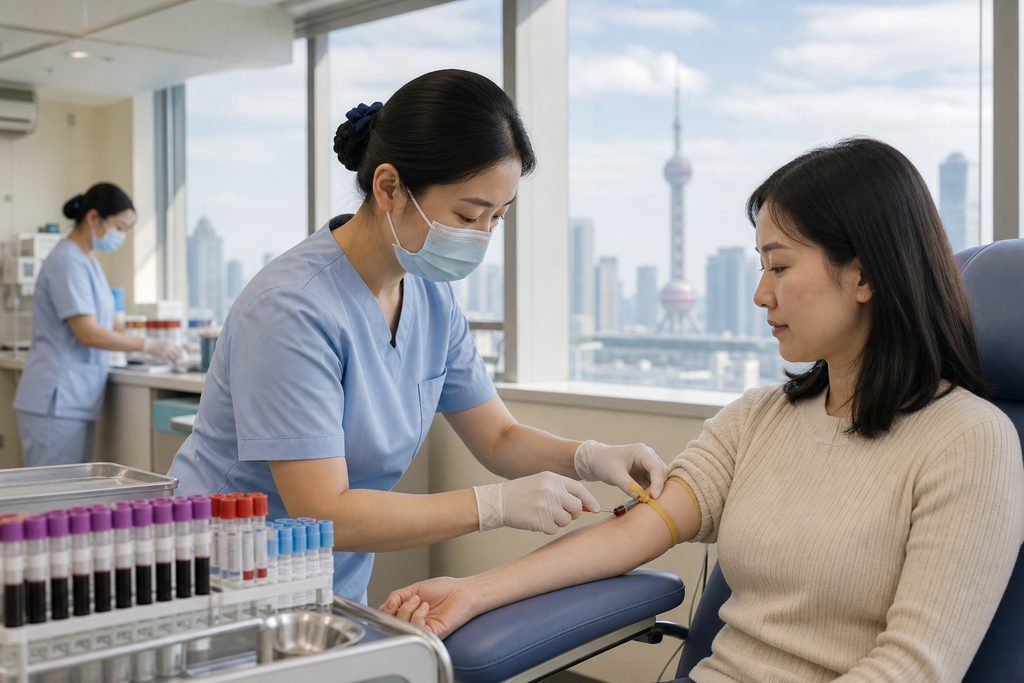
- Blood draw: Usually same day, often within an hour of payment.
- Results: Many hospitals release results the same day or next morning, retrievable via a hospital app or printed at a kiosk.
Private international clinics streamline all of this. You can often book online, staff speak English, and results arrive by email. You pay for that convenience — typically 5 to 10 times the public hospital price.
If you want to compare private international hospitals with direct insurance billing, that route removes most of the friction for a simple lab visit.
Booking CRP and ESR in Beijing or Shanghai: Two Different Experiences
In Beijing, the major Grade 3A hospitals — think Peking Union Medical College Hospital or similar top-ranked facilities — see enormous daily patient volumes. A simple blood test is entirely doable, but expect crowds, queues, and minimal English signage. The upside: your total cost for CRP, ESR, and a consultation might land under $40.
Shanghai leans slightly more international. Several hospitals have dedicated international departments with English-speaking staff and clearer pricing, and the city’s private clinic scene is denser. Expect to pay more, but the process feels closer to a Western outpatient visit.
Which should you choose? If you’re healthy, price-sensitive, and comfortable with a little chaos, a public hospital works fine. If you’re unwell, short on time, or need English communication, the private or international-department route is worth the premium.
Practical Considerations Before You Go
Documentation. Bring your passport and any prior lab results or a doctor’s note from home. If a Chinese physician needs to understand why you’re testing, translated records help enormously.
Visa. If your trip is specifically for medical treatment, the applicable short-stay category is the S2 visa, which covers medical treatment and private affairs; accompanying family members apply under the same category. Requirements are set by the latest embassy or consulate guidance and depend on supporting hospital documents. The M visa is for commercial and trade activities — it is not a medical visa, and using it for treatment is a mistake. Stays beyond 180 days fall under S1.
Payment. Public hospitals generally require prepayment; insurance is reimbursed afterward. Private international hospitals often bill insurers directly. Foreign credit cards work at some facilities but not all — have a backup.
Language. This is the single biggest practical barrier at public hospitals. Registration, payment, and pharmacy counters rarely have English support. A bilingual medical companion can handle queuing, payment, wayfinding, and translation — from $300 per day for a half or full day of accompaniment.
Follow-up at home. Ask for printed results with units clearly marked, plus a stamped invoice if you plan to claim reimbursement. Digital copies are convenient but paper travels better across borders.
Frequently Asked Questions
At public hospitals, generally no — routine outpatient registration happens on the day, and a doctor must issue the lab order. Private international clinics often allow online booking and email you the results. If you need certainty before you travel, the private route or a hospital’s international department is the realistic option.
At a public hospital, a consultation plus CRP and ESR commonly totals under $40. At a private international clinic, expect $150 to $300 for the same markers with English service and insurance billing. Final pricing varies by hospital and case complexity, and additional panels add cost.
Major Chinese hospital labs use internationally standardized assays, and results are generally comparable. The main issue is units — confirm whether CRP is reported in mg/L or mg/dL. Bringing your previous results lets your home doctor interpret the trend rather than a single value.
At a private international clinic, English is standard. At a public hospital, expect little to no English support at registration and payment counters. Many foreign patients use a bilingual companion for exactly this reason — it turns a stressful, confusing visit into a straightforward one.
For a short trip, standard tourist or business entry may cover a brief lab visit, but if the purpose is medical treatment, the S2 category is the applicable short-stay visa for medical treatment and private affairs. Confirm current requirements with the nearest Chinese embassy or consulate, since rules and supporting documents can change.
Your Next Step
A CRP and ESR test in China is cheap, fast, and reliable — the challenge is the system around it, not the science. Knowing the price ranges, the registration reality, and when to choose a private clinic over a public hospital puts you in control.
We are China Medical Services, a bilingual coordination team that helps international patients navigate Chinese hospitals — matching you with the right facility, coordinating appointments, and providing in-person language support. We are not a hospital and we do not diagnose or treat. If you’d like help planning a lab visit or a broader medical trip, start with a free consultation and we’ll walk you through your options.
This article is for general information only and is not medical advice. Always consult a qualified physician about your individual health, and confirm visa and hospital requirements with official sources before traveling.
For more medical information and treatment options in China, visit chinamedservices.com (China Medical Services).
