Heart Tests in China: What They Cost and Where to Go
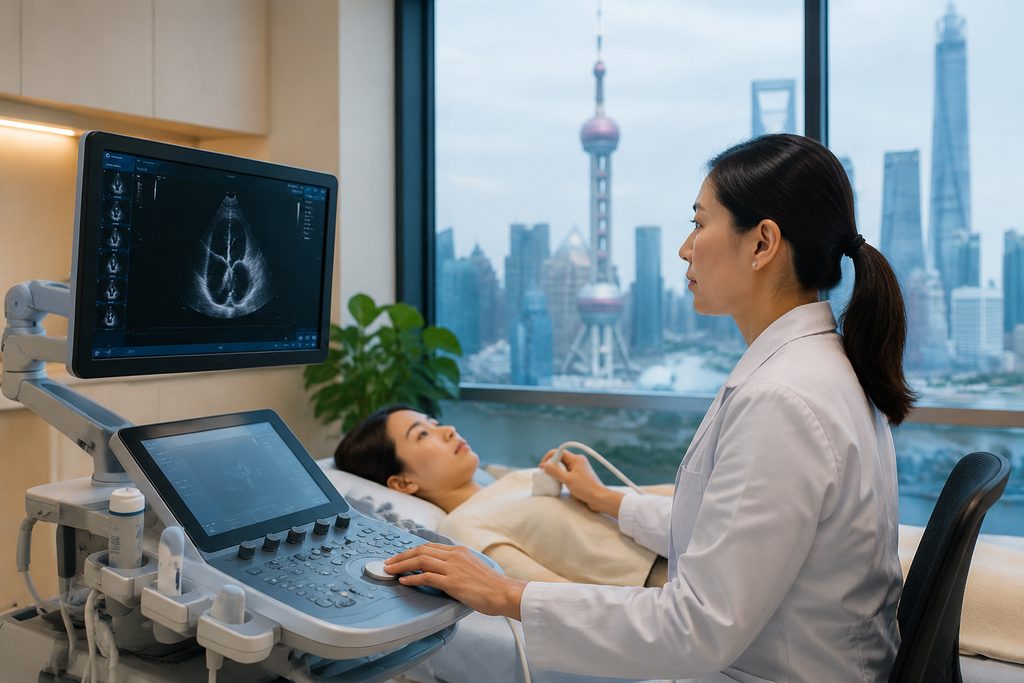
Heart Tests in China: What They Cost
What if a full cardiac workup cost less than a single night in a U.S. hospital? That is the reality for many international patients, and it is why searches for heart test cost China have climbed steadily over the past few years. A cardiac CT angiogram at a top-tier Chinese public hospital typically runs $280 to $700. A complete heart checkup package — bloodwork, ECG, echocardiogram, stress testing, sometimes CT — lands between $500 and $1,800 depending on the hospital tier and how deep you want to go.
Those numbers are real. But they come with a caveat that matters more than the price itself: the Chinese public hospital system was not built for foreign patients, and the gap between the advertised price and the practical experience is where most people get lost.
Heart Test Cost in China: The Short Answer
Here is the range you should expect at a major public hospital in Shanghai or Beijing, quoted in U.S. dollars for clarity:
- Resting ECG (electrocardiogram): $15–40
- Echocardiogram (ultrasound of the heart): $60–150
- Cardiac stress test (treadmill): $80–200
- Coronary CT angiography (CCTA): $280–700
- Cardiac MRI: $400–900
- Holter monitor (24-hour): $50–150
- Coronary angiography (invasive, catheter-based): $1,200–3,500
Prices vary by hospital tier, city, and whether contrast dye or additional imaging is required. A private international hospital will charge 2–4 times these figures for the same test, in exchange for English-speaking staff, shorter waits, and direct insurance billing.
Who This Is Right For — and Who It Isn’t
Medical travel for cardiac screening is not for everyone. Being honest about that is the only way the rest of this article is worth your time.
You are likely a good candidate if:
- You are uninsured or underinsured in your home country, and a cardiac workup would cost you thousands out of pocket
- You are already planning to be in China for work, family, or tourism and want to add a screening
- You need a specific advanced test — cardiac MRI, coronary CTA — that has a long waitlist at home
- You want a second opinion on an existing diagnosis, backed by fresh imaging
You should probably not pursue this if:
- You are experiencing active chest pain, shortness of breath at rest, or any acute symptom. Go to an emergency room where you are. Now.
- You have a known complex arrhythmia or recent cardiac event requiring continuity of care with your existing cardiologist
- You cannot travel for medical reasons, or your physician has advised against it
- Your insurance at home fully covers the tests and the wait is short
Nobody should fly 12 hours for a test their local hospital can do next week.
The Options, Compared
Three realistic paths exist for a foreigner seeking heart tests in China. They differ less in medical quality than in cost, comfort, and language support.
| Factor | Top Public Hospital (Standard Track) | Public Hospital International/VIP Wing | Private International Hospital |
|---|---|---|---|
| Coronary CT angiography | $280–500 | $500–900 | $900–2,000 |
| Full checkup package | $500–1,000 | $900–1,800 | $1,500–3,500 |
| English-speaking staff | Rare | Common | Standard |
| Advance booking from abroad | Generally not possible | Yes | Yes |
| Wait time for appointment | Same-day queue, often hours | Days to 1 week | Days |
| Insurance direct billing | No — pay first, claim later | Sometimes | Usually |
| Equipment quality | Excellent at top hospitals | Excellent | Excellent |
If budget is the deciding factor and you have patience — and some Mandarin, or a companion who does — the standard public track delivers world-class imaging at the lowest price. If you want the process to feel familiar, the VIP wing splits the difference. Private hospitals cost the most but remove nearly every friction point.
Is Heart Testing in China Safe?
This is the question that stops people from booking. And the honest answer is: at a top-ranked hospital, yes — the equipment, protocols, and physician training meet international standards.
China’s leading cardiac centers perform volumes that most Western hospitals never approach. Fuwai Hospital in Beijing, for instance, handles more than 14,000 cardiac surgeries a year — the highest volume of any heart center globally. High volume correlates with experienced operators and refined protocols. Many of these hospitals run equipment from Siemens, GE, and Philips, the same machines used in Germany and the United States.
What is not the same is the service environment. A standard public hospital may see 10,000+ outpatients in a single day. Corridors are crowded. Signage is in Chinese. Registration happens at a physical window, often with a queue. For a patient who does not speak Mandarin, navigating this alone is genuinely difficult — not because the medicine is inferior, but because the system assumes local fluency.
So the safety question splits in two. Is the testing safe? At a top hospital, yes. Is the experience manageable for a non-Chinese speaker? That depends entirely on the support you arrange.
Heart Checkup Price in Shanghai vs. Beijing
Shanghai and Beijing hold the densest concentration of top cardiac hospitals in the country. Beijing has 21 hospitals in the Fudan Top 100 ranking; Shanghai has 18. Prices between the two cities are broadly similar, with a slight premium in Shanghai’s private sector.
A typical Shanghai package — resting ECG, echocardiogram, blood panel including lipid profile and troponin, blood pressure monitoring, and a cardiologist consultation — runs $500–900 at a top public hospital. Add a coronary CT and you are at $800–1,400. In Beijing, expect roughly the same, occasionally 10–15% lower at the largest public institutions.
For a search like heart checkup price in Shanghai, the range matters more than a single figure, because what is bundled varies enormously. Some packages include carotid ultrasound and abdominal screening; others are heart-only. Always ask for the itemized list before comparing two quotes.
Readers looking for the best heart hospital in Beijing for foreigners should focus on institutions with dedicated international departments — these are the ones set up to register foreign patients, provide English-language reports, and coordinate follow-up.
What Drives the Final Bill
Four variables move the number more than anything else.
Hospital tier. A Fudan Top 100 hospital charges more than a regional facility, and its international wing charges more still. You are paying for expertise density and, at the VIP level, service.
Test complexity. A resting ECG takes ten minutes and costs less than a restaurant meal. A cardiac MRI with contrast takes an hour, requires a specialist to read it, and costs twenty times more. The spread within “heart tests” is enormous.
Contrast dye and add-ons. CT and MRI with contrast add $80–250. Functional studies, genetic panels, and specialist consultations stack on top.
Language and coordination support. This is the line item most people forget. A bilingual medical companion — someone who handles registration, queuing, payment, wayfinding, and interpretation — runs from $300 per day through our patient support service. It is not a medical fee and it does not buy priority access. It buys the ability to actually complete your tests in a system that was not designed around you.
Practical Considerations Before You Book
Records first. Bring your existing reports — prior ECGs, imaging, medication lists, and any relevant history — translated into Chinese where possible. Chinese cardiologists will review them, but a clear translated summary speeds everything up.
Visa category. Medical travel to China uses the S2 visa, annotated for medical treatment purposes. Stays beyond 180 days fall under S1. Accompanying family members apply for S2 as well. Note that the M visa is strictly for commercial and trade activities and has nothing to do with medical care — do not apply for it on medical grounds. Requirements shift, so confirm current rules with your nearest Chinese embassy or consulate and bring supporting hospital documentation.
Payment. Public hospitals require prepayment; you settle the bill, then claim from your insurer afterward. Private international hospitals often bill your insurance directly. Bring a card that works internationally, and confirm daily transaction limits with your bank before you travel.
Reports and follow-up. Ask for your imaging on disc and a written report in English. Once home, share everything with your regular cardiologist. Continuity of care matters more than where the scan was taken.
Timing. A straightforward checkup package can be completed in one or two days. If a CT shows something requiring a specialist consultation or further imaging, plan a buffer of several extra days.
Frequently Asked Questions
Coronary CT angiography at a top public hospital typically runs $280–700. Private international hospitals charge $900–2,000 for the same scan. The price depends on contrast use, hospital tier, and city. Always request an itemized quote rather than a bundled figure.
At private international hospitals and public hospital VIP wings, yes — these accept advance bookings from overseas. Standard-track public hospital appointments generally cannot be reserved from abroad; you register in person on the day. If a confirmed appointment before your flight matters to you, plan on the international or VIP channel and budget accordingly.
At top-ranked hospitals, the imaging equipment and clinical protocols meet international standards, and physician training at major cardiac centers is rigorous. The genuine challenge is the service environment — crowds, Chinese-language signage, and in-person registration. Arranging bilingual support addresses that gap directly. This is not a substitute for personalized medical advice; discuss your specific situation with a qualified physician.
Medical travel falls under the S2 visa category, annotated for treatment, with S1 for stays exceeding 180 days. Family accompanying you also apply for S2. The M visa is for commercial and trade activity only and is not appropriate for medical purposes. Confirm current requirements with your nearest Chinese embassy or consulate, as rules are updated periodically.
Top Chinese hospitals can arrange specialist consultations and, where appropriate, further imaging or treatment. But any decision about surgery or ongoing care should involve your physicians at home as well. We help coordinate logistics and communication; we do not diagnose, and we do not promise any particular clinical outcome.
Your Next Step
Heart testing in China delivers genuine value — often a fifth to a tenth of U.S. prices for equivalent imaging at internationally equipped hospitals. The catch is navigation, not medicine. That is the gap we exist to close.
China Medical Services is not a hospital and we do not practice medicine. We connect international patients with more than 340 top-ranked hospitals across 37 cities, coordinate appointments through official international departments, and provide bilingual companions who handle the logistics so you can focus on your health. If you would like to understand what a cardiac workup would cost for your specific situation, start with a free consultation — no pressure, no obligation.
Get the clarity you need before you book a flight. That is the whole point.
For more medical information and treatment options in China, visit chinamedservices.com (China Medical Services).
