Tympanometry in China: What It Shows and What It Costs
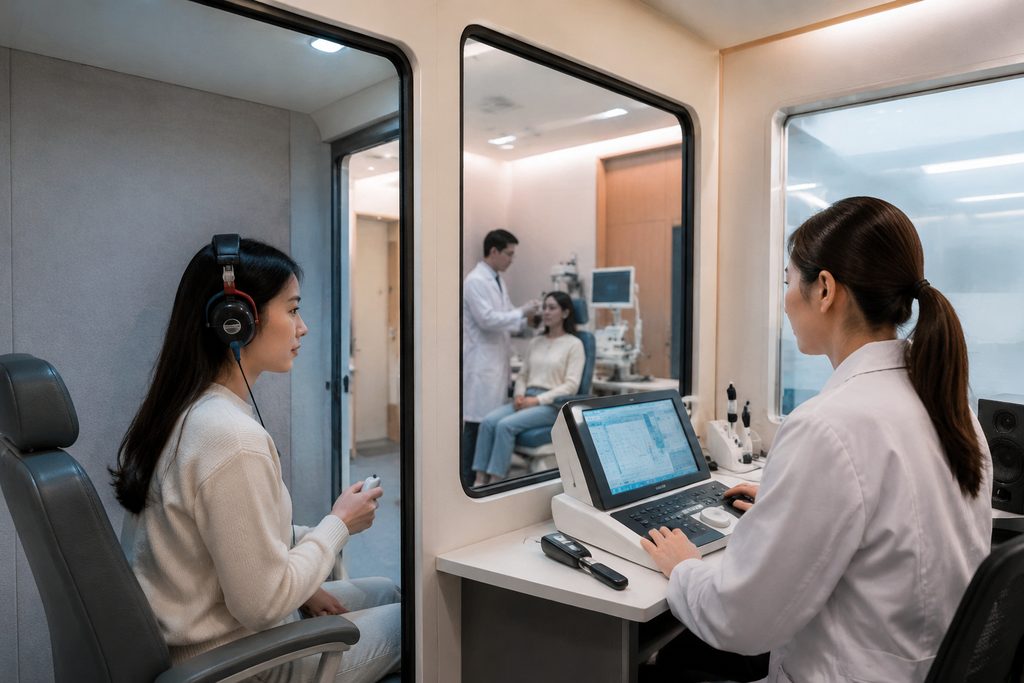
When 46-year-old Sarah from Oregon started feeling a strange fullness in her left ear, her local clinic told her it was “probably allergies” and sent her home. Three months later, the pressure hadn’t budged. Her hearing felt muffled, like a hand was cupped permanently over her ear. A specialist back home wanted $1,400 just for the diagnostic workup, with a two-month wait for the first available slot. Sarah started searching for alternatives and found herself typing “tympanometry test cost China” into Google at 2 a.m. That search is what brought you here, too.
The tympanometry test is one of the most useful, least invasive hearing diagnostics available. It takes about two minutes. It produces a graph called a tympanogram that tells an ear specialist whether your eardrum and middle-ear system are working properly. And in China’s top hospitals, it typically costs a fraction of what Western clinics charge. Here is what the test actually shows, why patients travel for it, and how to arrange one without wasting a trip.
What Does Tympanometry Actually Show?
Think of your ear as a small mechanical room with three moving parts: the eardrum, the tiny bones behind it, and the Eustachian tube that equalizes air pressure. Tympanometry measures how well that room is functioning by pushing a small puff of air into your ear canal and tracking how the eardrum responds.
What does tympanometry show? It reveals four things your doctor needs to know:
- Eardrum mobility — whether the membrane moves freely or is stiffened by fluid, scarring, or infection
- Middle-ear pressure — whether pressure behind the eardrum is normal, negative (often from Eustachian tube dysfunction), or positive
- Fluid presence — the test is highly sensitive to otitis media with effusion, the “glue ear” that’s easy to miss on a basic exam
- Ear canal volume — a large reading can flag a perforated eardrum or a tube that has fallen out
The output is a curve. A normal result is a neat peak (called a Type A). A flat line (Type B) usually means fluid or a hole. A peak shifted to the left (Type C) points to negative pressure. Your ENT reads the curve alongside your symptoms and audiogram — the test never stands alone.
Tympanometry Test Cost in China: The Real Numbers
Here’s where China’s top hospitals separate themselves. A tympanometry test cost in China typically runs between $15 and $60 at a major public tertiary hospital, and $80 to $200 at a private international clinic. The full hearing assessment — audiometry, tympanometry, and a specialist consultation — usually lands between $100 and $350 depending on the hospital tier and city.
Compare that to the United States, where a standalone tympanometry test commonly bills at $150 to $400, and a full audiological evaluation runs $250 to $600 before insurance. In the UK, private tympanometry sits around £80 to £200. The gap isn’t because Chinese equipment is inferior — the top hospitals use the same Interacoustics, Otometrics, and GSI devices found in Boston or Berlin.
| Location / Tier | Tympanometry Only | Full Hearing Assessment |
|---|---|---|
| China — top public hospital | $15–$60 | $100–$250 |
| China — private international clinic | $80–$200 | $200–$350 |
| United States | $150–$400 | $250–$600 |
| United Kingdom (private) | $100–$250 | $250–$500 |
Prices vary by hospital and case complexity, and every figure above is a range — not a quote. A hospital in a second-tier city may charge less than one in Beijing or Shanghai. If you want a sense of which centers handle the highest volumes, our specialty rankings by department list the top ENT programs across 45 specialties.
How This Actually Works, Step by Step
Say you’ve decided to get evaluated in China. Here is the sequence, from where you sit right now to the results in your hand.
Step 1 — You send your existing records. Forward your prior audiograms, imaging, medication list, and a short note describing your symptoms. Anything in English is fine. Our team handles translation into Chinese for the hospital.
Step 2 — A Chinese ENT reviews them. The relevant specialty team reads your file and tells you whether tympanometry is even the right next test. Sometimes it isn’t — sometimes you need imaging first. Getting this answer before you book a flight saves real money.
Step 3 — You receive a written plan or a video consultation. Written second opinions from top-hospital specialists run $300–$500. A live video consultation with a specialist team runs $100–$300 at a standard international department, or $500–$800 for a top-specialist session.
Step 4 — You decide whether to travel. If the plan calls for in-person testing, we coordinate the appointment through the hospital’s official international department. That’s registration, medical card creation, and scheduling — not a shortcut around the queue.
Step 5 — You arrive and get tested. The tympanometry itself takes two minutes. The consultation and audiometry take about 45 minutes. Results are typically ready the same day.
Is Tympanometry Safe in China?
Is tympanometry safe in China? The procedure itself is safe anywhere. It’s non-invasive, involves no radiation, no needles, and no sedation. The probe delivers a soft tone and a gentle pressure change. Most patients describe it as mildly odd, not painful. It’s routinely performed on infants.
The more useful question is whether the clinical environment is safe and reliable. At China’s top-ranked hospitals, the answer is yes — these are the same institutions that train international fellows and publish in peer-reviewed audiology journals. The genuine friction points are logistical, not clinical. Public hospitals see enormous daily patient volumes, and without Chinese-language support, navigating registration, payment, and department wayfinding is genuinely difficult. That’s a language and process problem, not a medical one.
A Realistic Timeline
Here’s what a typical path looks like, including the waiting steps people forget.
| Stage | Typical Duration | What’s Happening |
|---|---|---|
| Records collection | Day 1–3 | You gather audiograms, imaging, medication list |
| Translation & review | Day 3–7 | Documents translated; specialty team reviews |
| Second opinion returned | Day 7–14 | Written analysis or video consultation scheduled |
| Appointment coordination | 1–3 weeks | International department slot confirmed |
| Visa (S2 category) | 1–3 weeks | Requires hospital invitation documents |
| Travel & testing | Day of arrival +1 | Tympanometry, audiometry, ENT consultation |
| Results & follow-up plan | Same day to 48 hrs | Report issued, treatment options discussed |
Total realistic window from first email to holding results: four to eight weeks. If you’re already in Asia, that compresses significantly — sometimes to under two weeks for the appointment alone.
What Can Go Wrong — and What Happens Then
Honest failure modes matter more than success stories.
The appointment can’t be secured for your preferred date. Public hospital ENT departments are busy, and specific slots fill fast. If we can’t confirm the appointment you requested, the coordination fee is refunded in full. We don’t promise a specific doctor or a specific date — we promise a genuine attempt and a fair outcome if it fails.
Your records are incomplete. Tympanometry results are far more useful when paired with a prior audiogram. If you arrive without one, the ENT may need to run additional tests, adding time and cost. Send everything you have, even if it feels old.
The test shows something unexpected. A flat tympanogram in an adult who has never had ear surgery can indicate a cholesteatoma or a perforation requiring imaging. That means a longer stay and a surgical consultation. This is not a failure of the trip — it’s the reason you came. But budget for the possibility.
Language breakdown at the hospital. Even with an appointment confirmed, the registration desk, cashier, and testing rooms operate in Chinese. This is the single most common point of friction for international patients.
How to Evaluate Where to Get Tested
Not every hospital with an ENT department is the right choice for an international patient. Three criteria matter most.
Volume and subspecialization. A hospital that performs thousands of otology procedures annually will read your tympanogram differently than a general clinic. Look for centers with dedicated otology or neurotology units. Our ranked list of top hospitals by city groups facilities by tier so you can compare.
International department infrastructure. Hospitals with an established international or VIP department offer English-speaking coordinators, clearer pricing, and faster scheduling. Expect to pay roughly 1.5 to 2 times the standard rate for this channel — a fair trade for predictability.
Whether they can act on the result. A tympanogram that reveals fluid or a perforation is only useful if the same institution can offer surgical or medical follow-up. Testing without a treatment pathway is a dead end.
For patients asking which is the best ENT clinic in China for tympanometry, the honest answer is: the one attached to a full otology service at a top-ranked hospital, with international patient support. That combination exists in Beijing, Shanghai, Guangzhou, and Chengdu, among others.
Practical Considerations: Records, Visas, and Payment
Records. Bring prior audiograms, CT or MRI imaging on disc, and a written symptom history. Digital copies are fine for review; bring originals for the in-person visit.
Visa. Medical travel to China uses the S2 visa with a medical-treatment annotation. Stays beyond 180 days require the S1. Accompanying family members apply under S2 as well. Requirements shift, so confirm current rules with the nearest Chinese embassy or consulate, and note that hospital-issued invitation documents are usually part of the application. The M visa is for commercial and trade activity — it is not a medical visa.
Payment. Public hospitals require prepayment; you then seek reimbursement from your insurer afterward. Private international hospitals often bill insurance directly. Confirm before you arrive.
Follow-up at home. Ask for your tympanogram and audiogram as a printed report with numeric values, not just a conclusion. Your ENT at home can interpret the raw data.
Frequently Asked Questions
At a top public tertiary hospital, expect $15 to $60 for the test alone. A private international clinic charges $80 to $200. A complete hearing assessment including consultation usually falls between $100 and $350. Final pricing varies by hospital and case complexity.
Standard outpatient registration at public hospitals generally cannot be pre-booked from abroad — same-day queuing is the norm. Pre-scheduled slots are typically arranged through a hospital’s international or VIP department. That’s the channel we coordinate through, and it’s also where English-language support is available.
It’s non-invasive, radiation-free, and routinely done on infants. Most people feel a brief pressure sensation and hear a soft tone. Discomfort is uncommon and short-lived. If you have an active ear infection or a recent ear surgery, tell the clinician first.
An abnormal result is a starting point, not a diagnosis. Type B or C curves typically trigger further evaluation — otoscopy, audiometry, sometimes imaging. The value of testing at a major hospital is that the follow-up pathway exists on-site.
Any medical visit requires an appropriate visa. For short medical stays, the S2 category with a treatment annotation is the standard route, subject to current embassy requirements. A same-day test still requires lawful entry.
Your Next Step
A tympanometry test is quick, cheap by Western standards, and genuinely informative — but only when it’s part of a proper diagnostic sequence at a hospital equipped to act on the result. That’s the difference between a two-minute test and a useful answer.
China Medical Services connects international patients with more than 340 top-ranked hospitals across 37 cities, and our team handles records translation, appointment coordination through official international departments, and bilingual accompaniment on the day. We are a coordination service, not a medical provider — we don’t diagnose, treat, or promise clinical outcomes. If you’d like to know whether tympanometry is the right next step for your symptoms, start with a free consultation and we’ll tell you honestly what makes sense.
This article is for general information only and does not constitute medical advice. Always consult a qualified physician about your individual condition before making treatment decisions.
For more medical information and treatment options in China, visit chinamedservices.com (China Medical Services).
