Cardiac Tests in China: Wait Times and Costs for Foreigners
Cardiac Tests in China: Wait Times and Costs for Foreigners
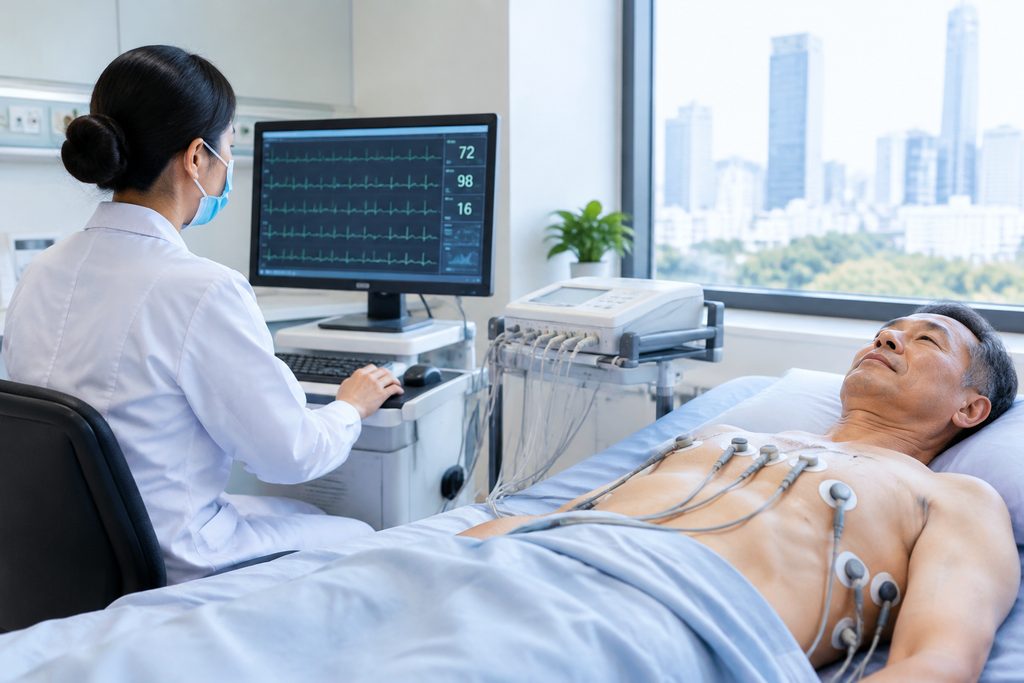
A cardiac stress test cost in China typically runs $80 to $400 depending on the hospital tier, and most patients complete the test within one to three days of walking in. That is the short answer. The longer answer involves which hospital you choose, whether you need an appointment booked before you fly, and why the difference between a public cardiology department and an international wing can mean two days versus two weeks.
While patients in Canada wait a median of 28.6 weeks for cardiac surgery according to the Fraser Institute’s 2023 wait time report, a major Chinese heart center like Fuwai Hospital in Beijing performs more than 14,000 cardiac surgeries a year. Volume changes everything. It changes how fast a slot opens, how many echo machines run at 7 a.m., and how quickly a report lands in your hand.
Who This Is Right For — and Who It Isn’t
China’s cardiac diagnostics infrastructure is genuinely strong. But it is not the right answer for every person reading this page. Here is the honest split.
Good candidates:
- You have symptoms or risk factors and a diagnostic question that needs answering in weeks, not months.
- You are paying out of pocket or through travel insurance and want a coronary angiogram or cardiac CT without a multi-month queue.
- You want a second set of eyes on an existing diagnosis — a written review of your echocardiogram, stress test or angiogram films by a Chinese cardiology team.
- You are already traveling in Asia and can fold a cardiac workup into the trip.
- You need a structured heart checkup package and are willing to use an international department or private hospital.
Poor candidates:
- You are having active chest pain, breathlessness at rest, or fainting. Go to the nearest emergency room. Do not book a flight.
- You need a procedure that is genuinely time-critical and unstable. Local emergency care beats any travel plan.
- You expect a Western-style appointment system at a public hospital. You will not get one.
- You have no budget for interpretation or coordination and no Mandarin. A 10,000-patient-per-day outpatient hall is not navigable alone.
Cardiac Tests in China: The Options, Compared
Four test types cover most of what international patients come for. Here is what each costs, how long it takes, and where you can realistically get it.
| Test | Typical cost (public tertiary) | Typical cost (private international) | Realistic wait (public, walk-in) | Realistic wait (international wing / private) |
|---|---|---|---|---|
| Resting echocardiogram | $60–$150 | $250–$500 | Same day to 3 days | Same day to 48 hours |
| Cardiac stress test (treadmill ECG) | $80–$200 | $300–$600 | 1–5 days | 1–3 days |
| Cardiac CT angiography (coronary CTA) | $250–$600 | $700–$1,500 | 3–10 days | 2–5 days |
| Coronary angiogram (invasive) | $1,200–$3,000 | $4,000–$8,000 | 1–3 weeks (needs admission) | 3–7 days |
Prices vary by hospital and case complexity, and they are not fixed published rates — treat these as ranges, not quotes. The column that suits you depends on two things: how much time you have, and how much hand-holding you need. A patient with conversational Mandarin and a flexible schedule can do the whole workup at a top public hospital for a fraction of the private price. A patient flying in for five days should look hard at the international wing or a JCI-accredited private hospital, where English-speaking staff, direct insurance billing and same-week scheduling come standard.
For a full list of ranked cardiac departments, see our specialty rankings by department.
How Long Do You Wait for an Echocardiogram in China?
This is the question we get most, and the answer has a catch most guides skip.
At a top public hospital, an echocardiogram is often available the same day you see a cardiologist — but only if you have already seen the cardiologist, and only if you were issued a registration number that morning. Public hospitals in China generally do not let you book an outpatient slot from overseas in advance. You queue, you register on the day, you get seen, and the doctor orders the test. The test itself is fast. The bottleneck is the front door.
That front door is why the “wait time” question is misleading. It is not that the echo machine is booked for six months. It is that the appointment system does not work the way a foreigner expects.
There are two ways around it. First, use a hospital’s international department or VIP channel, where scheduling ahead is normal and English service is available — expect to pay roughly 1.5 to 2 times the standard rate. Second, use a private international hospital such as United Family, Jiahui or Parkway, where the entire model is built around appointment-based care.
Is It Safe to Get a Coronary Angiogram in Beijing?
Safety is a fair question, and the answer is not “trust us.” It is “look at the numbers.”
Fuwai Hospital in Beijing is consistently ranked at the top of China’s cardiac specialty rankings and performs more than 14,000 cardiac surgeries annually, making it one of the highest-volume heart centers in the world. High volume correlates with procedural experience — that is a general principle in surgery, not a marketing claim. A coronary angiogram is a routine diagnostic procedure at this level of institution.
That said, “safe” depends on your specific case. Age, kidney function, contrast dye allergy, bleeding risk and current medications all matter. A coronary angiogram involves catheter insertion and contrast dye, and it carries small but real risks anywhere in the world. The relevant difference is not that China is safer or less safe than your home country — it is that the wait to get one may be shorter, and the cost substantially lower.
For context on cost: a coronary artery bypass graft at a top Chinese public hospital typically runs $12,000 to $20,000, against $120,000 or more in the United States. The diagnostic tests scale similarly.
If you want a Chinese cardiology team to review your existing films before you commit to travel, that is exactly what a written second opinion is for. Learn more on our consultation and companion services page.
Book a Cardiac CT Scan in China Fast Track: How It Actually Works
Here is the sequence that works, step by step, for a foreign patient who wants a cardiac CT scan or a full workup without wasting a trip.
Step one — send your records. Existing ECGs, echo reports, stress test results, medication list, and a short summary of your symptoms and goals. A Chinese cardiology team reviews these remotely.
Step two — get a written opinion or a video consultation. The team tells you which tests are actually indicated. This matters. Plenty of patients arrive expecting a full battery and learn that half of it is unnecessary.
Step three — appointment coordination. If travel makes sense, a slot is arranged through the hospital’s international or VIP channel. You are not buying a queue jump. You are using the hospital’s own official channel for international patients, which exists precisely for this.
Step four — arrive and complete the tests. A bilingual companion handles registration, queueing, payment and translation on the day.
The fast-track advantage is real but bounded. Nobody can promise you a specific doctor on a specific date. What can be promised is that the paperwork, the channel and the language barrier stop being your problem.
What It Costs: Tests, Coordination and the Full Picture
Test prices are in the table above. Coordination and interpretation are separate line items, and we publish them because hiding them wastes everyone’s time.
- Bilingual medical companion: from $300 per day (half day 4 hours, full day 8 hours) — registration, queueing, payment, wayfinding, translation.
- Written second opinion from a top-hospital specialist: $300–$500. For reference only, not a prescription.
- Video consultation with a standard tertiary or private international department: $100–$300.
- Top-specialist video consultation: $500–$800.
- Multidisciplinary team (MDT) video consultation: $1,500–$2,000.
- Hospital appointment coordination for checkup, outpatient or admission: from $300. If the appointment shown in your order cannot be secured, it is refunded in full.
- Airport transfer: $200 round trip.
One mechanism worth knowing: any consultation fee is credited in full toward on-the-ground coordination if you upgrade within 90 days. It is a one-time credit applied to the coordination fee only, never to hospital treatment charges.
What drives variance? Hospital tier, whether the test needs contrast dye, whether admission is required, and how many specialists review your file. A treadmill stress test and an invasive angiogram are not in the same cost universe.
Practical Considerations for Cardiac Testing in China
Visa. Medical travel to China uses the S2 visa, with a notation for medical treatment purposes. Stays beyond 180 days fall under S1. Accompanying family members also apply for S2. Requirements shift, so confirm current rules with the nearest Chinese embassy or consulate and bring your hospital’s supporting documents. The M visa is a commercial and trade category and has nothing to do with medical treatment.
Payment. Public hospitals require prepayment; insurance is reimbursed afterward. Most private international hospitals bill insurance directly. Bring a card that works internationally and confirm limits before you arrive.
Records. Get your home cardiologist to release your imaging in DICOM format. A PDF report alone is less useful than the raw files.
Language. Top Chinese hospitals see tens of thousands of outpatients daily. Signage is in Chinese. Without a bilingual companion, even a simple echo appointment becomes a full-day navigation exercise.
Follow-up at home. Ask for your reports and images in English before you leave. Your home cardiologist will need them, and chasing documents across time zones later is unpleasant.
To see which cities host the strongest cardiac programs, browse our ranked hospital directory by city.
Frequently Asked Questions
Not directly at a standard public outpatient clinic — those generally require same-day registration. You can book ahead through a hospital’s international or VIP department, or at a private international hospital. That is the practical route for anyone flying in.
A structured cardiac checkup — echo, ECG, bloodwork, stress test — typically lands between $300 and $900 at a public tertiary hospital, and $1,000 to $2,500 at a private international facility. Package contents vary widely, so compare what is included, not just the headline number.
Then you have a decision to make, and you should make it with full information. Chinese hospitals can provide treatment, but admission and scheduling always depend on hospital rules and clinical assessment. No service can guarantee admission or outcome. If you are unstable, local emergency care is the right call.
You need to see a cardiologist first at most public hospitals, and that consultation is what generates the test order. Private international hospitals are more flexible. Either way, bringing existing records speeds up the assessment considerably.
Top Chinese heart centers use current-generation CT, MRI and echocardiography equipment, and many hold JCI accreditation. The gap that matters for international patients is not hardware — it is language, scheduling and process familiarity.
Your Next Step
The core message is simple: cardiac testing in China is fast and inexpensive by Western standards, but the system is not built for walk-in foreigners, and the workaround is using the right channel with the right support. We are a medical concierge service, not a hospital — we do not diagnose or treat, and we do not sell queue jumps. We translate records, coordinate appointments through hospitals’ official international channels, and put a bilingual person beside you on the day. If you want to know what your specific workup would cost and how quickly it could happen, start with a free consultation and we will tell you honestly whether China is the right answer for your case.
This article is for general information only and is not medical advice. Always consult a qualified physician about your individual situation.
For more medical information and treatment options in China, visit chinamedservices.com (China Medical Services).
