Vascular Screening in Jinan: Cost, Prep, and What to Expect
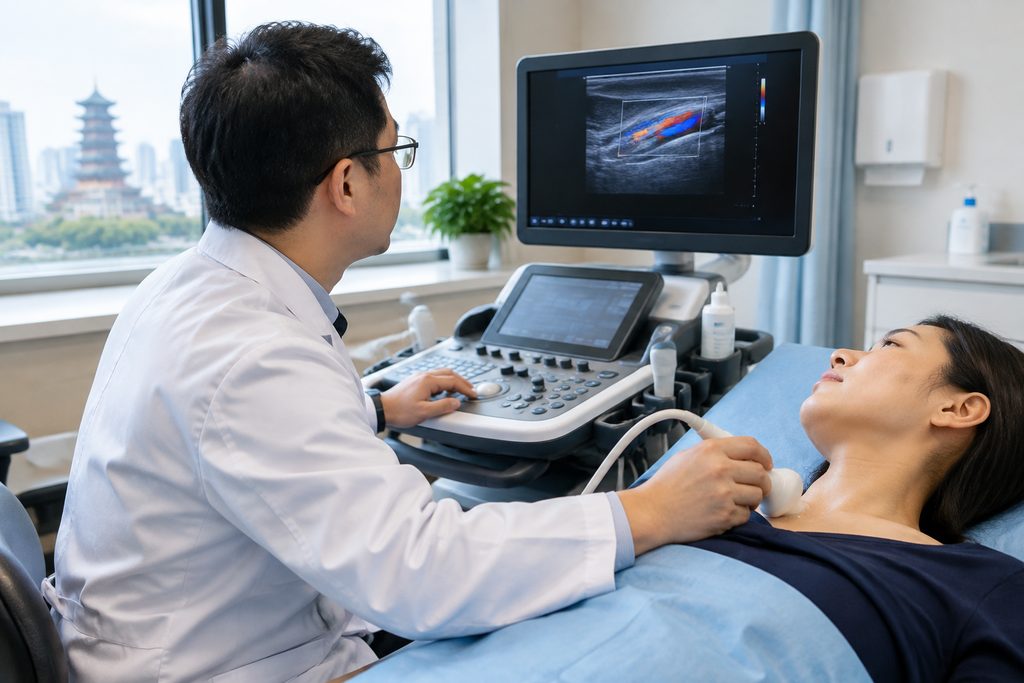
Vascular Screening in Jinan: Cost and Prep
You’ve probably heard that getting medical care in China means long lines, confusing paperwork, and no one who speaks your language. For a straightforward preventive service like a vascular screening, that fear is understandable. The reality is more workable than most people expect — especially once you understand what a vascular screening cost Jinan actually looks like, and how the preparation works. This guide walks you through the numbers, the steps, and the honest limits so you can decide whether Jinan makes sense for you.
Jinan is the capital of Shandong Province, home to several large teaching hospitals, and a city where a growing number of international patients come for diagnostics and second opinions. Vascular screening here is not a single test. It is a bundle of imaging and blood-flow studies that check your arteries and veins for narrowing, plaque, aneurysms, and circulation problems before symptoms appear.
How This Actually Works, Step by Step
Here is the real sequence, from your first message to holding the report in your hand.
Step 1 — You send your existing records. That means recent blood work, any prior ultrasound or CT images, a list of your medications, and a short note on why you want screening: family history, leg pain when walking, a previous stroke, diabetes, or simply age. Nothing needs to be translated yet. Send what you have.
Step 2 — A specialty team reviews the file. In China, the relevant department for vascular screening is usually Vascular Surgery or the Health Examination Center of a large hospital. A clinician looks at your history and decides which tests are appropriate. This is important: vascular screening is not one-size-fits-all. A 45-year-old with no symptoms needs a different panel than a 68-year-old smoker with claudication.
Step 3 — You receive a written plan and a price range. Not a final bill. A range, because the exact cost depends on which vessels are imaged and whether contrast dye is used.
Step 4 — Appointment coordination. This is where most foreign patients get stuck. Public hospital outpatient registration in China generally cannot be booked from overseas in advance — you take a number the same day. For international patients, the workable route is the hospital’s International Department or VIP channel, which can pre-arrange a slot. That channel costs roughly 1.5 to 2 times the standard fee.
Step 5 — You arrive, register, and complete the tests. A bilingual companion can handle registration, payment, queueing, and wayfinding inside a hospital that may see over 10,000 outpatients a day.
Step 6 — Results and interpretation. Most vascular ultrasound reports come back within 24 to 48 hours. You leave with images and a written report, ideally with an English translation.
What Drives the Vascular Screening Cost in Jinan
Let’s talk numbers, because this is the question that brought you here.
At a top-tier public hospital in Jinan, a basic vascular screening package — carotid artery ultrasound, ankle-brachial index, and a consultation — typically runs in the range of $150 to $400. Add abdominal aortic ultrasound and you move toward the middle of that band. Add a CT angiography study with contrast, and the total can climb to $500 to $900.
At a private international clinic, expect roughly 1.5 to 2.5 times those figures, with English-speaking staff and direct insurance billing in some cases.
| Service | Public Top Hospital (Jinan) | Private International Clinic | Typical US Price |
|---|---|---|---|
| Carotid duplex ultrasound | $80–$180 | $200–$400 | $500–$1,200 |
| Ankle-brachial index (ABI) | $40–$100 | $100–$200 | $300–$700 |
| Abdominal aortic ultrasound | $60–$150 | $150–$300 | $400–$900 |
| CT angiography (with contrast) | $250–$500 | $500–$900 | $1,500–$4,000 |
| Vascular specialist consultation | $30–$80 | $120–$250 | $250–$600 |
Two caveats. First, these are ranges, not quotes — final pricing varies by hospital and case complexity. Second, the comparison is not about “cheap vs. expensive.” It is about where the same test sits in each system’s cost structure. The imaging equipment at a major Jinan teaching hospital is generally current-generation, and the reading physicians are often subspecialists who perform these studies daily.
If you want to see how Jinan’s hospitals sit within the wider landscape, our directory of top-ranked Chinese hospitals groups facilities by city and tier so you can compare before committing.
A Realistic Timeline
People underestimate the paperwork. Here is a schedule that reflects reality, not a brochure.
| Stage | Time Needed | What Happens |
|---|---|---|
| Record collection & translation | 3–10 days | You gather reports; medical translation into Chinese if needed |
| Remote review | 2–5 business days | Specialty team reviews your file and proposes a screening panel |
| Appointment coordination | 1–3 weeks | International Department slot arranged; peak seasons run longer |
| Visa (S2, short-stay) | 1–3 weeks | Applied for with hospital supporting documents; processing times vary by consulate |
| Travel & arrival | 1–2 days | Flight, hotel, airport transfer |
| Testing itself | Half a day to 2 days | Ultrasound and ABI done in one visit; CT angiography may be scheduled separately |
| Report turnaround | 24–72 hours | Written report, ideally with English translation |
Total realistic window from first email to results: four to eight weeks. If someone promises you a screening in five days including visa, be skeptical.
What Can Go Wrong — and What Happens Then
Honesty matters more than reassurance here.
Your preferred appointment date is unavailable. Public hospital scheduling is tight, and the International Department has limited slots. The recourse is a different date or a different hospital in the same city. We do not promise a specific specialist or a specific date — only that we will coordinate and, if the appointment cannot be secured as ordered, the coordination fee is refunded in full.
Your records are incomplete. If you arrive without prior imaging, the physician may order additional studies on the spot, which extends your stay and your budget. Send everything in advance.
The screening finds something. This is the scenario people don’t plan for. A vascular screening can reveal a significant stenosis or a small aneurysm. In that case you are no longer a screening patient — you are a patient needing a treatment decision. Nothing is done without your consent, and any follow-up procedure is a separate discussion with its own costs and its own hospital rules. Screening is not treatment.
The report is in Chinese. Without translation, the document is of limited use to your doctor at home. Request a translated summary before you leave.
Visa delays. S2 applications require hospital supporting documents, and consulate timelines shift. Build buffer into your plans. Note that the M visa is a commercial and trade category — it is not the right category for medical travel.
Is Vascular Screening Safe in China — and How to Judge a Provider
Is vascular screening safe in China? For ultrasound-based studies, the procedure itself is non-invasive and low-risk, and the technology is the same equipment used in Western hospitals. The real variable is not safety — it is who reads the images and how the findings are communicated.
Three criteria worth applying:
- Volume. A hospital that performs thousands of vascular studies a year has readers who have seen your pattern before. Ask how many the department handles annually.
- Subspecialty. Vascular surgery and radiology are different departments. For carotid and peripheral artery questions, a vascular surgery department is usually the better first stop. Our specialty rankings by department can help you identify which hospitals lead in a given field.
- Report usability. Ask upfront whether an English-language summary is available. A report you cannot read is a report you cannot act on.
One more point. Screening is a snapshot, not a diagnosis. A normal scan does not rule out future disease, and an abnormal one does not automatically mean surgery. Both results need context from your full history.
Practical Considerations: Records, Visa, Payment, and Follow-Up
Standard public hospital outpatient registration generally cannot be pre-booked from abroad; you take a number on the day. International Departments and VIP channels can pre-arrange appointments, usually at 1.5 to 2 times the standard fee. Coordination services exist to handle this, but no one can guarantee a specific specialist or date.
Ultrasound and ABI testing are non-invasive and carry minimal risk. CT angiography involves contrast dye and radiation, so it requires screening for kidney function and allergies — the same precautions used anywhere. The equipment and protocols at major hospitals match international standards.
Rarely. Most “packages” cover the tests and a consultation but exclude visa costs, flights, hotels, translation, and any follow-up procedure. Compare line by line, and ask what happens if the screening reveals something requiring treatment. That answer tells you more than the headline price.
Often not. Many policies exclude elective preventive screening performed abroad, and reimbursement for overseas care varies widely. Confirm coverage in writing with your insurer before booking anything.
Your Next Step
A vascular screening in Jinan is a practical, affordable way to get a clear baseline on your arterial and venous health — provided you plan for the logistics, not just the scan. The cost is real and knowable; the preparation is manageable; the limits are honest. What we do is bridge the gap between your records and a Chinese specialty team: written second opinions, video consultations, appointment coordination, and bilingual accompaniment on the ground. We are not a hospital and we do not provide medical care. If you would like to understand what a screening would involve in your specific case, you can start with a free consultation — no obligation, and no pressure to travel.
This article is for general information only and is not medical advice. Screening decisions should be made with a qualified physician who knows your history.
Frequently Asked Questions
Yes. The hospitals used for international patients are JCI-accredited and follow the same international safety standards as top hospitals in the US and Europe. Surgical teams perform high volumes of procedures — often more than their Western counterparts — which studies show leads to better outcomes.
Costs vary by procedure and hospital, but international patients typically save 40-80% compared to US prices — even when factoring in travel and accommodation. A consultation with our team will give you an exact, all-inclusive quote with no hidden fees.
Send us your existing medical reports to get started. We handle everything from hospital selection and appointment scheduling to visa assistance and post-operative recovery planning. Your medical records are reviewed by the specialist before you even book a flight.
For more medical information and treatment options in China, visit chinamedservices.com (China Medical Services).
