Ankle-Brachial Index in China: Costs, Top Vascular Clinics & Screening
Key Takeaways
- An ankle-brachial index (ABI) test in China typically runs from $40 to $150 at public tertiary hospitals and $150 to $400 at private international clinics — a fraction of US pricing, where a single ABI study can bill at $200 to $500 before physician fees.
- Several Shanghai and Beijing hospitals perform vascular ultrasound and ABI studies at volumes that exceed most Western centers, which matters for accuracy in borderline cases.
- The honest catch: public hospital outpatient slots cannot be reserved from overseas in advance. You queue on the day, and you need a Chinese speaker beside you.
- An ABI is a screening and diagnostic tool, not a treatment. A low reading is a starting point for a vascular specialist’s evaluation, not a diagnosis you can act on alone.
What an ABI Test Actually Measures
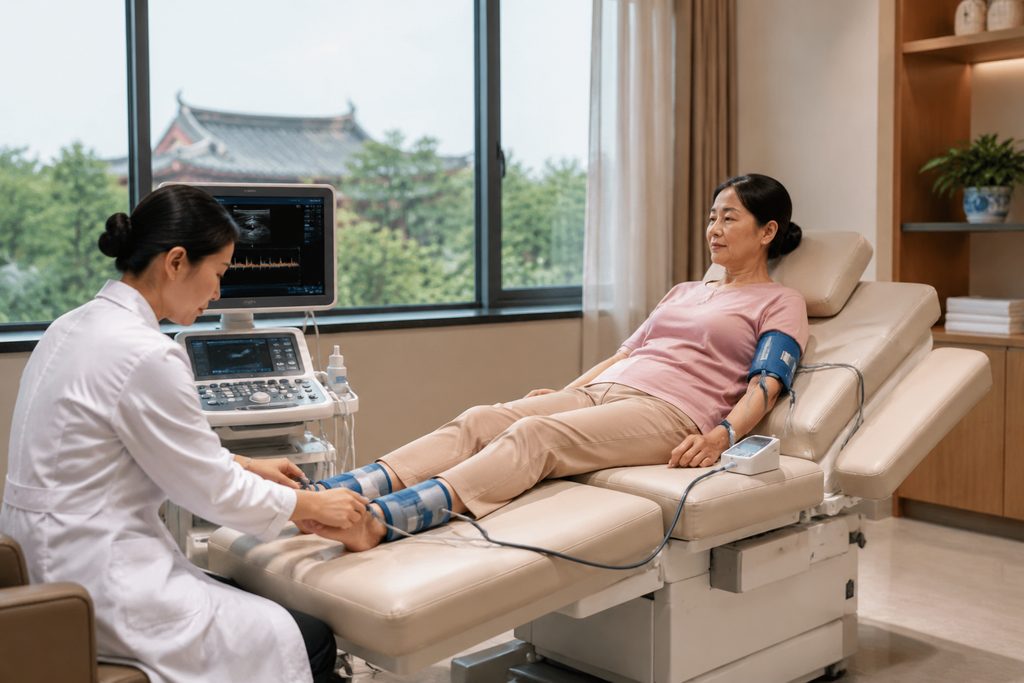
An ankle-brachial index test is a simple, non-invasive way to check how well blood flows to your legs and feet. That’s the whole idea in one sentence. A technician places blood pressure cuffs on both arms and both ankles, then compares the systolic pressure at the ankle against the pressure at the arm. The resulting ratio tells a vascular specialist whether your leg arteries are narrowed.
A normal ABI sits between roughly 1.0 and 1.4. A reading below 0.90 suggests peripheral artery disease (PAD). Below 0.40 signals severe disease. Above 1.4 can mean stiff, calcified vessels — common in people with long-standing diabetes or kidney disease — and requires a different test to interpret properly.
Why does this matter? The American Heart Association estimates that peripheral artery disease affects more than 8.5 million Americans over age 40, and a large share of them have no obvious symptoms. PAD is also a red flag for cardiovascular risk elsewhere. People with a low ABI face a markedly higher chance of heart attack and stroke, which is exactly why cardiologists and vascular surgeons order the test so often.
So if your doctor at home has recommended an ABI, or if you have leg pain when walking that eases with rest, you are asking a reasonable question: where can I get this done well, and what does it cost?
The Problem: Long Waits and High Bills for a 30-Minute Test
Here’s the frustration our team hears constantly. An ABI takes about 20 to 30 minutes. The equipment is not exotic. Yet in Canada, a vascular ultrasound referral can sit on a waitlist for three to nine months depending on the province. In the United States, the same study may be scheduled quickly but arrives with a bill that shocks people — hospital-based vascular labs frequently charge several hundred dollars, and that’s before the interpreting physician’s fee.
For patients managing diabetes, hypertension, or a family history of cardiovascular disease, this delay is not neutral. PAD progresses. A narrowed artery does not wait politely for a scheduling slot to open.
And there’s a second layer of pain. Many people researching the ankle-brachial index test cost China angle are not just price-shopping. They are trying to combine several things in one trip: a full vascular workup, a second opinion on whether they need intervention, maybe a cardiac assessment while they’re at it. Piecing that together from abroad, in a system where the best hospitals are the size of small cities, is genuinely hard without help.
Why China Delivers Results for Vascular Screening
China’s top hospitals see extraordinary patient volumes, and vascular medicine is no exception. That volume shapes how the system works.
Clinical Volume and Diagnostic Experience
China’s 35,000-plus hospitals include a top tier of roughly 340 institutions that sit in the top 5% nationally, ranked by the Fudan Hospital Ranking and JCI accreditation. These are the hospitals where vascular surgery and vascular medicine departments handle thousands of ABI studies and lower-extremity angiograms each year. Reading a borderline ABI — say 0.85 with calcified vessels — takes pattern recognition, and pattern recognition comes from repetition.
Fuwai Hospital in Beijing, for instance, performs more than 14,000 cardiac surgeries annually, the highest volume of any single heart center globally. Its vascular and cardiovascular diagnostic throughput is correspondingly enormous. That kind of scale exists across the top tier.
Equipment and Speed of Access
If you walk into the international department of a major Shanghai or Beijing hospital, the workflow is fast by Western standards. Registration, cuff placement, Doppler readings, and a same-day preliminary report are often achievable within a single visit. Contrast that with systems where the study and the interpretation happen weeks apart.
For readers specifically searching for the best vascular clinic Shanghai ABI screening, the practical answer is this: look at hospitals with dedicated vascular surgery departments listed on the Fudan specialty reputation ranking, then confirm the international department can schedule diagnostic studies for foreign patients. Our specialty department directory lists the top-ranked hospitals by discipline, including vascular and cardiac specialties.
Cost Structure Without Quality Trade-offs
Why is an ABI so much cheaper in China? Labor economics, hospital efficiency, and sheer volume. The physician reading your study is not less trained — many completed fellowships in the US, Europe, or Japan. The overhead structure is simply different. A hospital that runs 10,000 studies a year amortizes equipment and staffing across far more patients than a small Western lab doing 800.
Lower price here reflects system economics, not corner-cutting. That said, always ask whether the report includes a physician’s interpretation, not just the raw ratio.
What ABI Testing Costs in China: A Real Comparison
Prices vary by hospital tier, city, and whether you use the standard outpatient channel or the international/VIP channel. The figures below are reference ranges, not quotes — final pricing depends on the hospital and the complexity of your case.
| Service | Public Tertiary Hospital (standard channel) | International / VIP Department | Typical US Price |
|---|---|---|---|
| Resting ABI (both legs) | $40–$90 | $150–$400 | $200–$500+ |
| ABI with duplex ultrasound | $80–$180 | $250–$600 | $500–$1,200 |
| Vascular specialist consultation | $15–$50 | $100–$300 | $250–$500 |
| Treadmill (exercise) ABI | $100–$220 | $300–$700 | $600–$1,500 |
| Bilingual medical companion | from $300/day | Not applicable | |
So the direct answer to how much does ABI test cost in Beijing: a straightforward resting ABI at a top public hospital generally lands between $40 and $90, while the same test through an international department with English-speaking staff runs $150 to $400. Add a specialist consultation and you are still well under what a US hospital-based lab would bill for the study alone.
One important note on channels. Standard public outpatient slots cannot be reserved from overseas in advance. You register on the day, in person, in a queue. The international department route costs roughly 1.5 to 2 times more but allows advance coordination and English-language service. That trade-off is the single biggest decision most foreign patients make.
Is ABI Testing Safe in China, and Who Should Skip It?
Patients ask us directly: is ankle-brachial index testing safe in China? The honest answer is yes — the test itself is about as low-risk as medical diagnostics get. Cuff inflation is briefly uncomfortable. There are no needles, no contrast dye, no radiation. The real variables are operator technique and how the result is interpreted, not the setting.
Certain conditions make ABI less reliable. If you have severely calcified arteries from advanced diabetes or end-stage kidney disease, the ratio can read falsely high. In those cases, vascular specialists use toe-brachial index or duplex ultrasound instead. Non-compressible vessels are a known limitation documented in AHA guidelines, not a flaw unique to any country.
Who should think twice about traveling for this specifically? Anyone whose only goal is a single screening test with no other medical need. A 30-minute ABI rarely justifies an international trip on its own. It makes far more sense as part of a broader evaluation — a cardiac check, a diabetes management review, or a second opinion on whether you need leg artery intervention. That’s where the trip earns its keep.
Also worth knowing: if your ABI comes back abnormal, the next step is usually an imaging study such as CT angiography or MR angiography, and possibly a consultation about angioplasty or bypass. Those are bigger decisions. Having a bilingual coordinator who can explain the findings and help you weigh options before you fly home is where the real value sits, not in the cuff test itself.
Practical Considerations: Visas, Payment, and Records
Getting to the test is the easy part. The logistics around it need planning.
Visa. Foreign patients coming to China for medical treatment apply for the S2 visa, which covers short-stay medical treatment and private affairs. Stays exceeding 180 days require the S1 category. Accompanying family members also apply for S2. Requirements are set by the relevant Chinese embassy or consulate and depend on supporting documents from the treating hospital — always verify current rules before applying. Note that the M visa is for commercial and trade activities and is not the medical travel category.
Records. Bring your existing reports: prior ABIs, lipid panels, HbA1c results, medication lists, and any imaging. A vascular specialist can move much faster with a documented history. If your records are in English, most international departments handle them directly; for standard channels, translation helps.
Payment. Public hospitals generally require prepayment, with insurance reimbursement handled afterward in your home country. Private international hospitals often bill insurers directly, which simplifies things if your plan supports it. Confirm your policy’s overseas coverage before you travel — many US plans reimburse a portion of medically necessary care abroad, but the paperwork is yours to file.
Language. This is not a minor point. China’s flagship hospitals handle tens of thousands of outpatient visits daily. Signage, registration systems, and queue procedures are in Chinese. Without a Chinese speaker, a simple ABI appointment becomes a stressful scavenger hunt. Bilingual medical companions handle registration, queuing, payment, wayfinding, and interpretation — from $300 per day for a half or full day. Our patient consultation page explains how that coordination works.
For a broader look at how foreign patients choose among China’s flagship institutions, our Fudan-ranked hospital directory groups the top 100 by city, and the China Medical Services homepage outlines the full range of support available.
Frequently Asked Questions
You generally cannot reserve a standard public outpatient slot from overseas. The workable paths are the hospital’s international or VIP department, which accepts advance coordination and provides English-speaking staff, or a standard channel where you register in person on the day. Most foreign patients choose the international route for exactly this reason. Our team assists with appointment coordination and can arrange a bilingual companion for the visit.
Not always. Some hospitals quote the technical study alone, with the physician’s reading billed separately. Always confirm in writing whether the fee covers a signed report from a vascular specialist. A raw ratio without interpretation is far less useful, and this is one of the most common misunderstandings we see among patients comparing prices.
An abnormal reading triggers further evaluation, typically duplex ultrasound or CT angiography, plus a specialist consultation about management. Mild cases are often handled with medication, supervised exercise, and risk-factor control. More severe narrowing may prompt discussion of angioplasty or bypass surgery. Nothing is decided from the ABI alone — it is a screening signal, and any treatment plan must come from a qualified vascular specialist who has examined you.
Yes. You can send existing examination reports to a Chinese specialty team for written analysis and treatment direction, typically $300 to $500 for a top-hospital expert review. A video consultation with the specialty team, where you discuss symptoms and goals directly, runs $100 to $300 at standard international departments and $500 to $800 with a top specialist. These are for reference and direction only — not a prescription, and not a substitute for in-person examination.
It depends entirely on what else you need. For a standalone ABI, no — the trip rarely justifies itself. But bundled with a cardiac assessment, diabetes review, or second opinion on vascular intervention, the economics change dramatically. A comprehensive workup that might cost five figures in the US can often be completed in China for a fraction of that, even including flights and accommodation. The honest test is whether you have other medical questions that need answering in the same trip.
Your Next Step
An ABI is one of the cheapest, safest, and most informative vascular tests available — and in China, it is both fast and affordable. The key is choosing the right channel, bringing your records, and having someone beside you who speaks the language of the hospital.
We are China Medical Services, a coordination service that connects international patients with top-ranked Chinese hospitals. We are not a hospital and we do not diagnose or treat anyone — we handle hospital matching, appointment coordination, bilingual accompaniment, and visa guidance so you can focus on your health. If you’d like to understand your options, start with a free consultation at our patient services page. No pressure, no obligation — just clear answers.
This article is for general information only and does not constitute medical advice. Ankle-brachial index results must be interpreted by a qualified physician. Always consult a licensed healthcare provider before making decisions about diagnosis or treatment.
For more medical information and treatment options in China, visit chinamedservices.com (China Medical Services).
