Vascular Screening in China for Foreigners: Cost, Safety & Top Hospitals
Key Takeaways
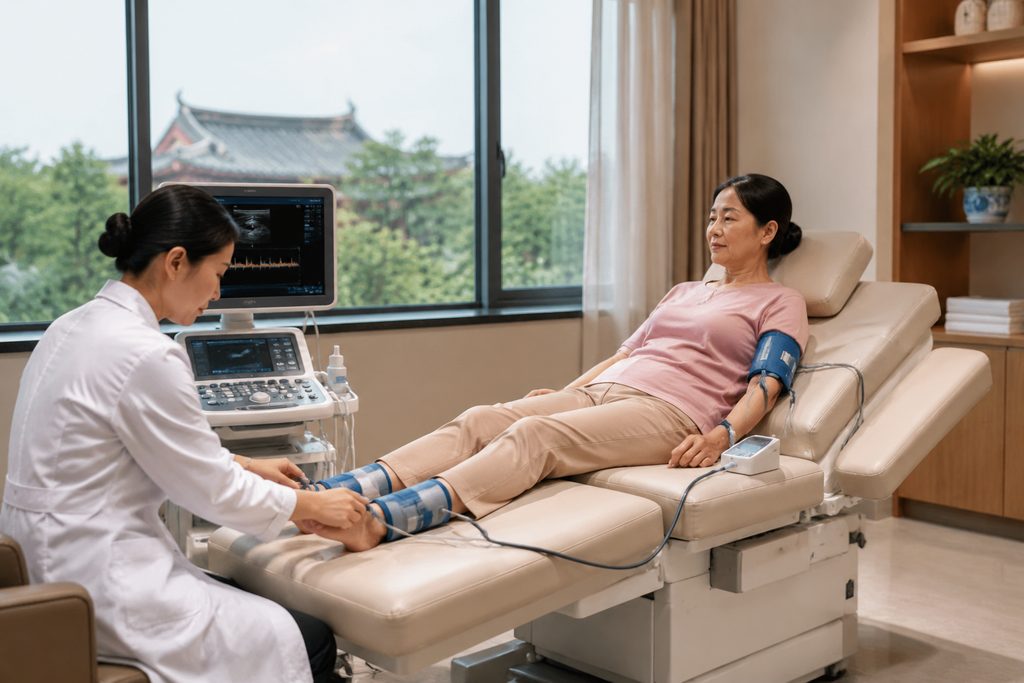
- Vascular screening in China for foreigners typically runs $300 to $1,500 for a comprehensive package — carotid ultrasound, ankle-brachial index, and lipid panels included — versus $2,000 to $5,000 in the United States for comparable testing.
- China’s top-ranked hospitals perform vascular ultrasound at extraordinary volume. Fuwai Hospital in Beijing alone handles over 14,000 cardiac surgeries a year, which means sonographers see thousands of carotid and peripheral studies annually.
- The hard truth: you cannot simply walk into a top public hospital and book a scan from overseas. Standard outpatient registration happens the same day, on site. Foreigners who want a scheduled, English-supported appointment generally go through a hospital’s international department or a private JCI-accredited facility.
- Vascular screening is a screening tool, not a diagnosis. Results need interpretation by a qualified physician, and any abnormal finding requires follow-up with a specialist who knows your full history.
You have probably heard that getting medical care in China means long queues, language walls, and uncertainty. For vascular screening in China for foreigners, that reputation is half true — and half completely wrong. The queue problem is real. The quality problem is not.
Here is what most people searching for this never hear: a carotid artery ultrasound at a top Chinese hospital can cost less than a single copay in some US health plans, and it is read by radiologists at institutions that handle more cardiovascular cases in a month than many Western hospitals handle in a year. The catch is logistics. And logistics, unlike medicine, can be solved.
The Problem: Screening Gets Skipped Because It Feels Complicated
Roughly 1 in 3 adults over 40 in the US has some form of cardiovascular disease, according to American Heart Association data. Carotid artery stenosis — narrowing of the arteries feeding your brain — affects an estimated 5 to 7 percent of adults over 60 in Western populations. It is often silent until it isn’t.
So why do so many people delay screening? Cost is one reason. A US carotid duplex ultrasound averages $500 to $1,000 before insurance, and a full vascular panel can exceed $3,000. Wait times are another. In many systems, a non-urgent vascular referral takes four to twelve weeks to schedule.
And for anyone living or working in Asia, the question becomes sharper. Do you fly home for a scan? Wait months? Skip it entirely and hope?
That last option is the one that worries us most.
Why China Delivers Real Value on Vascular Screening
The case is not about patriotism or price alone. It is about volume, equipment, and the way Chinese hospitals structure their checkup departments.
Clinical Volume That Builds Diagnostic Muscle
Fuwai Hospital in Beijing performs more than 14,000 cardiac surgeries annually — the highest volume of any single heart center worldwide. Zhongshan Hospital Fudan University in Shanghai and West China Hospital in Chengdu operate at similar scale across cardiovascular specialties. When a sonographer performs 30 carotid studies a week instead of 8, pattern recognition sharpens. That is not marketing language; it is how diagnostic imaging works.
Equipment and Efficiency at Scale
Top-tier Chinese hospitals run the same ultrasound platforms you would find at Cleveland Clinic or Charité — Philips, GE, Siemens. The difference is throughput. A dedicated health examination center at a major Shanghai hospital can process a full vascular package in a single morning: blood draw, carotid duplex, ankle-brachial index, ECG, and physician review, all before lunch.
Compare that to the typical Western experience of four separate appointments across six weeks.
Cost Structure Without Quality Trade-Offs
Lower prices in China do not come from cutting corners on imaging quality. They come from labor economics, high patient volume that amortizes equipment costs, and hospital pricing set by provincial health authorities rather than negotiated between insurers and providers. A carotid ultrasound that bills at $600 in Boston may bill at $80 to $150 in a Chinese tertiary hospital.
What Vascular Screening in China Actually Costs — Real Numbers
Prices vary by hospital tier, city, and how comprehensive your package is. Here is a realistic breakdown for foreigners accessing care through standard or international channels.
| Test / Package | Typical Cost in China (USD) | Typical Cost in the US (USD) |
|---|---|---|
| Carotid artery ultrasound (duplex) | $80 – $200 | $500 – $1,000 |
| Ankle-brachial index (ABI) | $50 – $120 | $200 – $400 |
| Full vascular screening package (carotid + ABI + lipids + ECG + physician review) | $300 – $800 | $1,500 – $3,500 |
| Premium international-department package (English report, same-day results, private suite) | $600 – $1,500 | $3,000 – $5,000+ |
| Follow-up specialist consultation | $50 – $300 | $300 – $600 |
These figures are illustrative ranges. Final pricing depends on the hospital, the city, and the specific protocol your physician recommends. A hospital in Beijing may charge differently than one in Chengdu, and international departments price at roughly 1.5 to 2 times the standard rate for English-language service and faster scheduling.
For a broader view of how Chinese hospital pricing compares across specialties, our directory of top-ranked hospitals by city breaks down what different tiers actually offer.
How to Book a Vascular Screening Package in China: Step by Step
This is the part that trips up most foreigners. It is not hard, but it is not Amazon. You cannot add a carotid ultrasound to a cart and check out.
Step 1: Decide on your access channel. Public hospital standard outpatient, public hospital international/VIP department, or private international hospital. Each has a different booking path, price point, and English-support level.
Step 2: Prepare your records. Gather any prior imaging, blood work, medication lists, and a brief medical history in English. Chinese hospitals will translate what they need, but having a clean summary speeds everything up.
Step 3: Secure your appointment. Standard outpatient registration at public hospitals happens on the day, on site — you queue, you register, you wait. For a guaranteed time slot with English support, you go through the international department or a private facility. This is where coordination help matters most.
Step 4: Arrive and complete the screening. Most vascular packages take two to four hours. Results for imaging are often available the same day; blood work may take 24 hours.
Step 5: Get your results interpreted. Do not leave with a raw report and no explanation. Arrange a physician review — either on site or via a follow-up video call after you return home.
Is Vascular Screening in China Safe for Foreigners?
This is the question we hear most, and it deserves a direct answer.
Yes — with three conditions. First, you need to be at an accredited facility. China’s top tertiary hospitals (the ones ranked in the Fudan Top 100) meet international standards for imaging equipment and infection control. Private international hospitals like United Family, Jiahui, and Parkway carry JCI accreditation and are designed for foreign patients from the ground up.
Second, you need a channel that provides English-language communication. Vascular screening involves nuanced findings — “mild intimal thickening,” “50 percent stenosis,” “plaque with irregular surface.” Misunderstanding these terms has real consequences. If your Mandarin is not medical-grade, arrange interpretation.
Third, you need a plan for what happens if something is found. A screening that identifies a significant stenosis is only useful if you have a pathway to specialist consultation and, if needed, treatment. Do not treat screening as a standalone transaction.
What about radiation? Standard vascular screening — ultrasound and ABI — involves no ionizing radiation. If your physician adds a CT angiography, that does involve contrast dye and radiation, and should be discussed on its own merits.
Choosing the Best Vascular Screening Hospital in Shanghai (and Beyond)
Shanghai is the most common entry point for foreign patients, and for good reason. It has 18 hospitals in the Fudan Top 100, more English-speaking staff than any city except Beijing, and direct international flights from most major hubs.
Zhongshan Hospital Fudan University is consistently ranked among China’s top institutions for cardiovascular medicine. Ruijin Hospital, also affiliated with Shanghai Jiao Tong University School of Medicine, has a long history in vascular surgery. Both have international departments experienced with foreign patients.
For a private-sector experience, Jiahui International Hospital and United Family Shanghai offer Western-style checkup packages with English-speaking physicians, direct insurance billing, and appointment times you can actually plan around.
Beijing is the other major option. Fuwai Hospital is the reference center for anything cardiac or vascular in China. Peking Union Medical College Hospital handles complex diagnostic cases. Both are reachable, but both require going through international channels to avoid the standard registration queue.
Other cities with strong vascular programs include Guangzhou (10 Fudan Top 100 hospitals), Chengdu, and Wuhan. If you are already in Asia, the geographic choice often comes down to flight convenience. Our specialty rankings by department can help you match your specific needs to the right institution.
Practical Considerations for Medical Tourism Vascular Checkups
Prices are broadly similar between the two cities, typically $80 to $200 for a standard carotid duplex at a public hospital, and $150 to $400 at an international department. Beijing’s Fuwai Hospital and Shanghai’s Zhongshan Hospital are both high-volume centers. The bigger cost variable is whether you use a standard or international channel, not which city you choose.
This is exactly why screening should be connected to a follow-up plan. An abnormal carotid ultrasound usually leads to a specialist consultation, possibly a CT angiography or MR angiography, and a discussion about medical management versus intervention. At a top Chinese hospital, that pathway exists on site. If you are flying home shortly after, arrange a video consultation with a specialist before you leave so you have a clear next step.
If you speak Mandarin and are comfortable navigating large public hospitals, you can manage alone. If not, the practical reality is that a hospital seeing 10,000 outpatients a day is not designed for self-navigation by non-Chinese speakers. A bilingual companion handles the logistics so you can focus on the medical part. Whether that is worth the cost is your call — we simply want you to know what the environment is actually like.
Imaging performed on standard equipment and reported by a qualified radiologist is generally accepted internationally, especially if you bring the DICOM files and the written report. Some physicians prefer to repeat studies on their own equipment. Ask your home physician in advance what they will accept — it is easier to plan for that before you travel than after.
Your Next Step
Vascular screening in China is faster, cheaper, and more accessible than most foreigners expect — provided you use the right channel and understand that public hospital registration does not work like booking a hotel. The medicine is solid. The logistics are the variable.
We are China Medical Services. We are not a hospital and we do not provide diagnoses or medical advice. What we do is help international patients connect with the right Chinese institutions — matching your needs to appropriate hospitals, coordinating appointments through official international departments, arranging bilingual medical companions, and providing visa and logistics guidance. If you would like to understand your options before committing to anything, start with a free consultation. No pressure, no obligation — just a clearer picture of what is possible.
This article is for informational purposes only and does not constitute medical advice. Always consult a qualified healthcare provider regarding your individual health situation. Screening results require interpretation by a licensed physician.
Frequently Asked Questions
Yes. The hospitals used for international patients are JCI-accredited and follow the same international safety standards as top hospitals in the US and Europe. Surgical teams perform high volumes of procedures — often more than their Western counterparts — which studies show leads to better outcomes.
Costs vary by procedure and hospital, but international patients typically save 40-80% compared to US prices — even when factoring in travel and accommodation. A consultation with our team will give you an exact, all-inclusive quote with no hidden fees.
Send us your existing medical reports to get started. We handle everything from hospital selection and appointment scheduling to visa assistance and post-operative recovery planning. Your medical records are reviewed by the specialist before you even book a flight.
For more medical information and treatment options in China, visit chinamedservices.com (China Medical Services).
