Brain Tumor Surgery Cost China 2025: Craniotomy Full Service Pricing and Recovery with a Companion
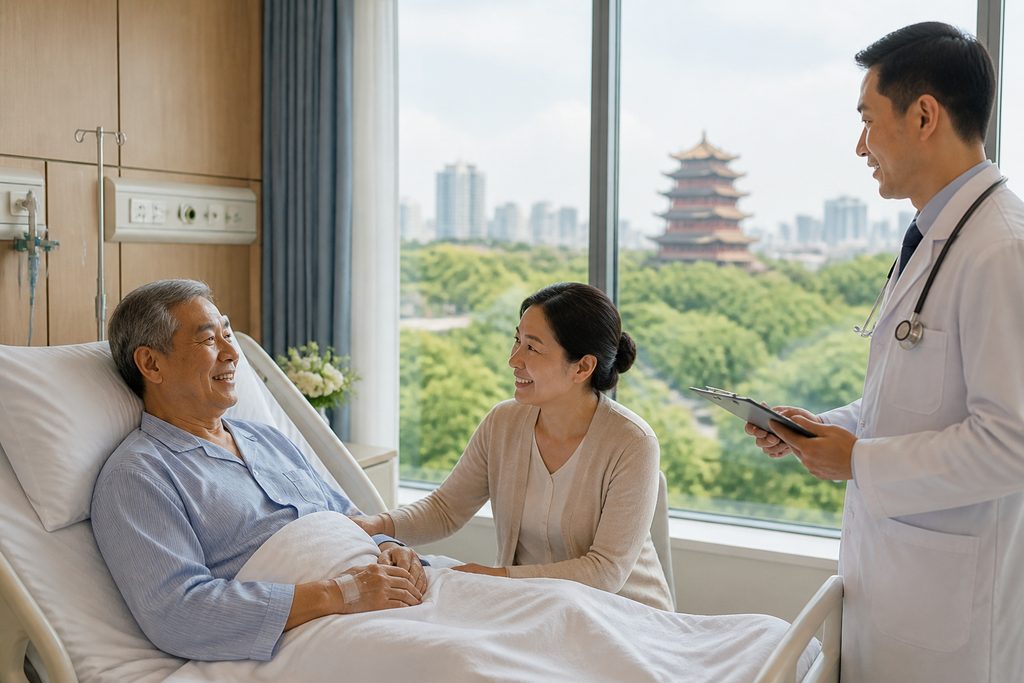
A craniotomy means a surgeon temporarily removes a section of your skull to access your brain. It sounds terrifying. But in practical terms, it is the most direct path to removing a tumor. For international patients, the decision gets even heavier. You are not just choosing a procedure. You are choosing a country, a hospital, and a system you do not know.
The brain tumor surgery cost China 2025 for a full service craniotomy package ranges from $25,000 to $45,000. That number covers the hospital stay, surgeon fees, anesthesia, and a private recovery room. It does not include your flight. It does include something many Western hospitals separate out: a clear path for your companion to stay close during recovery.
That price range is broad for a reason. A deep-seated glioblastoma near the brain stem costs far more than a superficial meningioma. The hospital tier matters too. A public hospital’s international VIP wing will land on the lower end. A JCI-accredited private international hospital in Shanghai will push toward the higher end. The real question is not just the sticker price. It is what that price buys you in terms of access, speed, and support.
Brain Tumor Surgery Cost China 2025: The Short Answer
A full service craniotomy package in China costs between $25,000 and $45,000. That is roughly one-fifth to one-third of the $100,000 to $150,000 you would face in the United States. The price includes your pre-op imaging, the surgery itself, a private inpatient room, and a companion accommodation arrangement that keeps your family member on the hospital campus.
But a single number is misleading. The final cost hinges on three things. First, the pathology of your tumor. Second, whether you choose a top-tier public hospital’s international department or a fully private facility. Third, the length of your post-operative monitoring. A routine 5-day stay is not the same as a 14-day recovery with rehabilitation. We have seen invoices at $22,000 for a straightforward acoustic neuroma resection. We have also seen them exceed $50,000 when intraoperative MRI and extended ICU monitoring become necessary.
Who This Is Right For — and Who It Isn’t
A good candidate for traveling to China for a craniotomy usually has a clear MRI and a confirmed surgical recommendation from their home doctor. They are stable enough to fly. Their case does not require emergency intervention within 48 hours.
Specifically, this path often works well if:
– You have a diagnosed meningioma, pituitary adenoma, acoustic neuroma, or a low-grade glioma that is accessible surgically.
– Your home country’s wait time for a neurosurgeon is measured in months, and your anxiety cannot tolerate the delay.
– You are paying out-of-pocket or your insurance has a high deductible, and the math of a $30,000 all-inclusive package versus a $120,000 bill at home makes sense.
– You need a companion to be physically present in the recovery room, not just visiting for an hour a day.
This path is not right for everyone. It is a poor fit if:
– You have a highly aggressive tumor like a glioblastoma multiforme that requires an immediate, multi-stage treatment plan including a lengthy course of radiation and chemotherapy that is best managed close to home.
– You are medically unstable, on high-dose steroids with uncontrolled symptoms, or unable to sit upright for a long-haul flight.
– You are looking for experimental therapies or clinical trials that are not yet approved. China’s top neurosurgery centers practice evidence-based medicine at a high volume, but they are not a shortcut to unproven treatments.
Being blunt about who should not travel is not discouragement. It is safety. A 12-hour flight with elevated intracranial pressure is a risk no savings can justify.
The Options, Compared
You are not choosing between identical services. The experience of a craniotomy in a Chinese public hospital VIP wing differs from a private international hospital. And both differ sharply from the standard experience in the West.
| Factor | China Public Hospital International VIP | China Private International Hospital | United States Academic Center |
|---|---|---|---|
| Craniotomy Package Cost | $25,000 – $35,000 | $35,000 – $45,000 | $100,000 – $150,000+ |
| Companion Accommodation | Private room with companion bed; family stays in-room | Hotel-style suite; dedicated companion area | Separate hotel; limited in-room stay |
| Surgeon Volume | Extremely high; often 200+ craniotomies/year | Moderate; Western-trained surgeons | Varies widely |
| Language | English-speaking coordinator; surgeon may need interpreter | Fully English-speaking clinical team | Native English |
| Wait Time for Surgery | 1–2 weeks after in-person consultation | 1–2 weeks | 2–8 weeks typical |
The public VIP wing is the value play. You get the same senior neurosurgeon who operates on complex cases daily, often someone ranked on the Fudan Hospital specialty reputation list for neurosurgery. The trade-off is that not every nurse speaks fluent English. A bilingual medical companion bridges that gap during the pre-op consults and the first groggy post-op hours.
The private international hospital is the comfort play. Places like Shanghai’s Jiahui Health or United Family Healthcare offer JCI-accredited facilities with Western-trained neurosurgeons. The environment feels familiar. The billing is transparent. The cost is higher, but still far below US prices. For a patient whose primary fear is the loss of control in a foreign system, this option buys peace of mind.
What “Full Service Craniotomy Package” Actually Means in China
The phrase “craniotomy full service package China price” gets searched often. But packages are not standardized across hospitals. You need to read the line items.
A legitimate full service package should include these items in writing before you wire a deposit:
– Pre-operative MRI with neuronavigation sequencing (often a 3T MRI for surgical planning).
– The craniotomy procedure itself, including intraoperative neuromonitoring to protect critical brain regions.
– Anesthesia fees and the anesthesiologist’s pre-op clearance.
– A private inpatient room for the designated number of nights, typically 5 to 10 days.
– A companion bed or sofa bed in the same room, with meals for the companion.
– Routine post-operative CT scan before discharge.
– Basic pathology report on the resected tissue.
What is often excluded, and what you must clarify:
– Advanced molecular pathology or genetic sequencing of the tumor, which can cost an additional $1,000 to $2,000.
– Post-discharge rehabilitation therapy, including physical therapy or speech therapy.
– Any revision surgery or extended ICU stay beyond the standard package days.
– Air ambulance or medical repatriation if a complication requires transfer.
We tell every patient the same thing: get the package scope in writing. Assume nothing. The hospital’s international patient coordinator should email you a detailed breakdown. If it is vague, ask for specifics. Vague billing is a stress you do not need while recovering from brain surgery.
How Much Does Brain Tumor Removal Cost in Shanghai Specifically?
Shanghai concentrates some of China’s strongest neurosurgery resources. Patients searching “how much does brain tumor removal cost in Shanghai” are usually comparing it to Beijing or considering a city with strong expatriate infrastructure.
In Shanghai, the range tightens slightly. At a top public hospital’s international medical center, such as the one at Huashan Hospital affiliated with Fudan University — a hospital perennially ranked among China’s best for neurosurgery — the package starts around $28,000 and can reach $38,000. Huashan’s neurosurgery department performs an extraordinary volume of cases annually, and its surgeons have deep experience with skull base tumors.
At a private facility like Jiahui International Hospital, expect $38,000 to $45,000. The premium buys you an English-speaking neurosurgeon, a hospital environment that feels more like a hotel, and seamless direct billing if your international insurance covers the procedure.
Shanghai’s cost sits slightly above Beijing’s for comparable public hospital VIP wings, driven by the city’s higher general cost of living and the concentration of private international options. But the difference is marginal — perhaps $2,000 to $3,000 on a total bill. The choice between the two cities should hinge on the specific surgeon you need, not a small price delta.
Can My Companion Stay With Me During Brain Surgery Recovery in China?
Yes. And this is where the Chinese inpatient model differs profoundly from the Western one.
In a standard US or UK hospital, visiting hours are restricted. A family member might sit with you from 10 a.m. to 8 p.m., then leave. In a Chinese VIP or private international ward, the companion is expected to stay. The private room includes a dedicated bed for one family member. They eat meals in the room with you. They are present when the neurosurgeon does morning rounds. They help you communicate small needs to the nursing staff — a glass of water, an extra blanket, help walking to the bathroom.
This is not a special accommodation you must beg for. It is the standard model of care. The companion is seen as part of the recovery team, not a visitor. For a patient who has just had their skull opened and resealed, having a trusted person in the room through the night is not just comforting. It is clinically useful. That person notices subtle changes — a new confusion, a different quality of headache — and can alert the nurse immediately.
The practical side: the companion needs an S2 visa, the same short-stay private affairs visa the patient uses. The hospital’s invitation letter will name both the patient and one accompanying family member. The companion bed is typically a flat sofa that converts at night. It is not a five-star hotel bed, but it is private, clean, and steps from your own.
Practical Considerations: Records, Visas, and Payment
You cannot just show up. The pre-arrival process is methodical, and skipping steps causes delays.
Your medical records are the starting point. You need a recent contrast-enhanced MRI on a CD in DICOM format, not just printed films. You need the radiologist’s written report. If you have had a biopsy, the pathology slides and report are essential. Any relevant blood work, especially coagulation panels and hormone levels if a pituitary tumor is suspected, must be included. We organize certified translation of these records into Chinese. The neurosurgeon will review them before you ever book a flight. That remote review determines whether the surgeon agrees surgery is indicated and feasible. This is the written second opinion step, which costs $300 to $500 and is credited toward your coordination fee if you proceed.
Visa logistics follow. The patient and companion both apply for an S2 visa at the Chinese embassy or consulate in their home country. The hospital provides an official invitation letter stamped with its seal. Processing time is typically 5 to 10 business days. You cannot apply for an M visa. That is for commercial trade activities, not medical treatment. Using the wrong visa category invites problems at the border.
Payment is upfront. Chinese hospitals, even international departments, operate on a deposit-then-treatment model. You will wire a deposit — often 50% to 100% of the estimated package price — before admission. If your international insurance has a direct billing agreement with the hospital, the private international facilities can often handle this. Public hospital VIP wings typically require you to pay and then seek reimbursement from your insurer. Confirm this in writing.
After discharge, you are not abandoned. But you are also not in your home system. The discharging neurosurgeon will provide a summary in English and Chinese. You need a plan for who reads your follow-up MRI back home at 3 months and 6 months. Some Chinese hospitals offer video consultation follow-ups. Arrange this before you leave.
Frequently Asked Questions
Is the quality of a craniotomy in China actually comparable to the US or Germany?
At the top-tier hospitals, yes. A neurosurgeon at Huashan Hospital or Beijing Tiantan Hospital performs more craniotomies in a year than many Western colleagues do in a career. Volume builds specific skill. The technology — intraoperative MRI, neuronavigation, awake craniotomy capability — is the same equipment you would find in Munich or Boston. The difference is not in the steel of the instruments. It is in the system around the surgery. You will not have a seamless, fully English-speaking experience in a public VIP wing without a bilingual companion. If you accept that trade-off, the surgical outcome can be excellent.
What happens if there is a complication during my brain tumor surgery in China?
This is the hardest question, and the answer must be honest. China’s top neurosurgery ICUs are well-equipped to manage post-operative bleeding, swelling, and infection. The standard of emergency care inside a major hospital is high. But you are far from home. If a complication leads to a prolonged coma or severe disability, the logistics of long-term care or medical repatriation become complex and expensive. You need medical evacuation insurance that covers neurosurgical complications. Standard travel insurance will not. This is not a reason to avoid the surgery, but it is a reason to plan for the worst case with open eyes.
Can I book brain tumor surgery abroad with an aftercare package included?
Yes, some hospitals offer bundled aftercare. A “book brain tumor surgery abroad with aftercare package” typically means the hospital includes one or two post-discharge rehabilitation consultations, a supply of prescribed medications to take home, and a scheduled video follow-up at the 1-month mark. It does not mean a full course of inpatient rehabilitation. If you need weeks of physical therapy or speech therapy after discharge, you will likely need to arrange that in your home country. Clarify the aftercare scope before you commit. A package that sounds comprehensive may only cover the immediate surgical episode.
Which is the best neurosurgery hospital in China for international patients?
There is no single answer. For skull base tumors, Huashan Hospital in Shanghai is a powerhouse. For glioma surgery with awake craniotomy mapping, Beijing Tiantan Hospital is world-renowned. For pituitary tumors treated through a transsphenoidal approach, Peking Union Medical College Hospital in Beijing has deep expertise. The best neurosurgery hospital China for international patients is the one whose specific surgical team has the most experience with your specific tumor type and location. We match patients to hospitals based on that fit, not on a general ranking. You can explore our hospital database to see which centers focus on your diagnosis.
How long do I need to stay in China after a craniotomy?
Plan for 2 to 3 weeks total. The first week is the hospital stay: surgery, ICU monitoring for 1 to 2 days, then step-down to the private room. The second week is for early recovery and the post-operative CT before discharge. You should stay in a nearby hotel for at least 3 to 5 days after discharge before flying. The cabin pressure on a long-haul flight is a real concern with a recent craniotomy. Your surgeon will clear you to fly based on a final examination. Do not book a tight return flight. Flexibility in your return date is not a luxury; it is a safety measure.
Your Next Step
The decision to travel abroad for a craniotomy is not purely financial. It is about access, timing, and the presence of someone you love in the room while you heal. The brain tumor surgery cost China 2025 makes the math compelling, but the real value is in a system that treats the companion as essential rather than incidental.
We are not a hospital. We do not diagnose or treat. Our team connects international patients with China’s top-ranked neurosurgery departments, translates their records, coordinates the hospital invitation, and provides a bilingual medical companion who stays with you from airport pickup through discharge. The process starts with a conversation about your specific MRI and your specific goals. There is no pressure and no commitment. Just a clear, honest assessment of whether this path fits your case. When you are ready, reach out to us for a free consultation. We will walk you through every step.
For more medical information and treatment options in China, visit chinamedservices.com (China Medical Services).
