Payment Coordination in China: A Guide for Foreign Patients
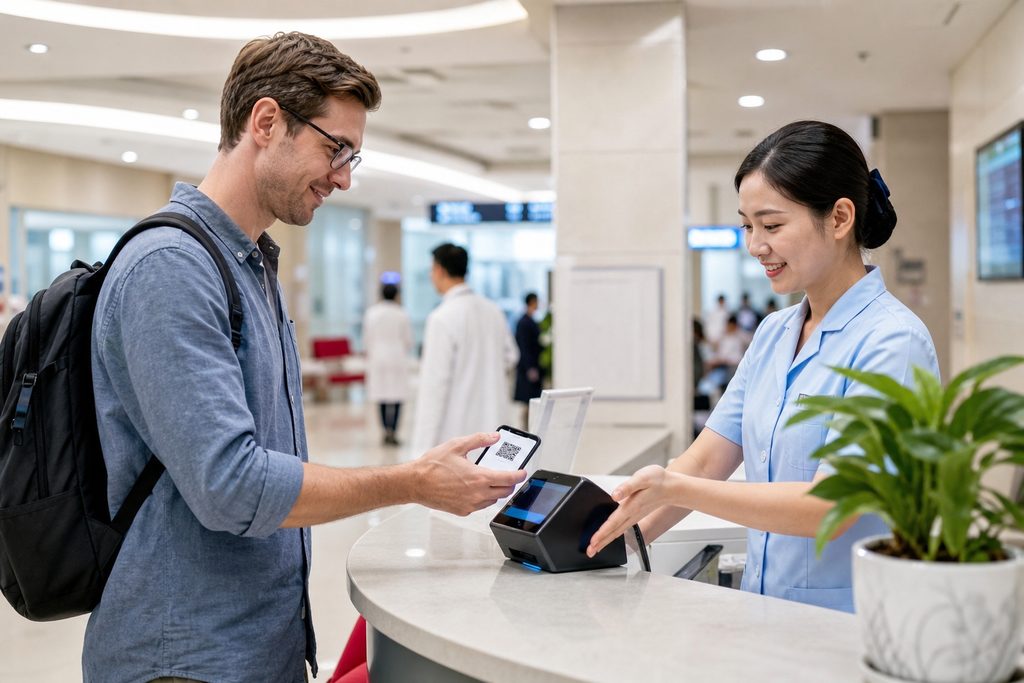
Payment Coordination in China: A Guide for Foreign Patients
When 54-year-old David from Portland learned he needed a cardiac bypass, his first call wasn’t to a surgeon. It was to his bank. He’d read that the same procedure costing $120,000 at home might run $12,000–20,000 at a top Chinese hospital, and his real question was simpler and harder than any diagnosis: how does a foreigner actually move money to a Chinese hospital without getting burned? That question sits at the center of medical tourism payment China, and it deserves a straight answer.
The short version: you can pay a Chinese hospital from overseas, but the path depends on whether you’re at a public tertiary hospital or a private international one. Public hospitals want prepayment, usually by international wire. Private international hospitals often bill your insurer directly. The gap between those two worlds is where most confusion lives.
Payment Coordination in China: The Short Answer
Public hospitals in China require prepayment before scheduled surgery or admission, typically via international bank transfer to the hospital’s official corporate account. Private international hospitals frequently accept direct insurance billing and international credit cards. There is no single national payment portal for foreign patients. Each hospital runs its own finance office, and each has its own rules about deposits, currencies, and refunds.
That’s the caveat that makes this more complicated than a one-liner. A deposit is not a quote. Hospitals often estimate a deposit based on the expected procedure, then settle the final bill after discharge, which means you may pay more or receive a refund depending on what actually happened in the operating room.
Who This Is Right For — and Who It Isn’t
Coordinating payment across borders works well for some patients and poorly for others. Being honest about that saves everyone time.
Typically a good fit:
- Patients with a confirmed treatment plan and a written hospital estimate in hand
- People paying out of pocket who can absorb a deposit of several thousand dollars before travel
- Patients with international health insurance that includes overseas treatment benefits
- Those willing to work through a hospital’s international department rather than a general outpatient window
Probably not a fit:
- Anyone hoping to pay the full surgical cost after treatment is complete — public hospitals won’t schedule on those terms
- Patients whose insurer requires pre-authorization the hospital cannot process in time
- People who cannot access international banking or a card that works abroad
- Emergency cases where there is no time to arrange transfers — those go through a different, faster channel
The Options, Compared
Four payment routes exist in practice. They differ in speed, cost, and risk.
| Method | Typical Use | Speed | Fees / Risk |
|---|---|---|---|
| International wire transfer (SWIFT) | Public hospital deposits and surgery prepayment | 1–5 business days | Bank fees $25–60; currency conversion spread; must match hospital’s exact account name |
| Direct insurance billing | Private international hospitals with insurer contracts | Same-day at admission | Requires pre-authorization; not all insurers or hospitals participate |
| International credit card | Outpatient visits, smaller bills, private hospitals | Immediate | Some public hospitals don’t accept foreign cards; issuer may charge 2–3% foreign transaction fee |
| Cash in RMB | Minor fees, registration, pharmacy | Immediate | Withdrawal limits; carrying large sums is impractical and unsafe |
Which column suits you? If you’re at a public tertiary hospital for major surgery, the wire transfer is effectively your only option — plan for it two weeks before travel. If you’re at a JCI-accredited private hospital and your insurer has a contract, direct billing removes almost all the friction. Everyone else sits somewhere in between, usually combining a wire for the deposit with a card for incidentals.
How Do I Pay a Chinese Hospital From Overseas?
This is the question that keeps people up at night, so let’s walk through it concretely.
First, the hospital’s international department issues a written estimate and payment instruction sheet. That document contains the beneficiary bank, the account name, the SWIFT code, and often a reference number tied to your case. Treat that reference number as sacred. Wire transfers without it can sit unallocated for weeks while staff try to match your money to your file.
Second, your bank executes the transfer. Expect the hospital to receive slightly less than you sent, because intermediary banks take a cut along the way. Some patients add $30–50 to cover that gap. Confirm with the hospital’s finance office whether they want the deposit in USD or RMB — sending the wrong currency triggers a conversion at whatever rate the receiving bank applies, which is rarely in your favor.
Third, you get a receipt, usually by email, within a few business days of the funds landing. Keep it. You’ll need it at registration.
Can Foreigners Use International Health Insurance in China?
Sometimes, and the answer depends entirely on two things: your policy and your hospital.
Private international hospitals in China — the ones with English-speaking staff and JCI accreditation — frequently hold direct-billing agreements with major international insurers. At those facilities, you present your insurance card and pre-authorization, and the hospital bills your insurer. You may still owe a co-pay or deductible at discharge.
Public tertiary hospitals mostly operate on a pay-first, reimburse-later model. You pay, you collect itemized invoices and medical records, and you file a claim with your insurer when you get home. Reimbursement timelines vary widely — some insurers process overseas claims in three weeks, others take three months. Check whether your policy requires pre-authorization before treatment. If it does and you skip that step, you may fund the entire procedure yourself.
Our team regularly helps patients map their insurance benefits against a specific hospital’s billing practices before anyone books a flight. You can see which facilities in our private international hospital directory typically support direct billing.
Is It Safe to Pay a Chinese Hospital Deposit by Wire Transfer?
Yes, provided you send money to the hospital’s official corporate account and nowhere else.
The risk isn’t the wire itself. It’s the intermediary. If anyone — a broker, an agent, a “facilitator” you found online — asks you to wire funds to a personal account or a company account that isn’t the hospital’s, stop. Legitimate hospital payments go to an account bearing the hospital’s registered name. Anything else is a red flag.
Two more safety practices. Request the payment instructions on hospital letterhead or from an official hospital email domain, not a personal messaging app. And keep every document: the estimate, the wire confirmation, the receipt, the final itemized bill. If a dispute arises, that paper trail is your leverage.
What a China Medical Tourism Package Payment Plan Actually Looks Like
There’s no standardized “package” in Chinese healthcare the way there is in, say, cosmetic surgery tourism in Thailand. Hospitals bill for services rendered. What patients call a package is really a sequence of payments.
A typical sequence for surgical care at a public hospital runs like this. You pay a consultation and diagnostic fee at your first outpatient visit, often a few hundred dollars. Once surgery is scheduled, the hospital requests a deposit covering the estimated procedure cost — this is the big wire, frequently $8,000–15,000 depending on complexity. After discharge, the hospital reconciles actual charges against your deposit and either refunds the difference or asks for a top-up. Follow-up visits and medication are billed separately.
At a private international hospital, the sequence is smoother. Consultation, pre-operative testing, surgery, and recovery may all flow through a single billing relationship, with insurance covering what your policy allows and you settling the remainder at the end.
What drives the variance? Procedure type, hospital tier, whether you’re in a standard ward or a VIP room, and how long you stay. A cardiac bypass at a top public hospital might land in the $12,000–20,000 range; the same operation at a private international facility could run two to three times that. Neither figure includes travel, lodging, or the companion services many patients bring along.
Practical Considerations Before You Send Money
Documentation comes first. You’ll want your passport, the hospital’s written estimate, and — if insurance is involved — a pre-authorization letter. Some hospitals also ask for a signed financial responsibility form.
On the visa side, medical travel to China uses the S2 category for short stays, with S1 for stays exceeding 180 days. Accompanying family members apply under the same category. The M visa is for commercial and trade activity and has nothing to do with medical treatment — if anyone tells you otherwise, they’re mistaken. Visa rules shift, so confirm current requirements with the nearest Chinese embassy or consulate and bring supporting hospital documents.
Language is the quiet obstacle. China’s top hospitals see thousands of outpatients daily, and billing counters rarely have English-speaking staff. This is where a bilingual medical companion earns their fee — handling registration, queuing, payment windows, and translation so you’re not navigating a finance office in a language you don’t speak.
Plan your follow-up before you leave. Ask the hospital for complete operative notes, imaging, and discharge summaries in English. Your doctor at home will need them, and requesting them later from another continent is slow and frustrating.
For a broader picture of how hospital selection, visas, and logistics fit together, our overview of medical treatment in China for international patients walks through the full journey.
Frequently Asked Questions
Private international hospitals generally accept major international cards. Many public hospitals do not, especially for large surgical deposits — they expect a bank transfer. Bring a card for smaller expenses and arrange a wire for anything substantial.
The hospital reconciles the final bill against your deposit after discharge and refunds the difference. Refunds to overseas accounts can take two to four weeks and may incur conversion fees. Ask about the refund process before you pay.
Only if your insurer has a direct-billing agreement with that specific hospital, which is most common at JCI-accredited private facilities. Otherwise you pay upfront and file for reimbursement. Verify coverage and pre-authorization requirements before committing to treatment.
Two weeks is a reasonable buffer for an international wire, accounting for intermediary bank delays and currency conversion. Some transfers clear in 24 hours; others take five business days. Send earlier if your surgery date is fixed.
A written second opinion before travel can clarify whether surgery is genuinely necessary and what it should involve, which sometimes changes the plan entirely. Remote consultations with a Chinese specialty team typically run $100–800 depending on the format, and those fees are credited in full toward on-the-ground coordination if you proceed within 90 days.
Your Next Step
Paying a Chinese hospital from abroad isn’t mysterious once you know which channel applies to your situation — it’s just paperwork, timing, and a wire that has to be right the first time. The patients who struggle are usually the ones who booked a flight before they understood the deposit, the insurance gap, or the language barrier at the billing window.
We’re China Medical Services, a coordination team — not a hospital and not a provider of medical advice. We help international patients match with appropriate hospitals, arrange written second opinions and video consultations, prepare payment and visa logistics, and provide bilingual companions on the ground. A free consultation costs nothing and commits you to nothing. If it turns out China isn’t the right answer for your case, we’ll tell you that too.
This article is for general information only and does not constitute medical or financial advice. Treatment decisions should be made with qualified healthcare professionals. Costs vary by hospital and case complexity; confirm all figures directly with the treating facility.
For more medical information and treatment options in China, visit chinamedservices.com (China Medical Services).
