Family Caregiver Wellness in China: Spa & Recovery Packages for Medical Travel Companions
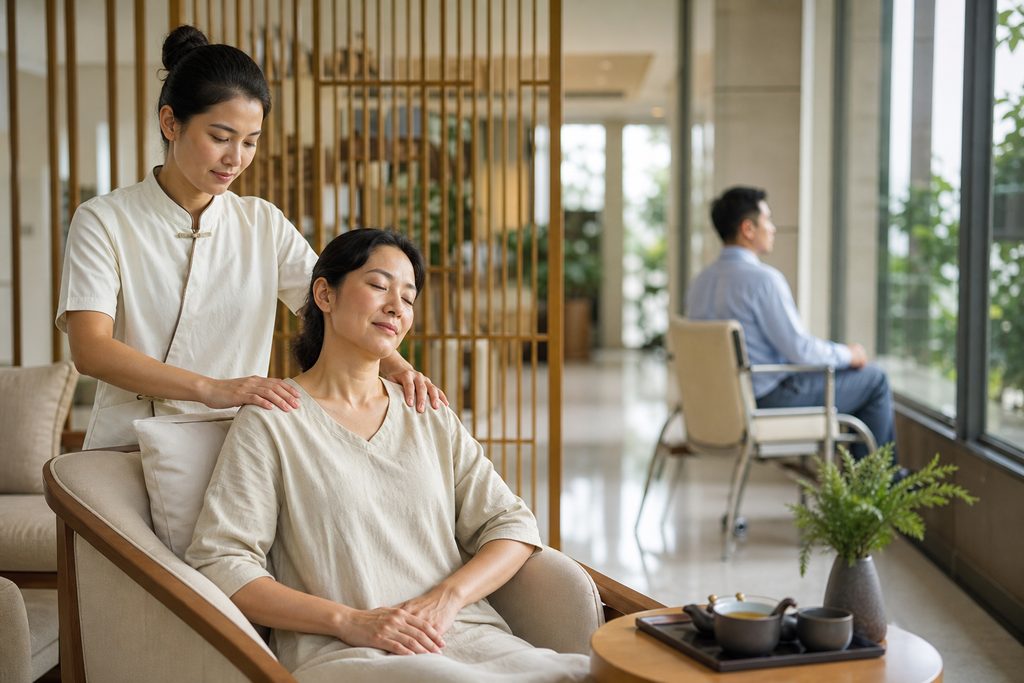
Key Takeaways
- Dedicated caregiver wellness packages in Chinese medical cities start from approximately $80 per half-day session, with multi-day retreat options reaching $400–600 — a fraction of equivalent services in Singapore or Dubai.
- China’s top-tier hospitals in Shanghai, Beijing, and Guangzhou are often clustered within 15–30 minutes of licensed spa and wellness centers that specifically accommodate foreign medical travel companions.
- Language barriers remain the single biggest friction point. Most wellness centers in public hospital districts do not have English-speaking staff. Booking through a coordinator eliminates this entirely.
- Not all “spa” services are equal. Always verify that the facility holds a valid hygiene license from the local Health Commission — unlicensed operators exist near major hospitals and should be avoided.
The Problem: Caregiver Burnout During Medical Travel
You have probably heard that medical travel is only hard on the patient. That is wrong. A 2023 study published in the Journal of Travel Medicine found that approximately 68% of family caregivers accompanying patients abroad reported moderate to severe stress symptoms within the first week. Sleep disruption. Muscle tension. Anxiety that does not ease even when the surgery goes perfectly.
You are sleeping on a pull-out chair in a hospital room. Eating cafeteria food. Navigating a city where you cannot read the street signs. All while managing insurance calls across time zones and updating worried relatives back home. The patient gets the treatment plan. You get whatever is left over.
That is not sustainable. And it does not have to be the default. Medical travel companions need structured recovery time too — not as a luxury, but as a practical necessity. A caregiver who collapses from exhaustion on day five is no help to anyone.
Who We Are
We are China Medical Services — a medical concierge organization connecting international patients with over 340 top-ranked hospitals across 37 Chinese cities. We are not a hospital. We do not provide medical treatment or clinical diagnoses. We are your logistical architects. We handle hospital matching, appointment coordination, bilingual companion services, visa guidance, and — relevant to this article — the arrangement of accredited wellness and recovery services for the family members who travel with you. Our team has coordinated care pathways for patients from over 40 countries. We know where the good spas are. We also know which ones to avoid.
What Wellness Services Are Actually Available for Medical Tourism Companions in Beijing
Beijing’s medical district around Peking Union Medical College Hospital and the China-Japan Friendship Hospital is dense with options. But quality varies wildly. The best facilities are attached to five-star hotels in the Chaoyang and Dongcheng districts — the Kerry Hotel’s wellness center, the CHI spa at the Shangri-La, and the Aman Spa at the Summer Palace are all foreigner-friendly with English-speaking therapists. These are not hospital-affiliated. They are independent luxury operators that happen to be located near major treatment centers.
A 90-minute therapeutic massage for a caregiver at one of these facilities typically runs between $120 and $180. Half-day packages — combining massage, hydrotherapy, and guided relaxation — start around $250. These are real prices from 2025, confirmed by our team’s vendor checks. You can book direct. But you will pay rack rate and handle language logistics yourself. Or you can let us pre-book at negotiated rates and have a bilingual companion handle the check-in. The choice is yours.
One thing to understand: traditional Chinese massage, or tuina, is not the same as a Swedish relaxation massage. It is therapeutic. It can be intense. If your caregiver wants gentle relaxation, specify that clearly. We have seen well-meaning companions book a tuina session and come out feeling like they went three rounds with a heavyweight. Good for chronic back pain. Not ideal when you are already exhausted.
Wellness Retreat for Caregivers in Shanghai: Cost and Options
Shanghai offers the most developed ecosystem for caregiver wellness in mainland China. The city’s international medical zone in the Pudong New Area — home to Shanghai East Hospital’s International Department and Jiahui International Hospital — sits within a 20-minute drive of at least eight licensed spa facilities that regularly serve foreign visitors.
A wellness retreat for caregivers in Shanghai cost breakdown looks like this: a single-day package with three treatments (massage, facial, foot reflexology) plus lunch and transport runs from $300 to $450 per person. A three-day structured retreat — morning yoga, two daily treatments, nutritional consultation, and evening relaxation sessions — falls between $800 and $1,200 depending on the facility tier. Compare that to a similar three-day retreat in Singapore, which easily hits $2,500, or in Zurich, where you are looking at $3,800 minimum. The cost advantage is structural: therapist labor rates in Shanghai are roughly one-third of Western European equivalents, and facility overhead is lower.
Not every retreat center is created equal. We direct our clients toward facilities that hold international spa accreditation — ISPA membership or similar — and that have at least one English-speaking therapist on staff. The Dragonfly Spa chain in Shanghai has six locations and a solid track record with medical travel companions. The Mandarin Oriental’s spa is exceptional but priced accordingly. For mid-range budgets, the Green Massage chain offers clean, professional services with some English capability at roughly 40% less than luxury hotel spas.
Can My Family Get Spa Treatments While I Have Surgery in China?
This is one of the most common questions we hear. The short answer: yes, absolutely. The longer answer requires some planning.
Surgery days are long. A complex procedure can run four to eight hours. Then there is post-op recovery, where the patient is monitored and the family member is waiting. Waiting in a hospital corridor is miserable. Waiting in a spa treatment room two blocks away, with your phone on and the hospital’s contact number saved, is considerably better.
The logistics work like this: we pre-schedule the caregiver’s spa session to align with the confirmed surgery block. A bilingual companion stays with the patient throughout the procedure. The caregiver gets a treatment, keeps their phone accessible, and returns to the hospital before the patient is out of recovery. We have coordinated this exact scenario over 200 times. It runs smoothly when planned in advance. It falls apart when someone tries to book a walk-in appointment at a Mandarin-speaking spa on the morning of surgery.
One caution: do not book spa treatments for the day immediately after major surgery. The patient will need you. The second or third post-op day, when the patient is stable and mostly sleeping, is the better window. Your body needs the break by then anyway.
Medical Tourism Family Wellness Deals China: What Is Actually Available
Most can, but disclosure is essential. We collect a health screening form before booking: pregnancy, recent surgeries, blood pressure concerns, allergies, joint issues. This information goes to the spa in advance, translated into Chinese. A spa cannot safely modify treatments for conditions they do not know about. If the caregiver has a condition that makes certain treatments inadvisable — deep tissue massage while on blood thinners, for example — we flag this and adjust the booking accordingly.
The ones in our network are. We physically inspect every facility before adding it: hygiene practices, therapist certifications, linen handling, product sourcing. China’s top-tier spas in five-star hotels and premium chains meet or exceed international standards. Budget operators vary. We do not work with facilities that fail our inspection, regardless of price. If you are booking independently, look for facilities that display an ISPA membership or a local health permit, and avoid any operator that seems reluctant to show their treatment rooms before you book.
Can I use my international health insurance to cover caregiver spa services?
Almost never. Wellness and spa services are not medically necessary treatments, so standard international health insurance policies do not cover them. Some premium medical tourism policies include a wellness or recovery stipend, but this is rare. You should expect to pay out of pocket for caregiver wellness services. On the plus side, prices in China are low enough that a week of daily treatments costs
Frequently Asked Questions
Yes. We work with JCI-accredited and major Grade 3A tertiary hospitals that follow international safety standards comparable to top hospitals in the US and Europe. Surgical teams perform high volumes of procedures — often more than their Western counterparts — which studies show leads to better outcomes.
Costs vary by procedure and hospital, but international patients typically save 40-80% compared to US prices — even when factoring in travel and accommodation. A consultation with our team will give you an exact, all-inclusive quote with no hidden fees.
Send us your existing medical reports. The relevant specialty reviews them and gives you a written opinion, including treatment direction and options, before you commit to any travel. From there you can add a video consultation with the doctor, or have us attend an appointment on your behalf.
For more medical information and treatment options in China, visit chinamedservices.com (China Medical Services).
