Skin Cancer Check in China: Mole Mapping, Costs, and Safety
Skin Cancer Check in China: Mole Mapping, Costs, and Safety
Melanoma accounts for roughly 1% of skin cancers but causes the majority of skin cancer deaths, and the American Cancer Society estimates about 100,000 new melanoma cases in the US each year. For international patients weighing a skin cancer check cost China versus what they would pay at home, the numbers are genuinely striking. A full-body mole mapping session at a top-tier Chinese dermatology department typically runs $150 to $400, compared with $500 to $1,200 in the United States or Western Europe. That gap is real. It is also only one part of the decision.
What follows is a practical breakdown of how dermatology screening works in China, who it suits, and where the friction points are.
Skin Cancer Check Cost China: The Short Answer
Expect to pay $150–$400 for a full-body dermoscopic examination with digital mole mapping at a major public hospital’s international department, or $400–$900 at a private international clinic. A dermatologist’s initial consultation alone, without imaging, generally costs $30–$80 at a public tertiary hospital and $150–$300 privately. These figures vary by hospital tier and case complexity, and they exclude any biopsy or pathology work.
The caveat matters more than the price. China’s top hospitals are not set up like Western skin clinics. You cannot simply book a dermatology slot from overseas for a standard outpatient visit. Public hospital outpatient registration happens on the day, in person, and the queue starts early. For a first-time foreign patient, the realistic route is the hospital’s international or VIP department, which costs roughly 1.5 to 2 times the standard fee but offers English-speaking staff and advance scheduling.
Who This Is Right For — and Who It Isn’t
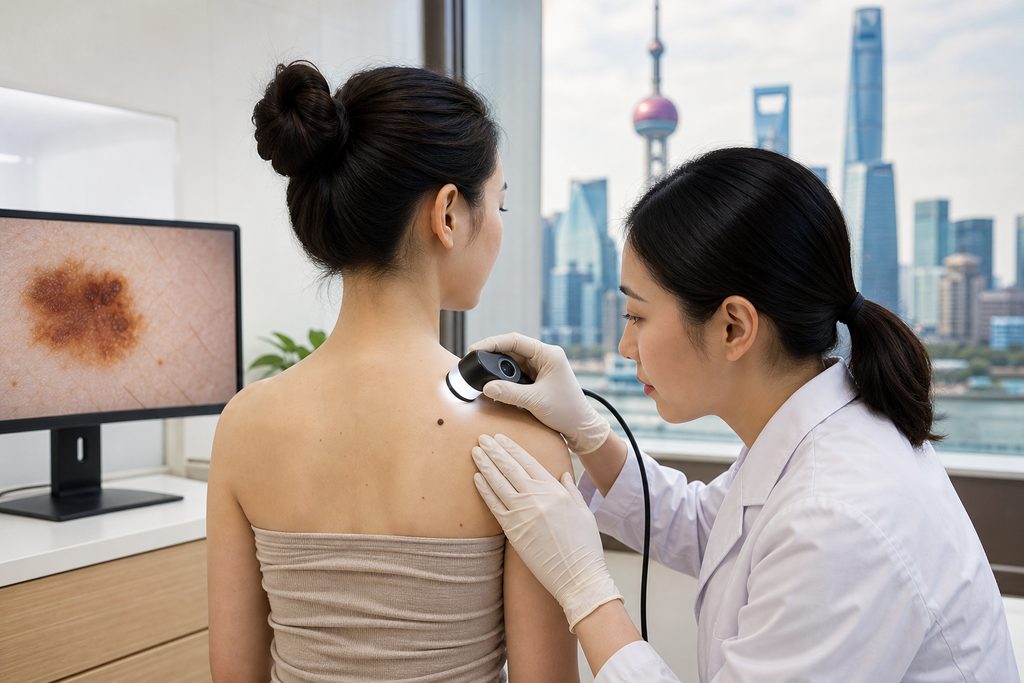
Mole mapping — sequential digital dermoscopy that photographs and tracks individual moles over time — is most valuable for people with many moles, a personal or family history of melanoma, fair skin, or a prior atypical mole biopsy. If you already live in a country with fast, affordable dermatology, traveling for routine screening rarely makes sense.
Typically a good fit:
- You are already in China for work, study, or another medical reason and want a thorough skin check while here.
- You have a high mole count or family history and face a 6–12 month wait for a dermatologist at home.
- You want a second read on a lesion a home clinician flagged as “watch and see.”
- You are combining screening with a broader executive health checkup.
Who should not pursue this:
- Anyone with a rapidly changing, bleeding, or ulcerated lesion. That needs urgent evaluation where you are, not a planned trip.
- Patients who cannot travel or manage a multi-day hospital process.
- People expecting a same-day biopsy result. Pathology takes time.
- Anyone whose only motivation is price. A cheap scan you cannot follow up on is not a bargain.
The Options, Compared
Here is how the realistic pathways stack up. Figures are indicative and vary by hospital and case complexity.
| Pathway | Typical cost | Booking lead time | English support | Best for |
|---|---|---|---|---|
| Public tertiary hospital, standard outpatient | $30–$80 consult; $150–$300 imaging | Same-day queue, no advance booking | Limited | Locals, Mandarin speakers |
| Public hospital international / VIP department | $150–$400 full mapping | Days to 2 weeks | Yes | Most international patients |
| Private international clinic (JCI-accredited) | $400–$900 | Often within days | Yes, Western-style | Speed, insurance direct billing |
| Executive health checkup package | $500–$2,000 bundled | 1–3 weeks | Yes | Combining skin check with full screening |
The middle two rows cover most foreign patients. Choose the public international department if budget matters and you can wait a week or two. Choose a private clinic if you need speed, direct insurance billing, or a familiar clinical style and are willing to pay for it.
Is Mole Mapping in China Safe, and How Accurate Is Skin Cancer Screening in China?
This is the question that decides the trip for most people, and it deserves a straight answer. Dermatoscopy itself is a standardized technology. The same digital dermatoscopes used in Germany, Australia, or the US are used in China’s leading hospitals, and the diagnostic method — pattern analysis, ABCD criteria, sequential imaging — is internationally taught.
What varies is not the equipment. It is the operator’s experience and the volume of cases they see. China’s top-tier dermatology departments sit inside hospitals that handle enormous patient volumes, which builds pattern recognition fast. Several Chinese dermatology departments appear in the Fudan University specialty reputation rankings, which list the top 10 hospitals per specialty nationally. If a department is ranked among China’s top 10 for dermatology, that is a meaningful signal of clinical depth.
Two honest limitations. First, mole mapping is a screening and monitoring tool, not a diagnosis. Suspicious lesions require biopsy and pathology — and you should confirm the hospital can deliver a pathology report in English before you commit. Second, follow-up is where medical tourism for skin screening often breaks down. Sequential mole mapping only works if you can compare images over time. If you get mapped in Shanghai and then return to Ohio, you need your image files and report in a usable format.
How to Book a Mole Mapping Appointment in Beijing or Shanghai
Beijing and Shanghai hold the largest concentration of Fudan-ranked hospitals, and both have strong international patient infrastructure. The practical sequence looks like this.
You send your existing records — photos of concerning moles, prior biopsy reports, family history — to the hospital’s international department or through a coordination service. A dermatologist reviews them and confirms whether an in-person visit adds value. If it does, the international department schedules you, usually within one to two weeks. You arrive, register with your passport, pay upfront, and attend the appointment with a bilingual companion if you do not speak Mandarin. Results and images follow, typically within days for the report and longer if a biopsy is taken.
For a city-by-city view of which hospitals carry the strongest dermatology programs, the specialty rankings by department page is the place to start. You can also browse top-ranked hospitals grouped by city to see what is available in Beijing, Shanghai, Guangzhou, and beyond.
One thing worth understanding early: public hospitals require prepayment, and insurance reimbursement happens after you return home. Private international clinics frequently bill insurers directly. That difference alone can decide which pathway you pick.
What Drives the Final Bill
The consultation and mapping fee is only the visible layer. A biopsy adds $100–$300 depending on the site and technique. Histopathology adds $80–$250. If the dermatologist recommends excision of a suspicious lesion, that is a separate procedure with its own facility and anesthesia charges, and it usually requires a follow-up visit after the initial consultation — public hospitals generally will not schedule a procedure on the same day as a first consultation.
Translation and interpretation, if you need it, is another line item. A bilingual medical companion typically runs from $300 per day, covering registration, queuing, payment, wayfinding, and interpretation. For a single screening appointment, a half-day is usually enough.
So a realistic all-in figure for a foreign patient doing a thorough skin check at a public hospital international department, with a biopsy and pathology, lands somewhere between $500 and $1,200. That is still well below comparable US pricing, but it is not the $150 headline number either. Budget for the whole pathway, not the first invoice.
Practical Considerations: Records, Visas, and Follow-Up
Bring your prior dermatology records if you have them. Sequential mole mapping is far more useful when a new image can be compared against an old one, and having baseline photos from your home clinic materially improves the value of the visit.
On visas: foreign patients coming to China for medical treatment use the S2 visa, which covers short-stay visits for medical treatment and private affairs, subject to the latest embassy or consulate requirements and supporting hospital documents. Accompanying family members apply under the same category. If treatment requires a stay beyond 180 days, S1 applies instead. Note that the M visa is for commercial and trade activities and is not the correct category for medical travel.
Payment at public hospitals is upfront, usually by card or mobile payment. Carry a method that works internationally, and confirm the hospital accepts it before you arrive. Insurance is typically reimbursed after the fact, so keep every receipt and the itemized English report.
The follow-up question deserves real planning. If a lesion is removed or flagged for monitoring, ask how images and reports will be transferred to your home dermatologist, and in what format. Getting this right at the point of care saves months of frustration later.
Frequently Asked Questions
Not through standard public hospital outpatient channels — those require same-day, in-person registration. You can arrange it in advance through a hospital’s international or VIP department, or through a private international clinic. Expect a lead time of a few days to two weeks, and be ready to send your records first.
The technology and diagnostic criteria are the same as those used in Western centers. Accuracy depends on the dermatologist’s experience and case volume, which is high at Fudan-ranked departments. Mole mapping is a screening tool, not a diagnosis — any suspicious lesion still requires biopsy and pathology, and you should confirm English-language pathology reports are available.
The procedure itself is non-invasive and low-risk. The practical risks are logistical: language barriers, upfront payment, and navigating a very large hospital. A bilingual companion service exists precisely for this. If you have no Mandarin and are attending a major public hospital, arranging interpretation is a reasonable precaution, not an admission of helplessness.
That is exactly why you want the pathway planned before you fly. A suspicious finding leads to biopsy, then pathology, then a treatment discussion — and treatment planning may require a follow-up visit or a longer stay. Public hospitals will not schedule surgery on the same day as a first consultation. If you are not prepared to stay longer or return, discuss this openly with the hospital before booking.
Your Next Step
A skin cancer check in China can be thorough, affordable, and well within international standards — provided you go in with clear expectations about access, payment, and follow-up. The screening is straightforward. The coordination around it is where most trips succeed or stall.
We are China Medical Services, a coordination service, not a hospital. We do not diagnose or treat anyone. What we do is help international patients match with appropriate hospitals, arrange written second opinions or video consultations with Chinese specialists, and provide bilingual support on the ground. If you want to understand your options before committing to travel, a written second opinion or a video consultation is a low-pressure way to start — and any consultation fee is credited in full toward on-the-ground coordination if you proceed within 90 days. You can start with a free consultation here whenever you are ready.
This article is for general information only and is not medical advice. Screening and treatment decisions should always be made with a qualified physician who has reviewed your individual history.
For more medical information and treatment options in China, visit chinamedservices.com (China Medical Services).
