Skin Cancer Check in China: How to Book It and What It Costs
Key Takeaways
- A full skin cancer check in China typically runs $150–$600 at a public tertiary hospital and $400–$1,200 at a private international clinic — a fraction of U.S. dermatology pricing.
- Dermatology is one of the few specialties where foreigners can often book a same-week appointment, because the bottleneck is language and registration, not the waiting list itself.
- Public hospital outpatient registration generally cannot be reserved from overseas in advance; the practical workaround is the hospital’s international or VIP channel.
- You will need the right visa category, your prior biopsy or imaging records in English, and a realistic understanding that a first visit is a consultation — not automatically a procedure.
The Problem: The Wait, the Cost, and the Uncertainty
You noticed a mole that changed. Or your dermatologist back home retired, and the next available appointment is four months out. In the United Kingdom, the National Health Service target for an urgent suspected-cancer referral is 14 days, but actual performance has slipped well beyond that in recent reporting — and routine dermatology referrals routinely stretch past three months in many regions. In the United States, a full-body skin examination without insurance can bill at $200–$400, and a single biopsy with pathology adds several hundred more.
Skin cancer is also the most common cancer in the United States, with the American Cancer Society estimating roughly 100,000 new melanoma cases and several million non-melanoma cases annually. Waiting is not a neutral act. Melanoma caught early has a five-year relative survival above 99%; caught after it spreads, that number drops sharply. So the question people actually ask is not “should I get checked” — it is “where can I get checked soon, by someone competent, without it costing a fortune.”
That is the gap China fills for a growing number of international patients.
Why China Works for Skin Cancer Screening
Dermatology in China’s top-tier hospitals is high-volume, technology-heavy, and comparatively inexpensive. Three structural reasons explain it.
Volume and Dermatoscopy Expertise
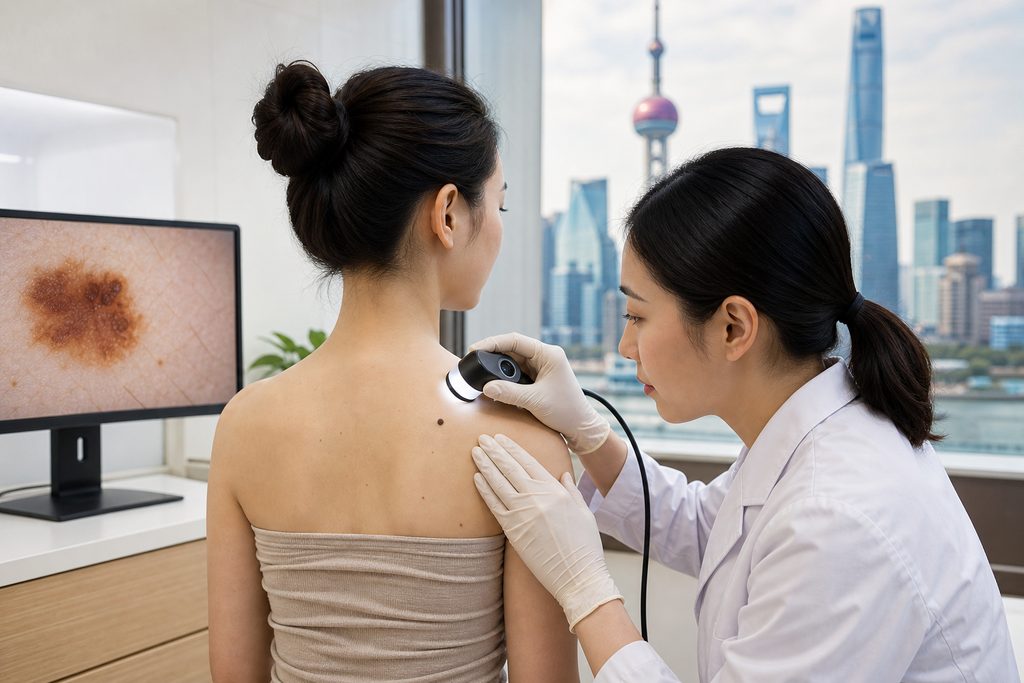
A senior dermatologist at a major Chinese tertiary hospital may see 60–100 outpatients in a single clinic day. That volume builds pattern recognition fast. Chinese teaching hospitals have also adopted digital dermatoscopy (dermoscopy) and, at the top centers, reflectance confocal microscopy and AI-assisted lesion analysis as routine tools rather than premium add-ons. For pigmented lesion assessment, that means the equipment a Western patient might wait weeks to access is often used in the first visit.
Same-Week Access, Not a Six-Month Queue
China’s 35,000+ hospitals are not equally busy. The top 5% — the roughly 340 hospitals ranked by Fudan University and JCI accreditation, spread across 37 cities — carry enormous volume, but dermatology outpatient slots open daily. A foreign patient using an international clinic or VIP channel at a major hospital in Shanghai or Beijing can frequently be seen within days, not months. That speed is the single biggest reason medical tourism for skin checks has grown.
Cost Structure, Explained Honestly
Lower prices in China do not come from cutting corners on the clinical side. They come from labor economics, government price ceilings on diagnostic procedures, and hospital throughput. A dermatologist’s consultation fee at a public tertiary hospital is set by provincial pricing schedules at a level that would be unthinkable in Boston or Munich. Pathology is priced similarly. The result is that a suspicious lesion can be examined, photographed, biopsied, and read by a pathologist for less than the cost of a single U.S. specialist co-pay plus deductible.
| Service | China (public tertiary) | China (private international) | United States |
|---|---|---|---|
| Dermatology consultation | $30–$80 | $150–$350 | $200–$400 |
| Full-body skin exam with dermatoscopy | $80–$200 | $250–$600 | $300–$600 |
| Punch or excisional biopsy | $100–$300 | $350–$800 | $400–$1,200 |
| Histopathology report | $50–$150 | $150–$400 | $200–$500 |
| Typical total first-visit package | $150–$600 | $400–$1,200 | $800–$2,500+ |
Figures are indicative ranges and vary by hospital and case complexity. A lesion requiring Mohs micrographic surgery or sentinel lymph node biopsy moves into a different cost bracket entirely.
How to Book a Skin Cancer Check in China: The Actual Sequence
Here is what the process looks like from your side, in order.
Step 1 — Decide the channel. Public tertiary hospitals have two doors: the general outpatient queue (cheap, no advance booking from abroad, Chinese-language) and the international or VIP department (roughly 1.5–2× the price, English-speaking staff, bookable in advance). For a first-time foreign patient, the international channel is almost always the right call. You can browse options by city and specialty through our department directory, which lists the top-ranked hospitals for dermatology and oncology.
Step 2 — Prepare your records. Send prior biopsy reports, pathology slides if you have them, dermatoscopy images, and any imaging. Chinese specialists read English pathology reports routinely, but a translated summary of your history speeds things up. If you have no prior records, that is fine — a first-visit screening starts from zero.
Step 3 — Book the appointment. This is where most foreign patients hit a wall. Public hospital registration systems are Chinese-language, require a Chinese mobile number or hospital card, and release slots days in advance. Private international clinics such as those in the JCI-accredited network book in English and bill insurance directly. If you want a specific public hospital expert, you need someone on the ground to register on your behalf.
Step 4 — Visa. Medical travel to China uses the S2 visa (short stay, annotated for medical treatment) or the S1 if your stay exceeds 180 days. Accompanying family members apply for S2 as well. Note clearly: the M visa is for commercial and trade activity and has nothing to do with medical treatment. Requirements change, so confirm current documentation with your nearest Chinese embassy or consulate before applying.
Step 5 — Attend, examine, decide. The first visit is a consultation and examination. If the dermatologist recommends a biopsy, it is usually performed the same day or within days. Results from a tertiary hospital pathology lab typically return in 3–7 working days. Surgery, if needed, is scheduled after the pathology confirms the diagnosis — not before.
Public Hospital vs. Private Clinic: Which Fits Your Case
The honest answer depends on what you suspect and what you can tolerate.
Choose a public tertiary hospital international department if you have a confirmed or strongly suspected malignancy, need a multidisciplinary opinion, or want access to the highest-volume dermatopathology and surgical oncology teams. The trade-off is crowds, a less Western service culture, and a need for interpretation support. Beijing concentrates the largest number of top-ranked hospitals in the country; if you specifically want to book skin cancer screening in Beijing, the international departments at the major teaching hospitals are the realistic entry point.
Choose a private international clinic if your concern is routine screening, a benign-looking lesion, or you value a calm English-language environment and direct insurance billing. For a straightforward full-body check, a private clinic in Shanghai is often faster and simpler. If your search has been for the best dermatology clinic in Shanghai, look for JCI accreditation, English-speaking dermatologists, and on-site dermatoscopy — those three signals separate genuine international clinics from general practice offices. Our Beijing and Shanghai city pages list vetted options in both categories.
Who should not come to China for this? Anyone with an unstable, rapidly changing lesion who cannot travel within days — get seen locally first. Anyone expecting a guaranteed same-day excision of a confirmed melanoma without prior records. And anyone who cannot arrange interpretation or a companion for a public hospital visit.
Is Skin Cancer Screening Safe in China?
This is the question we hear most, and it deserves a direct answer. Yes — provided you are seen at an accredited tertiary or international hospital, not a walk-in clinic of unknown standard. China’s top hospitals operate to international pathology standards, participate in external quality assessment, and publish in the same journals their Western counterparts do. The genuine risks are not clinical. They are logistical: miscommunication about your history, a biopsy performed without your full records in hand, or follow-up that falls apart after you fly home.
Two safeguards matter. First, bring your complete records, translated. Second, arrange a written pathology report and digital images you can carry back to your home physician. Continuity of care is your responsibility as much as anyone’s.
Practical Considerations Before You Book
Payment. Chinese public hospitals require prepayment for most services; international insurance is typically reimbursed after the fact, not billed directly. Private international clinics frequently do bill insurers directly — confirm before you arrive. International credit cards are accepted at international departments but not always at general outpatient cashiers.
Language. Outside international departments, expect Chinese-only signage and staff. A bilingual medical companion handles registration, queueing, payment, and interpretation — our service runs from $300 per day, and it is the difference between a smooth visit and a confusing one.
Records and follow-up. Ask for copies of everything before you leave the hospital. If a biopsy is done, confirm how and when results will reach you if you have already departed.
Timing. A screening visit can realistically be completed in 2–3 days on the ground. If a biopsy is taken, add 3–7 working days for pathology, or arrange for results to be sent to you.
Frequently Asked Questions
Sometimes. Private international clinics accept direct English bookings online. Public tertiary hospitals generally do not — registration requires a Chinese-language system and often a local phone number or hospital card. If you want a specific public hospital specialist, you will need on-the-ground coordination.
A first-visit screening package typically runs $150–$600 at a public tertiary hospital and $400–$1,200 at a private international clinic. Comparable U.S. care often exceeds $800–$2,500 once consultation, biopsy, and pathology are combined. Final pricing varies by hospital and case complexity, and any surgical treatment is quoted separately.
Yes, in many cases. Excision, Mohs surgery, and sentinel lymph node biopsy are performed at major Chinese centers, and treatment planning follows international guidelines. But we never promise admission, a specific surgeon, or a clinical outcome. Treatment decisions rest with the hospital and your treating physician, and staging determines what is feasible.
The S2 visa, annotated for medical treatment, covers short stays; S1 applies beyond 180 days. Family accompanying you also applies for S2. The M visa is strictly for commercial and trade activity and is not a medical visa. Always verify current requirements with the Chinese embassy or consulate in your country.
For a private clinic, a week or two is often enough. For a public hospital international department with a specific specialist, allow three to four weeks for records review, appointment coordination, and visa processing. Urgent cases move faster — tell us the timeline and we will be honest about what is realistic.
Your Next Step
Getting a skin cancer check in China is genuinely achievable, affordable, and fast — if you choose the right channel and arrive with your records in order. The clinical standard at accredited hospitals is high; the friction is logistical, and logistics can be solved.
We are China Medical Services, a coordination service that connects international patients with China’s top-ranked hospitals. We are not a hospital and we do not diagnose or treat anyone. If you would like help identifying the right hospital, understanding likely costs, or arranging a written second opinion before you travel, you can start with a free consultation through our patient services page — no obligation, and no pressure.
This article is for general information only and is not medical advice. Screening and treatment decisions should always be made with a qualified physician who has reviewed your individual case.
For more medical information and treatment options in China, visit chinamedservices.com (China Medical Services).
