Bone Cancer Screening in China: Imaging Costs, Safety & Top Hospitals
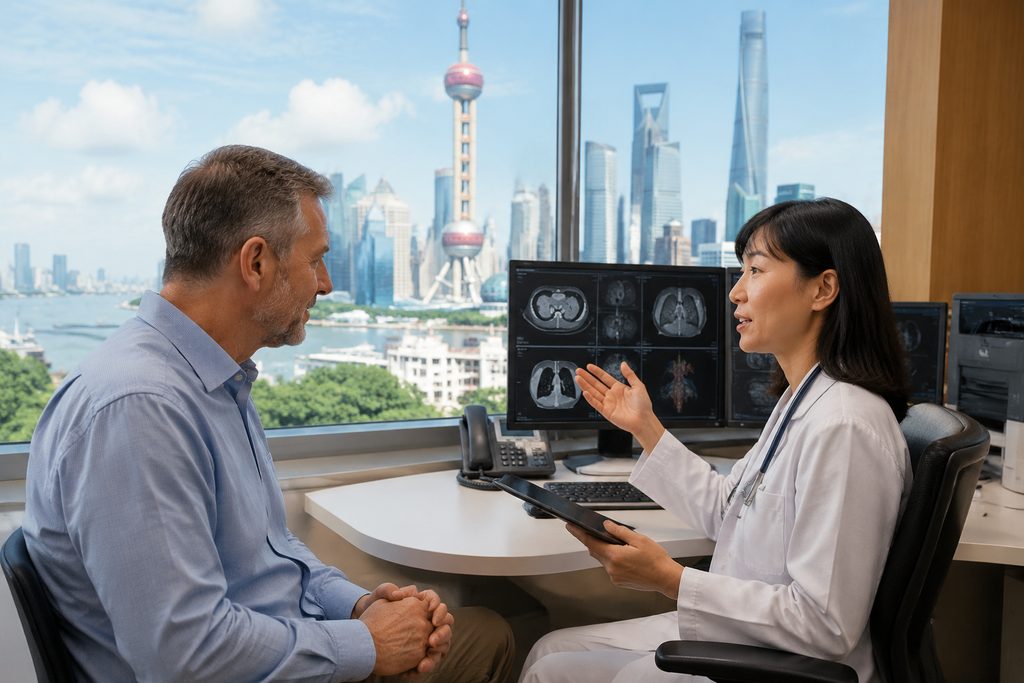
Bone Cancer Screening in China: Imaging
Bone cancer screening means using imaging — X-rays, MRI, CT, PET-CT — to find tumors in bone early, before symptoms become severe. In China, the bone cancer screening cost is typically a fraction of what you would pay in the United States or Western Europe, and several Chinese hospitals run imaging departments with equipment and volume that rival the best centers worldwide. This article explains what the tests involve, what they cost, where to go, and how to arrange it from abroad.
One clarification before we go further. “Screening” in the strict medical sense means testing people with no symptoms. What most international patients actually need is diagnostic imaging — they have a lump, a persistent bone pain, or a suspicious finding on an earlier scan. The distinction matters because it changes which department you approach and how quickly things move.
How This Actually Works, Step by Step
Here is the real sequence, from your home country to a completed scan in China.
Step one: you send records. Our team collects your existing imaging files (DICOM format, if available), pathology reports, blood work, and a short summary of your symptoms. If you have no prior imaging, that is fine — we still need the clinical picture.
Step two: a Chinese specialist reviews. The relevant specialty — usually orthopedic oncology or radiology — reviews your materials and tells us which imaging is actually needed. This is where unnecessary tests get filtered out. A patient who arrives asking for “everything” often leaves with a focused plan instead.
Step three: you receive a written opinion. Typically within 3–7 business days, you get written analysis of what the imaging should target, which modality is appropriate, and what the likely next steps are. If a video consultation makes more sense, we arrange that instead or in addition.
Step four: appointment coordination. Once you agree to proceed, we contact the hospital’s international department or special-needs channel to schedule the scan. You do not queue at a public registration window.
Step five: arrival and imaging. A bilingual companion meets you, handles registration and payment, and stays through the scan. Results usually return within 24–72 hours for standard imaging.
What Imaging Tests Are Used, and What They Cost
Bone tumors are evaluated with a specific ladder of tools, and each has a different price point in China.
| Imaging Modality | Typical Price in China (USD) | Typical Price in the US (USD) | What It Shows |
|---|---|---|---|
| X-ray | $30–80 | $150–500 | Bone destruction, periosteal reaction |
| CT scan (single region) | $150–400 | $800–3,000 | Cortical bone detail, lung staging |
| MRI (single region) | $300–800 | $1,500–5,000 | Marrow involvement, soft tissue extent |
| PET-CT (whole body) | $900–1,800 | $5,000–12,000 | Metastasis, metabolic activity |
| Bone scan (nuclear) | $200–500 | $1,000–2,500 | Skeletal spread across the body |
These figures vary by hospital tier, city, and whether contrast agents are used. A private international hospital in Shanghai will sit at the higher end; a top public hospital in Chengdu or Wuhan often sits lower. Nobody can quote you a final number without seeing your case — and anyone who does should be treated with caution.
For a patient asking how much does a bone scan cost in Shanghai, the honest answer is roughly $200–500 at a major public hospital, more at a private international facility. The same scan in the US frequently exceeds $2,000.
A Realistic Timeline
Patients consistently underestimate the administrative steps. Here is a grounded schedule.
| Stage | Realistic Duration | Notes |
|---|---|---|
| Records collection & translation | 3–7 days | Longer if pathology slides need shipping |
| Specialist review / written second opinion | 3–7 business days | Rush options exist at some hospitals |
| Appointment confirmation | 3–14 days | Top-tier specialists book out further |
| S2 visa application | 4–10 business days | Varies by consulate and season |
| Travel & arrival | 1–2 days | Jet lag affects scan quality — buffer a day |
| Imaging performed | 1–2 days | Multiple modalities may span two visits |
| Results & interpretation | 24–72 hours | Pathology, if needed, adds 3–7 days |
Add it up and a well-organized case moves from first contact to completed imaging in roughly three to five weeks. Trying to compress this into ten days usually means paying premium rates and accepting whoever is available.
Is Bone Cancer Screening in China Safe?
This is the question families ask most, and it deserves a direct answer.
China’s top-tier hospitals operate under the same imaging technology standards as Western centers — 3-Tesla MRI, 128-slice and above CT, and modern PET-CT systems from Siemens, GE, and Philips. The equipment is not the differentiator. What differs is the operational environment: patient volume is enormous, and a single major hospital may perform more scans in a week than a mid-sized European hospital does in a month.
High volume cuts both ways. Radiologists at these centers see rare presentations constantly, which sharpens diagnostic pattern recognition. But it also means appointments are tight and corridors are crowded. For an international patient without language support, the experience can be disorienting regardless of how good the medicine is.
Radiation exposure follows international protocols. Contrast agents are the same products used globally. Sterilization and infection-control procedures at JCI-accredited private hospitals meet international benchmarks, and the leading public hospitals maintain comparable standards in their international departments.
Choosing Where to Go: Beijing, Shanghai, and Beyond
For anyone searching for the best cancer hospital in Beijing for imaging, the honest answer is that “best” depends on what you need imaged and how complex your case is.
Beijing concentrates the largest number of top-ranked hospitals in the country — 21 of the Fudan Top 100 sit there, more than any other city. Shanghai follows with 18. Guangzhou has 10. If your case involves a suspected primary bone tumor such as osteosarcoma or Ewing sarcoma, you want a center with a dedicated orthopedic oncology team, not just good scanners.
Our specialty rankings by department list which hospitals sit among China’s top 10 for oncology and orthopedics. For hospital-by-hospital detail, the directory of top-ranked Chinese hospitals groups them by city with their tier classifications. Patients who prefer English-speaking staff, direct insurance billing, and shorter waits often choose a private international hospital instead — those are catalogued separately.
A practical point: a hospital with a world-class orthopedic oncology department but no international patient office will be harder to navigate than a slightly lower-ranked hospital that handles foreigners routinely. Match the hospital to your situation, not just to a ranking.
Practical Considerations: Records, Visas, Payment, Follow-Up
Records. Bring original imaging on disc or upload DICOM files in advance. Chinese radiologists can read foreign scans, but they cannot reinterpret images they never received. Pathology slides are harder to transfer and may need to be physically shipped.
Visa. Medical travel to China uses the S2 visa, which covers short-stay private affairs including medical treatment. Accompanying family members apply under the same category. The M visa is for commercial and trade activity and has nothing to do with medical care — if a service tells you otherwise, that is a red flag. Requirements shift, so confirm current documentation with your nearest Chinese consulate. Longer stays may fall under S1.
Payment. Public hospitals require prepayment; international insurance is typically reimbursed afterward. Many private international hospitals bill insurers directly. Bring a payment method that works in China, and expect a deposit before scheduling.
Language. This is the practical bottleneck. Registration systems, signage, and most staff operate in Chinese. A bilingual medical companion handles queuing, registration, payment, wayfinding, and translation so you are not managing logistics while anxious about results.
Follow-up at home. Ask for your imaging on disc and a written radiology report in English before you leave. Your oncologist at home will need both. Getting them later, remotely, is slow and sometimes impossible.
Frequently Asked Questions
A full diagnostic workup — X-ray, MRI, and PET-CT — typically runs $1,400–3,000 in China versus $7,000–20,000 in the US, depending on hospital tier and city. A medical tourism China cancer screening package arranged through a coordinator may bundle consultation and imaging, but always confirm what is included.
Not through standard public registration, which operates on same-day queuing. Advance scheduling is possible through a hospital’s international or special-needs department, and that is the route we coordinate. Expect to submit records first so the hospital can confirm the appropriate imaging.
The imaging itself is safe and uses internationally standard equipment and protocols. The real risks are logistical — miscommunication, missing records, or an incomplete workup — which is why pre-arrival record review matters more than the scanner’s brand.
Yes. The S2 visa covers short-stay medical treatment, and accompanying family members apply under the same category. Processing generally takes 4–10 business days but varies by consulate. Never travel on a tourist visa intending to receive medical care without declaring it.
You will receive a written report, and a specialist will explain the findings and outline options. Nothing proceeds without your agreement. If treatment in China is appropriate, we coordinate; if returning home is better, we help you leave with complete records.
Your Next Step
Bone cancer screening in China is affordable, technically strong, and genuinely accessible to international patients — provided someone handles the logistics. The imaging is rarely the hard part. Getting the right scan, at the right hospital, with your records in the right hands, is.
We are China Medical Services, a coordination team that connects international patients with Chinese hospitals. We are not physicians and we do not provide medical advice or diagnose anyone. What we do is review your records with the relevant specialty, arrange the imaging you actually need, and stand beside you through the process. If you would like to understand your options before committing to anything, start with a free consultation — no pressure, no obligation.
This article is for general information only and does not constitute medical advice. Always consult a qualified physician about your individual condition.
For more medical information and treatment options in China, visit chinamedservices.com (China Medical Services).
