Cancer Staging Scans in China: Booking Made Simple for Patients
Key Takeaways
- Cancer staging scans cost China significantly less than in the US — a PET-CT often runs $800–$1,500 versus $5,000–$8,000 in America.
- Top-tier imaging centers in Beijing and Shanghai operate late-model PET-CT and 3T MRI machines, many inside JCI-accredited hospitals.
- You cannot simply walk in from overseas and book a scan. Public hospital imaging slots open through the international department or a coordination service.
- Bring your pathology reports, prior imaging on disc, and a clear question your oncologist wants answered. The scan is only as useful as the context around it.
The Problem: Why Staging Scans Cost So Much and Take So Long
You have a diagnosis. Now you need to know how far it has spread. That single question — staging — determines everything that follows: surgery or systemic therapy, curative intent or palliation.
In the United States, a PET-CT scan averages between $5,000 and $8,000 before insurance. Even with coverage, patients report coinsurance bills of $1,000 or more. In the UK, NHS waiting times for urgent cancer imaging have stretched in some regions to several weeks, and private PET-CT runs £1,500–£2,500 out of pocket. For someone recently diagnosed, every week of delay feels like the disease is writing its own timetable.
That is the reality many international patients face. The scan itself takes under an hour. The waiting, the cost, and the paperwork take far longer.
Why China Delivers Results for Cancer Staging Scans
China’s top hospitals handle imaging volume that most Western centers never approach. That scale changes what is possible — in price, in speed, and in equipment access.
Clinical Volume and Equipment Density
China’s 35,000+ hospitals include roughly 340 top-ranked institutions — the top 5% by Fudan University rankings and JCI accreditation. Many of these operate multiple PET-CT scanners and 3T MRI units under one roof. A hospital like West China Hospital in Chengdu or Ruijin Hospital in Shanghai may run thousands of oncology imaging studies each month. High volume means radiologists read scans daily, not occasionally. It also means equipment is used, maintained, and replaced on a faster cycle than in smaller Western facilities.
Cost Structure Without Quality Trade-Offs
Lower prices in China do not come from cutting corners on the scanner. They come from labor economics, hospital efficiency, and government price controls on imaging. A PET-CT at a top public hospital typically costs between $800 and $1,500. A full-body MRI with contrast may fall in the $400–$900 range. These figures vary by hospital and case complexity, but the gap with US pricing is structural, not promotional.
Quality? The same radiopharmaceuticals, the same scanner generations, and increasingly the same reporting standards used in Europe and North America.
Speed From Diagnosis to Scan
For international patients using the hospital’s international department or a coordination service, the interval from records submission to scan date is often 5–10 business days. That is not a guarantee — public hospital capacity fluctuates — but it is a realistic planning window for many cases.
What a Staging Scan Actually Involves: Step by Step
Understanding the workflow removes the fear. Here is how it typically unfolds at a major Chinese hospital.
Step 1 — Records review. You send your pathology report, operative notes if any, and prior imaging (DICOM files on disc or via cloud link). The hospital’s oncology or nuclear medicine department reviews whether a PET-CT, MRI, or CT is the right next study.
Step 2 — Scheduling. If you are booking through the international department or a service like ours, a date is proposed. You will be asked to fast for 4–6 hours before a PET-CT and to avoid strenuous exercise for 24 hours.
Step 3 — Arrival and injection. On the day, you check in, receive an intravenous tracer injection (usually FDG), and rest quietly for 45–60 minutes while the tracer distributes.
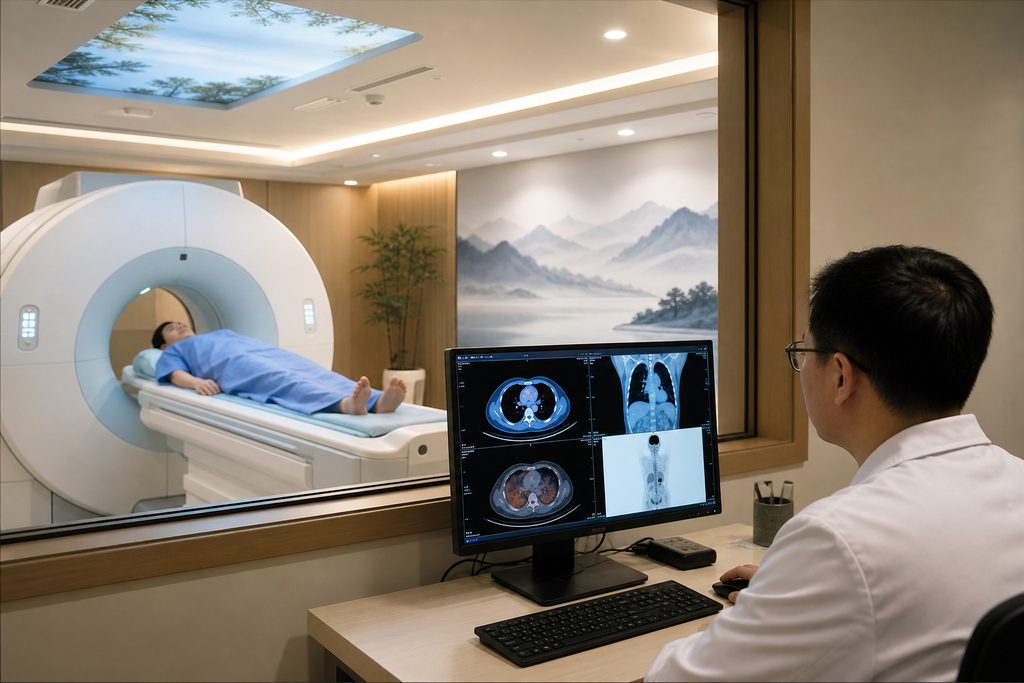
Step 4 — The scan itself. A PET-CT takes 15–30 minutes on the table. A full-body MRI may take 45–60 minutes. You lie still. The machine does the rest.
Step 5 — Reporting. Preliminary findings may be available same day. The formal written report, often with a CD or digital copy, is typically ready within 24–72 hours. If you need it translated for your home oncologist, that can be arranged.
How long does a full body cancer scan take? From walking in to walking out, plan on 2–3 hours. The imaging portion is short; the waiting for tracer uptake is the longer part.
How to Choose: Public International Department vs. Private JCI Center
You have two main paths for cancer staging scans in China, and they serve different needs.
| Factor | Public Hospital International Dept. | Private JCI Center |
|---|---|---|
| Typical PET-CT price | $800–$1,500 | $1,800–$3,500 |
| English service | Available but variable | Standard |
| Insurance direct billing | Rare; pay upfront, claim later | Common with international insurers |
| Booking lead time | 5–10 business days | 3–7 business days |
| Equipment | Latest generation, high volume | Latest generation, lower volume |
| Best for | Complex cases, second opinions, cost sensitivity | Convenience, insurance, English-first experience |
If your priority is a JCI-accredited cancer imaging center in Beijing or Shanghai with direct insurance billing, the private route is smoother. If you want the expertise of a high-volume oncology center and are paying out of pocket, the public international department often delivers more for less.
Is Cancer Staging Safe in China Hospitals?
This is the question every patient asks, and it deserves a direct answer.
PET-CT and MRI are non-invasive. The main risk is radiation exposure from the tracer and any accompanying CT. A standard staging PET-CT delivers an effective dose in the range of 10–25 mSv depending on the protocol — comparable to what you would receive at a US or European center. Chinese hospitals follow international guidelines on tracer dosing and scan parameters. If you are pregnant or breastfeeding, you must tell the team before the scan; alternative imaging may be recommended.
Contrast agents for MRI or CT carry a small risk of allergic reaction. Chinese hospitals stock the same classes of agents used globally and have emergency protocols in place. The bigger practical risk is not the scan itself — it is acting on an incomplete or misinterpreted report. That is why sending your full records and getting a written report you can share with your home oncologist matters.
If you want to compare hospital options by specialty, our department rankings page lists top-tier oncology and imaging centers by city.
Practical Considerations: Visa, Payment, and Records
Getting the scan is one piece. Getting there and paying for it is another.
Visa. For a short medical trip, the S2 visa is the applicable category for medical treatment and private affairs. It is not the M visa — M is for commercial and trade activities and has nothing to do with medical care. S2 applications require supporting documents from the Chinese hospital, typically an invitation letter or appointment confirmation. Always check the latest requirements with your nearest Chinese embassy or consulate, as rules can change.
Payment. Public hospitals generally require upfront payment for international patients. Credit cards are accepted at international departments; smaller facilities may prefer cash or local payment apps. Private JCI hospitals often bill international insurers directly. If you plan to claim reimbursement at home, request an itemized invoice and the radiology report in English.
Records. Bring your pathology slides or blocks if possible, not just the report. Bring prior imaging on disc. Bring a list of medications and allergies. And bring a written question from your oncologist — something like “Is there evidence of distant metastasis?” That focuses the radiologist’s attention.
Language. Outside international departments, English is limited. A bilingual medical companion can handle registration, queueing, payment, and translation on the day. That service starts from $300 per day.
Frequently Asked Questions
Yes, in many cases. You can send your records, have them reviewed, and schedule a scan date before you fly. But you cannot simply book online like a hotel. Public hospital imaging slots are managed through the international department or a coordination service. Expect to provide medical records and a passport copy as part of the process.
A PET-CT in China typically runs $800–$1,500 at a top public hospital, versus $5,000–$8,000 in the US. MRI and CT are similarly lower. These are ranges — final pricing varies by hospital, city, and whether contrast or additional sequences are needed. Private JCI centers cost more but may bill your insurance directly.
The scan report will describe findings. If something needs follow-up, the hospital’s oncology team can advise on next steps, but they will not start treatment without a full evaluation. You should share the report with your home oncologist. We do not provide diagnoses or treatment recommendations — we help you get the scan and the documentation, then you and your doctors decide what comes next.
Most foreign nationals need a visa. The S2 visa covers short-term medical treatment and requires supporting documents from the Chinese hospital. Apply through your nearest Chinese embassy or consulate and confirm current requirements before booking travel. Do not apply for an M visa for medical purposes — it is for business travel only.
Your Next Step
Cancer staging scans in China offer a path to faster, lower-cost imaging at hospitals with real oncology depth. The trade-off is navigation — visa rules, hospital booking systems, language, and payment logistics that are not designed for international patients.
We are China Medical Services. We are not a hospital and we do not diagnose or treat. We help you understand your options, connect with the right hospital, and coordinate the practical details — from records review to a bilingual companion on scan day. If you want to explore whether this path fits your situation, you can start with a free consultation. No pressure, just clarity.
For more medical information and treatment options in China, visit chinamedservices.com (China Medical Services).
