Cancer Screening in China: Video Review Before You Travel
Key Takeaways
- A video review of cancer screening in China lets you confirm the hospital, the exact test panel, and the price before you buy a plane ticket — no guesswork, no deposit into the void.
- Written second opinions from top-tier Chinese hospitals typically run $300–500, and video consultations range from $100–300 at standard international departments up to $500–800 with a top specialist.
- The hard part is not the medicine. It is the logistics: public hospital outpatient slots cannot be reserved from overseas in most cases, so screening packages are usually arranged through international or VIP channels.
- Cancer screening is not the same as cancer diagnosis. A screen that returns an abnormal result still requires in-person workup, and no remote review can replace that.
In the United States, a colonoscopy can carry a list price above $2,000 before insurance. At a top-tier Chinese hospital, the same procedure with pathology often falls between $300 and $700. That gap is why searches for cancer screening in China keep climbing — and why so many of those searches end in confusion about whether the result can be trusted.
Here is the honest answer up front: yes, screening at China’s leading hospitals is technically solid, and a video review is the cheapest way to find out whether it fits your situation. But the review is a planning tool, not a diagnosis. Understanding that distinction will save you money and disappointment.
The Problem: Screening Is Expensive, Slow, and Opaque
Consider what a 55-year-old in a country with a public system actually faces. In Canada, the median wait from referral to a diagnostic imaging appointment has stretched past 20 weeks in several provinces, according to annual wait-time reporting from the Fraser Institute. In the UK, the NHS target of a 62-day cancer pathway has been missed repeatedly in recent years. Meanwhile, in the US, high-deductible plans mean the patient often pays the first $3,000 to $7,000 out of pocket.
So people look abroad. And the moment they do, a new set of questions appears. Which hospital? Which package? Is the equipment the same? Will anyone speak English? Is the price quoted the price charged?
That last question matters more than most patients expect. Chinese public hospitals operate on a prepayment model — you pay before service, and insurance reimbursement happens afterward, often after you have returned home. Private international hospitals usually bill insurers directly, but their prices sit higher. Neither model is wrong. They are simply different, and nobody explains the difference to a first-time medical traveler.
Then there is the language wall. A major Chinese tertiary hospital can process more than 10,000 outpatient visits in a single day. Corridors are dense, signage is in Chinese, and registration queues move fast. Without someone beside you who reads the system, a routine screening morning can consume an entire day.
Why a Video Review Changes the Calculus
Most screening packages sold online are generic: a blood panel, an ultrasound, a chest X-ray, a tumor marker set. That is fine for a healthy 40-year-old. It is close to useless for someone with a strong family history of colorectal cancer who actually needs a colonoscopy and a genetic risk assessment.
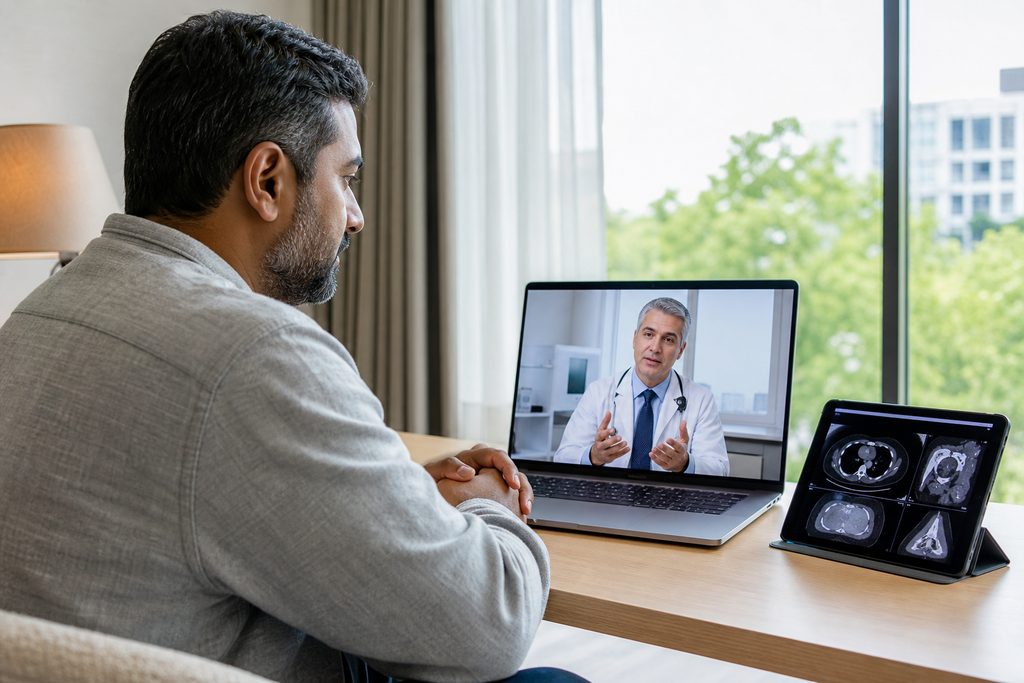
A video review forces specificity. The specialist tells you which modality, at which interval, for your risk profile. You hear the reasoning. You can push back. And you can decide whether the plan justifies travel.
Cost Transparency Arrives Before Commitment
Written second opinions from specialists at top-ranked hospitals generally run $300–500. Standard video consultations sit at $100–300; a session with a named top specialist runs $500–800. Multidisciplinary team reviews, where several departments weigh in together, range from $1,500–2,000.
Any consultation fee is credited in full toward on-the-ground coordination if you travel within 90 days. That is a one-time credit applied to the coordination service — it never applies to hospital treatment charges.
Accuracy Questions Get Answered Directly
How accurate are cancer screening tests in China? The equipment at the top tier is the same equipment used in Seoul, Singapore, and Cleveland — Siemens, GE, Philips imaging platforms, Roche and Abbott assay systems. The variable that matters is not the machine. It is the reader and the protocol.
China’s highest-volume hospitals read enormous numbers of scans per year. Volume builds pattern recognition. A radiologist at a major cancer center may review more chest CTs in a month than a small regional hospital sees in a year. That is a real advantage, and it is measurable in the published literature on diagnostic concordance.
What “Video Review” Actually Looks Like, Step by Step
Here is the sequence, with realistic timing. Nothing here requires you to commit to travel.
Days 1–3: Records collection. You gather whatever exists — prior scans on disc or DICOM files, lab reports, biopsy reports if any, medication list, family history. If your records are thin, the reviewing team will tell you what to obtain first.
Days 3–7: Translation and routing. Reports are translated and routed to the relevant department — oncology, gastroenterology, pulmonology, gynecology, depending on what you are screening for. This is where a general “health checkup” request becomes a targeted plan.
Days 7–14: The video session. You speak with the Chinese specialty team, usually 30–60 minutes, with interpretation. You explain your symptoms and goals. They explain their recommendations and the reasoning behind each test.
After the call: A written summary. You receive the recommended screening protocol, an estimated cost range, and an indication of how many days in China the plan would require. Most comprehensive screening programs take two to four days on the ground.
Choosing a Hospital and Package Without Getting Burned
China has more than 35,000 hospitals. The Fudan Hospital Rankings place only the top 100 in a tiered system from A++++ down to A — there is no public “number 37” ranking, and any provider claiming a precise national position for a general hospital is inventing it. Specialty reputation rankings are different: those do list top-10 positions per specialty, so a claim like “ranked among China’s top 10 for oncology” is verifiable.
For screening specifically, three hospital categories matter:
- Top public tertiary hospitals — the deepest diagnostic bench, the largest volume, the lowest prices. Beijing alone hosts 21 Fudan top-100 hospitals; Shanghai has 18. Expect queues and minimal English.
- Private international hospitals — English-speaking staff, JCI accreditation, direct insurance billing, Western-style scheduling. Higher cost, smoother experience. Brands like United Family, Jiahui, Parkway, and Raffles operate in this space.
- Traditional Chinese medicine hospitals — not a screening venue in the conventional sense, but often used for post-screening recovery and chronic condition management.
| Screening Package (typical) | Public Tertiary Hospital | Private International Hospital | US Benchmark |
|---|---|---|---|
| Basic adult panel (blood, ultrasound, chest imaging) | $200–500 | $800–1,500 | $1,500–3,000 |
| Colonoscopy with pathology | $300–700 | $1,200–2,000 | $2,000–4,500 |
| Low-dose chest CT | $80–200 | $300–600 | $300–1,000 |
| Breast MRI | $250–500 | $700–1,200 | $1,000–3,000 |
| Full-body PET-CT | $900–1,500 | $2,000–3,500 | $4,000–8,000 |
All figures are ranges. Final pricing varies by hospital and case complexity, and no responsible provider will quote a fixed number before seeing your records.
Be cautious with any package that promises “cancer detected early” as a marketing line. Screening reduces risk through systematic protocols over time. A single scan is one data point, not a guarantee.
Practical Considerations: Visa, Payment, Records, Follow-Up
Visa. Foreign patients traveling for medical treatment use the S2 visa, which covers short-stay medical treatment and private affairs, with accompanying family members applying under the same category. Stays beyond 180 days fall under S1. Requirements shift, so confirm current rules with the relevant Chinese embassy or consulate and bring the hospital’s supporting documents. Note clearly: the M visa is for commercial and trade activity and has nothing to do with medical treatment.
Payment. Public hospitals require prepayment. International cards are accepted at most large hospitals, but daily transaction limits on foreign cards can cause friction — a $5,000 limit against a $12,000 bill is a real problem. Private international hospitals frequently bill insurers directly, which removes the cash-flow issue at a higher headline price.
Records. Bring imaging on physical media or upload DICOM files. Chinese hospitals cannot always pull your foreign records electronically, and repeating a scan you already have wastes money and radiation exposure.
Follow-up. This is the part people underestimate. If a screening finds something that needs treatment, you will want a plan for where that treatment happens and how your home physician receives the results. Ask before you travel who will send records back and in what format.
Insurance. Most Western insurers do not reimburse elective screening abroad without prior authorization, and many exclude it entirely. Check your policy before assuming anything. For a broader view of how the system is organized, the Fudan-ranked top hospitals directory groups facilities by city and tier, and the specialty rankings page shows which hospitals lead in oncology and related fields.
Frequently Asked Questions
Is cancer screening in China safe?
At accredited tertiary and JCI-certified hospitals, safety standards for imaging, endoscopy, and lab work match international norms. The realistic risks are logistical rather than clinical: miscommunication about what was ordered, incomplete records transfer, and follow-up gaps after you fly home. A structured video review before travel closes most of those gaps.
How accurate are cancer screening tests in China, and will my home doctor accept the results?
Test accuracy depends on the modality and the reader, not the country. Major Chinese cancer centers use the same imaging and assay platforms as leading Western hospitals, and their radiologists read at very high volume. Whether your home physician accepts the report varies — some do without question, others ask for a repeat. Request a bilingual report with original images so your physician can review the raw data.
Can I book a cancer screening package in China directly, or do I need a service?
You can contact a hospital’s international department yourself, and some offer English-language screening packages. The limitation is that public hospital outpatient slots generally cannot be reserved from overseas in advance, and specialist appointments follow the same rule. International and VIP channels can hold appointments, typically at 1.5 to 2 times the standard price. A coordination service exists mainly to handle registration, translation, queueing, and payment logistics on the day.
What does medical tourism for cancer screening in China actually cost, all-in?
Beyond the screening itself, budget for flights, accommodation, airport transfers (roughly $200 round-trip through a coordination service), and interpretation if you need it. Bilingual medical companion support runs from $300 per day, covering registration, queueing, payment, wayfinding, and translation. A realistic three-day screening trip at a top public hospital, including companion support, often lands well below the cost of the same tests in the US.
What happens if the screening finds something serious?
You will be told, and the reviewing team will outline next steps. Those steps require in-person evaluation — imaging alone cannot confirm a diagnosis. Any admission or treatment plan remains subject to the hospital’s own assessment and rules. No remote review, and no coordination service, can promise a clinical outcome or guaranteed admission.
Your Next Step
A video review is the lowest-risk way to find out whether screening in China makes sense for you — you spend a few hundred dollars instead of a few thousand on flights, and you learn the plan before committing to anything. Our team at China Medical Services connects international patients with 340+ top-ranked hospitals across 37 cities, handles records translation, and arranges consultations through official international departments. We are not a hospital and we do not provide diagnoses or treatment. If you want to understand your options, start with a conversation at our patient consultation page — no obligation, and no pressure to travel.
This article is for general information only and does not constitute medical advice. Screening decisions should be made with a qualified physician who knows your history. Pricing varies by hospital and case complexity.
For more medical information and treatment options in China, visit chinamedservices.com (China Medical Services).
