Colorectal Cancer Treatment in China: A Complete Surgery and Chemotherapy Guide for Internationals
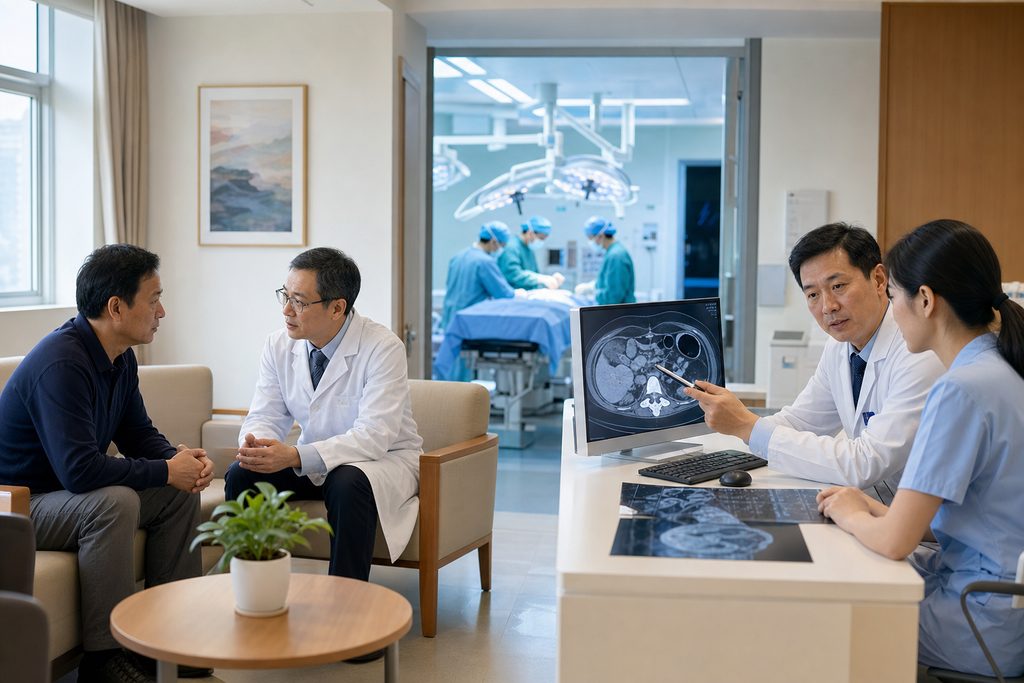
You have probably heard that seeking major cancer surgery abroad means stepping into the unknown, sacrificing quality for a lower colorectal cancer surgery cost China might offer. The data tells a different story. China’s top-tier oncology centers now perform a surgical volume that dwarfs most Western hospitals, and they do it using the same minimally invasive techniques—laparoscopic and robotic-assisted resections—that define the global standard of care. Our team regularly connects patients from North America, Europe, and the Middle East with these centers. We see the gap between perception and reality every day. The real question is not whether the expertise exists. It is whether you can navigate the pathway without burning time and money on avoidable mistakes.
How This Actually Works, Step by Step
The pathway does not start by booking a flight. It starts with your existing medical records. You send us your colonoscopy report, pathology slides, recent CT or MRI scans, and a summary of your clinical history. Our team translates these documents into clinical Chinese—not just linguistic translation, but formatting them to match what a Chinese multidisciplinary team expects to see. The records go to the international department of a hospital that matches your clinical stage and surgical needs. You do not need to guess which hospital is right. We match based on the exact procedure you require, whether that is a standard hemicolectomy or a more complex cytoreductive surgery.
Within 5 to 7 business days, you receive a written second opinion. This document outlines the proposed surgical approach, the rationale for neoadjuvant or adjuvant chemotherapy timing, and a treatment cost estimate. If you then want to speak directly with the specialist, we schedule a video consultation. The surgeon reviews your scans on screen, answers your questions, and refines the plan. Only after you have this clarity do we move to the logistics: visa support, hospital appointment coordination, and arrival planning. This sequence prevents the worst-case scenario—arriving in a foreign country only to learn that your case requires a different specialist or that your records were incomplete.
Breaking Down the Colorectal Cancer Surgery Cost China and What It Covers
The numbers matter, but only when you know what they include. For a laparoscopic radical resection of colorectal cancer at a top-ranked public hospital’s international department, the surgical package typically ranges from $18,000 to $28,000. This covers the surgeon’s fee, anesthesia, operating theater, a private room for 7 to 10 days, nursing care, and standard pathology. Robotic-assisted surgery using the Da Vinci system adds roughly $5,000 to $8,000 to that base.
Compare this to the same procedure in the United States, where the uninsured or cash-pay price often exceeds $100,000. Even in Western Europe, private-pay rates for colorectal cancer surgery rarely dip below $40,000. The differential is stark. But it is not just about the bottom line. The Chinese hospital’s quote is typically all-inclusive for the inpatient surgical episode. You will not receive separate surprise bills from the anesthesiologist, the surgical assistant, or the pathologist. This bundled approach makes financial planning much simpler for international patients who are paying out of pocket.
| Cost Component | China (Top Public, International Dept.) | United States (Cash-Pay Estimate) |
|---|---|---|
| Laparoscopic Colorectal Resection (all-inclusive) | $18,000 – $28,000 | $100,000 – $135,000 |
| Robotic-Assisted Surgery Surcharge | $5,000 – $8,000 | $15,000 – $25,000 |
| Adjuvant Chemotherapy (per cycle, FOLFOX) | $800 – $1,500 | $4,000 – $7,000 |
| Comprehensive Pre-Surgery Workup | $2,000 – $3,500 | $8,000 – $12,000 |
How much is chemotherapy for colorectal cancer in China? For FOLFOX or XELOX regimens—the standard adjuvant protocols—expect to pay between $800 and $1,500 per cycle. A full course of 6 months of adjuvant chemotherapy, typically 12 cycles, therefore falls in the range of $10,000 to $18,000. This cost includes the chemotherapy drugs themselves, administration in the day-infusion unit, and pre-medication antiemetics. It does not include the cost of lodging and living expenses during the months of treatment, which is a significant secondary financial planning point that we discuss with every patient upfront.
Finding the Best Colon Cancer Hospital Shanghai for Foreigners and Other Top Centers
Shanghai is not the only option, but it is often the first one international patients ask about. The city hosts several hospitals whose colorectal surgery departments are ranked among China’s top 10 in the Fudan University specialist reputation rankings. These are centers where surgical teams perform over 1,500 colorectal cancer resections annually—a volume that correlates strongly with lower complication rates and better sphincter-preservation outcomes.
The best colon cancer hospital Shanghai for foreigners is not a single institution. It depends on your specific need. One center may excel in transanal total mesorectal excision for low rectal tumors. Another may lead in cytoreductive surgery combined with HIPEC for peritoneal metastases. Our role is to match your pathology and imaging to the team whose specific surgical volume aligns with your diagnosis. We do this by drawing on our database of 340+ top-ranked hospitals across 37 cities. For colorectal cancer, the strongest surgical programs cluster in Shanghai, Beijing, and Guangzhou. But a patient with a rare genetic colorectal syndrome might be better served by a dedicated hereditary cancer program in a different city entirely.
The same principle applies to chemotherapy. Can international patients get cancer treatment in China? Yes. But the medical oncologist who designs your chemotherapy protocol matters as much as the surgeon. The top centers run active clinical trials and have molecular tumor boards that review complex cases weekly. This is not a system where you are simply handed a standard protocol and sent away. The level of subspecialization in cities like Shanghai rivals what you would find at major Western cancer centers.
A Realistic Timeline
Understanding the colorectal cancer treatment pathway means accepting that the clock does not start when you arrive at the hospital. It starts weeks earlier, with preparation that most patients underestimate.
| Phase | Duration | What Actually Happens |
|---|---|---|
| Document Preparation and Translation | Week 1 – Week 2 | You gather all records. We translate and format them. Missing slides or incomplete imaging reports cause delays here. |
| Written Second Opinion | Week 2 – Week 3 | The hospital’s colorectal team reviews your case and issues a written treatment proposal and cost estimate. |
| Video Consultation and Decision | Week 3 – Week 4 | You speak with the surgeon. Questions get answered. You decide whether to proceed. |
| Visa Processing (S2) | Week 4 – Week 6 | The hospital issues an invitation letter. You apply for the S2 visa. Processing time varies by embassy. |
| Arrival and Pre-Surgery Workup | Week 6 – Week 7 | You land. Within 2-3 days, you complete blood work, cardiac clearance, and a fresh CT scan. The surgical plan is finalized. |
| Surgery and Inpatient Recovery | Week 7 – Week 9 | Surgery itself. 7-10 days in the hospital. Bowel function returns. You are discharged to a nearby serviced apartment. |
| Adjuvant Chemotherapy (if indicated) | Month 2 – Month 8 | 12 cycles over roughly 6 months. Some patients complete this phase in China; others transfer the protocol to their home oncologist after the first few cycles. |
This timeline is not a promise. It is a realistic projection based on cases we have coordinated. The biggest variables are embassy visa processing speed and whether your initial records are complete. A missing pathology block can add two weeks. We flag these risks in the first consultation call so that no one is surprised later.
What Can Go Wrong — and What Happens Then
We lose trust the moment we pretend everything always goes smoothly. Here is what can go wrong with colorectal cancer treatment access in China, and what the actual recourse looks like.
The surgical plan changes after the pre-op workup. A new CT scan in China might show disease progression that was not visible on your older imaging. This happens. When it does, the surgeon pauses the scheduled procedure and reconvenes the multidisciplinary team. The new plan might mean starting with chemotherapy instead of surgery, or it might mean a more extensive resection than initially discussed. You are not rushed into an operating room under an outdated plan. The hospital’s international department coordinates the revised consent process, and our bilingual team ensures you understand every change before you sign.
Post-operative complications occur at the same rate as in any major Western center—roughly 15 to 20 percent for major colorectal resections. A leak at the anastomosis site. An ileus that prolongs your hospital stay. A wound infection. These are managed in-house by the same surgical team. You are not transferred to a different facility. The additional hospital days will increase your final bill, and we make sure you receive an itemized accounting of those charges as they accrue. There is no blank-check billing.
Chemotherapy tolerance is another failure point. Some patients start adjuvant chemotherapy in China and find the side effects too difficult to manage far from their home support system. The practical solution is a hybrid approach: complete the first 2 to 3 cycles in China under the supervision of the medical oncologist who knows your case, then transfer the remaining cycles to your local oncologist at home. The Chinese oncologist provides a detailed treatment summary and is available for peer-to-peer consultation with your home doctor. This is a standard coordination process, not an abandonment of care.
Why Patients Choose Colorectal Cancer Treatment Packages Abroad Instead of Local Options
The decision to travel for cancer care is never purely financial. If cost were the only driver, no one would leave their home country. The patients we work with are usually facing one of three situations. They have been given a surgical plan at home that they want a second opinion on, and they are willing to travel if the alternative is clearly superior. They are uninsured or underinsured and facing a cash-pay bill at home that would bankrupt their family. Or they require a specific surgical approach—such as a sphincter-preserving ultra-low anterior resection for a very distal rectal tumor—and they have been told that only a handful of surgeons worldwide perform it at high volume.
Colorectal cancer treatment packages abroad, when structured properly, address all three scenarios. A package is not a tourist product. It is a coordinated bundle of surgical care, inpatient stay, and post-discharge follow-up that gives you a single point of financial and logistical accountability. The best packages include a case manager who speaks your language and who stays with your file from the first inquiry until you are back home and stable. This is the model we use at China Medical Services. The package is built around your specific clinical needs, not around a pre-set menu of services.
Some patients ask whether they can book colon cancer surgery China fast track. The honest answer is that no ethical hospital allows you to skip the diagnostic and planning steps. But you can compress the timeline by eliminating the inefficiencies that plague unfamiliar patients. Knowing exactly which hospital to approach for your specific diagnosis. Having your records pre-translated and reviewed before you travel. Arriving with a scheduled surgical date, not a hope of getting on the calendar. That is the fast track that actually exists. It is not a queue-jump. It is a queue-avoidance strategy built on preparation.
Practical Considerations: Records, Payment, and Follow-Up at Home
Your medical records are the single most important variable in whether this process works. You need the original colonoscopy report with photographic documentation of the tumor. You need the pathology report specifying histological type, grade, and biomarker status—MSI, KRAS, NRAS, BRAF. You need contrast-enhanced CT images of the chest, abdomen, and pelvis on a CD or USB drive, not just the written report. You need an MRI of the rectum if the tumor is in the lower third. Missing any of these will delay the second opinion by the time it takes you to request and transmit them.
Payment is straightforward but inflexible. Chinese public hospitals require pre-payment for the estimated cost of surgery and inpatient stay. This is wired to the hospital’s international department account before admission. The hospital issues a formal receipt and an itemized discharge summary. You submit these to your insurance company for reimbursement if you have a policy that covers overseas treatment. Most international insurers recognize China’s top-tier public hospitals. We advise you to confirm coverage before you travel, not after.
Language is the barrier that surprises patients most. A top surgeon in Shanghai may read and write English fluently but speak it haltingly during morning rounds. The nursing staff on the ward will almost certainly not speak English. Our bilingual medical companion service bridges this gap. A companion is with you during admission, during the pre-op teaching session, and for a few hours each post-operative day to translate between you and the ward staff. This is not a luxury. It is a safety requirement.
Frequently Asked Questions
Yes, through the hospital’s international department or VIP wing. These are not separate, lower-quality facilities. They are the same surgical teams and operating theaters, with added English-language coordination, private rooms, and streamlined admission. The clinical care is identical. The administrative wrapper around it is what differs.
Adjuvant chemotherapy using standard FOLFOX or XELOX regimens costs between $800 and $1,500 per cycle. A full 6-month course of 12 cycles therefore ranges from $10,000 to $18,000. This covers the drugs and infusion-unit fees. It does not include accommodation or living costs during the months of treatment, which you should budget separately.
Your surgical team manages the complication in the same hospital. Extended stay costs are billed on a per-day basis, typically $300 to $600 for a private room with nursing care. You are informed of the accumulating costs as they occur. You are not discharged until you are medically stable to fly or to recover in local accommodation.
No reputable hospital will schedule surgery without reviewing your records and examining you in person. The “fast track” we facilitate is about eliminating administrative delays: pre-translated records, pre-scheduled appointments, and a clear timeline agreed upon before you travel. You cannot bypass the diagnostic workup, but you can avoid the weeks of uncertainty that come with navigating the system alone.
The S2 visa application is straightforward when supported by a formal invitation letter from the hospital’s international department. Processing times vary by embassy, typically ranging from 5 to 15 business days. The key is applying with complete documentation—invitation letter, passport, application form, and proof of financial means. We guide you through this process, but approval is always at the discretion of the visa officer.
Your Next Step
The pathway to colorectal cancer treatment in China is well-established, but it requires meticulous coordination. Our team exists to handle that coordination so you can focus on your health, not on logistics. We do not provide medical advice. We do not promise outcomes. What we do is connect you with the right surgical team, ensure your records are properly prepared, and stay with you through every step from the first inquiry to your return home.
If you are considering this pathway, start with a free consultation. Tell us about your diagnosis and what you are hoping to achieve. We will tell you honestly whether a Chinese center is a good match for your case, and if so, which one. There is no pressure and no commitment. Just a clear, informed next step. Reach out to our team today and let us help you understand your options.
For more medical information and treatment options in China, visit chinamedservices.com (China Medical Services).
